Object Status:
Extant
Accession Date:
By 1792
Primary Source Reference:
Charles Willson Peale, "My design in forming this Museum" broadside, dated 1792; Selected Papers, 2, part 1: 17.
Additional Source Text:
In his 1792 broadside, Charles Willson Peale (1741-1827) wrote: "I find [that glass cases are] the best mode to keep all the small birds. But the birds of the largest size, such as the ostrich, the cassawar [sic], the albatross, and some other very large birds, may, in the method which I must use for preserving large animals, be kept without glass covers, their strength and form being superior to slight injuries" (Miller 1988: 17, Selected Papers, Vol. 2, part 1, Yale University Press).
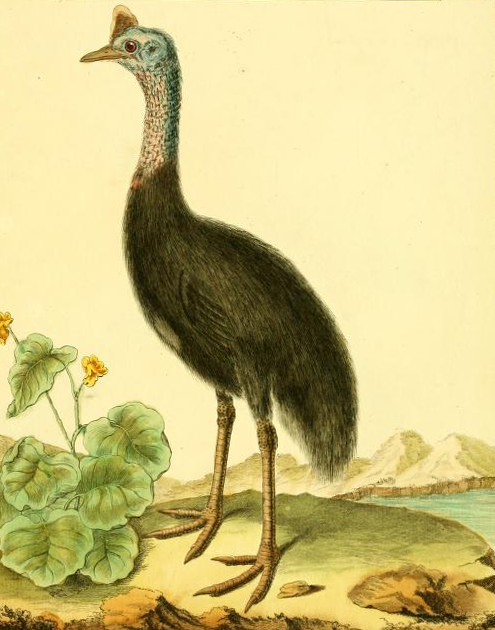
On 30 April 1797, when Peale was visiting New York, his son Raphaelle Peale (1774-1825) wrote to him from the museum: "The Cassowary bird is here" (Miller 1988: 230).
Peale wrote, in "A Walk Through the [Philadelphia] Museum" (1805–1806): "...And also two species of the Cassowary." (Historical Society of Pennsylvania, coll. 0481)
Notes:
The “two species” mentioned in the “Walk” essay were probably the male and female of C. casuarius, which are sexually dimorphic in size and plumage. The other two extant cassowary species (C. benneti and C. unappendiculatus) were not described until the mid-19th century.
Specimen Type:
Dead/preserved
Current Common Name:
Southern Cassowary
Current Scientific Name
Casuariidae | Casuarius casuarius
!["A Walk through the Philad[elphi]a Museum"](/sites/default/files/2026-04/Cassowary_Walk.png)