Object Status:
Extant
Accession Date:
By 1799
Primary Source Reference:
Charles Willson Peale, Lecture on Natural History 18. (ca. 1799). Academy of Natural Sciences of Drexel University Archives, coll. 40. / https://ansp.org/research/library/archives/0000-0099/coll0040/
Additional Source Text:
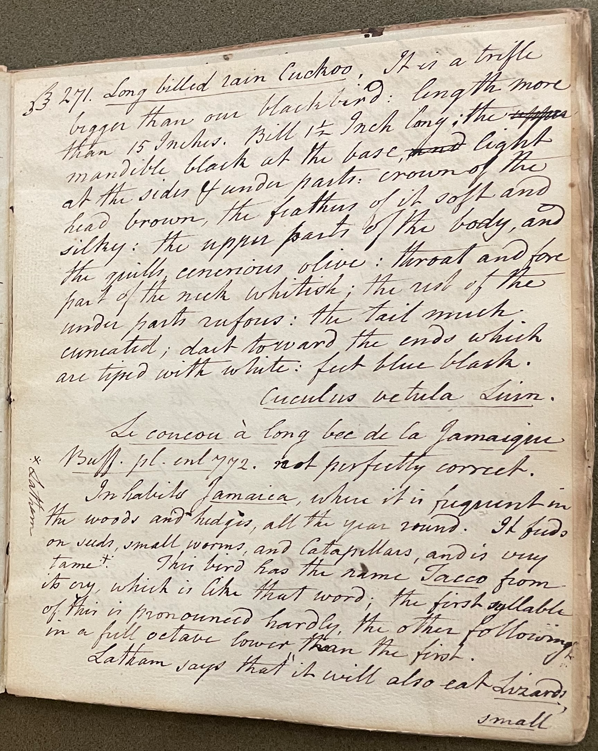
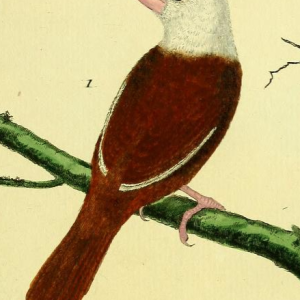
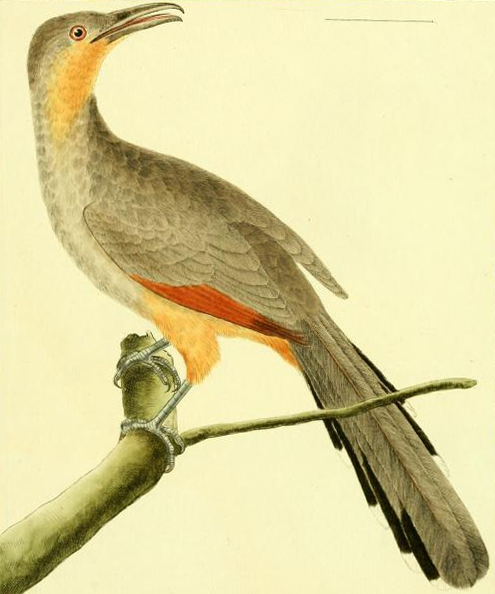
Charles Willson Peale (1741-1827) wrote, in his 18th Lecture (ca. 1799): "271. Long billed rain Cuckoo. It is a trifle beigger than our blackbird; length more than 15 Inches; Bill 1 ½ Inch long; the upper mandible black at the base, light at the sides & under parts; crown of the head brown, the feathers of it soft and silky; the upper parts of the body, and the quills cenerious olive; throat and forepart of the nek whitish; the rest of the under parts rufous; the tail much cuneated; dark toward the ends which are tipped with white; feel blue black. Cuculus vetula Linn. Le coucou à long bec de la Jamaique Buff. pl. enl. 772. not perfectly correct. Inhabits Jamaica, where it is frequent in the woods and hedges, all the year round. It feeds on seeds, small worms, and Catapillars, and is very tame." [A note in the margin indicates this information was sourced from Latham.] (Academy of Natural Sciences of Drexel University Archives, coll. 40)
Peale continued: "This bird has the name Jacco from its cry, which is like that word; the first syllable of this is pronounced hardly, the other following in a full octave lower, than the first. Latham says that it will also eat Lizards, small snakes, frogs, young rats, and, sometimes, even small birds. The Snakes they swallow head foremost, letting the tail hang out of the mouth till the foreparts are digested. It might easily be tamed, as it is so gentle as to suffer the negro hildren to catch it with their hands. Its gait is that of leaping Their flight is short, chiefly from bush to bush. At the season when other birds breed, they likewise retire into the woods, but their nests have never been found; from which one should be inclined to think, that they are indebted to other birds for the rearing their young, in the manner of the European Cuckow. It has the name of Rain-bird, as it is said to make the greatest noise before rain." (ANSP Archives, coll. 40)
Peale wrote, in "A Walk Through the Philad[elphi]a Museum" (1805–1806): "Long billed Cuckow (C. vetula) inhabits Jamaca. It has acquired the name of Rain bird, as it is said to make the greatest noise before Rain/ Latham & Buffon says 'it feeds on seeds, small worms, and also eats Lizards, small Snakes, frogs, young Rats, and, sometimes even small birds. That the Snakes they swallow head foremost, letting the tail hang out of the mouth till the foreparts are digested. It might be easily tamed, asit is so gentle as to suffer the negrow Children to catch it with their hands. Their flight is short, chiefly from bush to bush'." (Historical Society of Pennsylvania, coll. 0481)
Specimen Type:
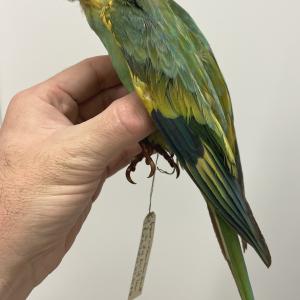
Dead/preserved
Current Common Name:
Jamaican Lizard Cuckoo
Current Scientific Name
Cuculidae | Coccyzus vetula