Object Status:
Extant
Accession Date:
By 1799
Primary Source Reference:
Charles Willson Peale, Lecture on Natural History 34. (ca. 1799). Academy of Natural Sciences of Drexel University Archives, coll. 40. / https://ansp.org/research/library/archives/0000-0099/coll0040/
Additional Source Text:
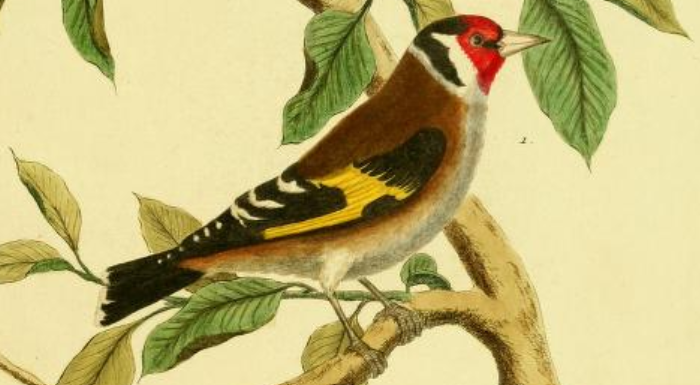
Charles Willson Peale (1741-1827) wrote, in his 34th Lecture (ca. 1799): "No. 1579. Lesser red-pole is about half the size of the last [Common Linnet, Linaria cannabina], and a rich spot of purplish red on the forehead; the breast is of the same colour, but less bright. Fringilla Linaria Linn. 29. Le Cabaret f. 2. Buff. pl. enl. 485. Lesser Red-pole Pennt. & Latham. No. 1580. Female is less lively in colour, has no red on the breast, and the spot on the head is of a saffron hue. Mr. Pennant mentions an Instance of this bird being so tenacious of her nest, as to suffer herself to be taken off by the hand; and that when released she would not forsake it. This species is known about London by the name of Stone redpole." (Academy of Natural Sciences of Drexel University Archives, coll. 40)
Peale continued: "Whole flocks of them, frequent places where Alders grow for the sake of picking the catkins [here a footnote reads: 'imperfect flowers hanging from trees, in manner of a rope or cod's tail']. They generally hang like the titmouse [i.e., Tufted Titmouse, Baeolophus bicolor], with the back downwards; and in this state are so intent on their work, that they may be entangled one after another by dozens, by means of a twig smeared with birdlime fastened to the end of a fishing rod or other long pole. This species seems to be plenty throughout Europe, from the extreme parts of Russia on the one hand to Itally on the other. [It] is very common in Greenland, and was also met with by late voyagers at Aoonalashka. In America it is likewise known according to several authors." (ANSP Archives, coll. 40)
Peale continued: "No. 1581. American Redpole. There is a considerable likeness to that we have just described, but the Red is much more brilliant in the specimen before us, perhaps in my picking the handsomest, when I had a choise of hundreds. In the winter of [blank] thousands came into the City of Philadelphia. The ground was covered with snow at the time, and I caught as many as we choose to take in traps, since which period I have not seen any more of them. Most probably they came from the northern regions, as Latham says he had one sent him from Hudsons Bay. Probably these have been drove southerly by lack of food, then were poor when they made their first appearance, and might be knocked down with sticks. No. 1582. Female, it has the same black patch on the throat as that of Europe—it is red on the top of the head, but none of that colour on the breast." (ANSP Archives, coll. 40)
Peale wrote, in "A Walk Through the Philad[elphi]a Museum" (1805–1806): "before we leave this Case – take notice of the Common Linnet of Europe (F. Linaria) & then compare them with the American Linnets — we rarly find Birds of this country so much resemble those of Europe. It almost induces us to think that this species was brought here by the first settlers & let loose to breed – and as Sparrows have a rapid encrease, they may have become so numerous in this Country as they must be in some parts of it – though it is sildom we find them in the vicinity of Philadelphia. In the winter of the [17…] when the ground was covered with Snow, such Numbers of them came into our Gardens, that hundreds might have been taken in a day – they were so famished with hunger that they would come almost to the feet of a person who Scattered a few crums or small seed. / However this Species of linnet is described as being numerous throughout Europe, from the Extreme parts of Rusia to Italy – and also said to be common in Greenland & [met] by late voyagers at the Islands of Ooonalaska the north west coast of America." (Historical Society of Pennsylvania, coll. 0481)
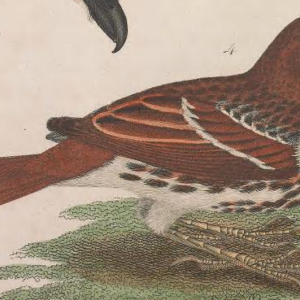
Alexander Wilson (1766-1813) described this species under the name "Lesser Red-poll / Fringilla linaria" in American Ornithology vol. 4 (Pl. 30), where "Peale's Museum, No. 6579" was cited (Wilson 1811: 42). / https://www.biodiversitylibrary.org/item/175531#page/52/mode/1up (text) / https://www.biodiversitylibrary.org/item/175531#page/39/mode/1up (plate)
Specimen Type:
Dead/preserved
Current Common Name:
Common Redpoll
Current Scientific Name
Fringillidae | Acanthis flammea