Object Status:
Extant
Accession Date:
By 1799
Primary Source Reference:
Charles Willson Peale, Lecture on Natural History 19. (ca. 1799). Academy of Natural Sciences of Drexel University Archives, coll. 40. / https://ansp.org/research/library/archives/0000-0099/coll0040/
Additional Source Text:
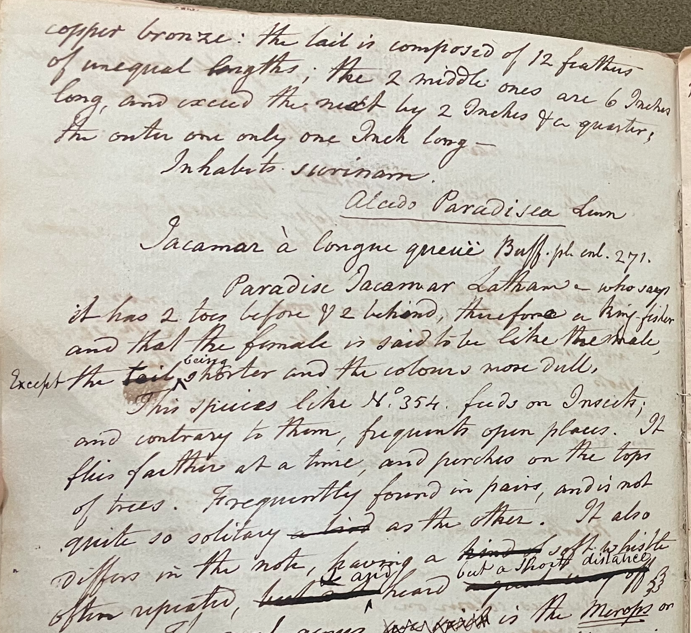
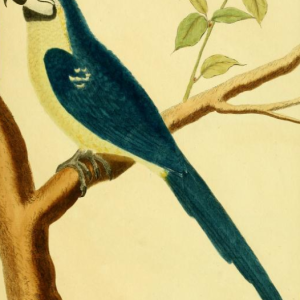
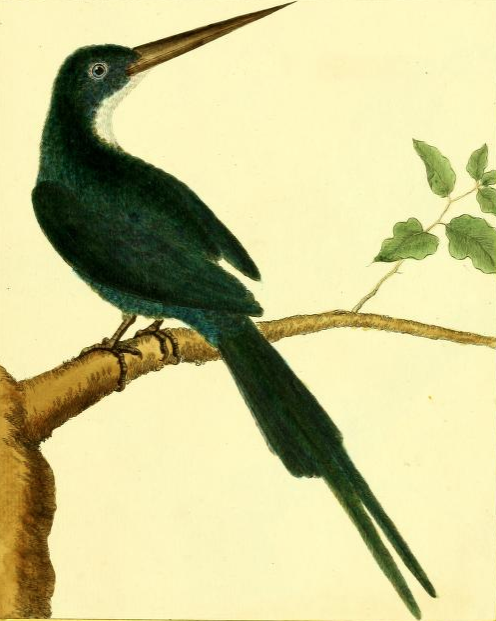
Charles Willson Peale (1741-1827) wrote, in his 19th Lecture (ca. 1799): "357. Swallow tailed Kingfisher, of Edwards. The head is brown; throat, fore part of the neck and under coverts of the wings are white; the rest of the plumage of a deep dull green; in some lights appearing black, in others with a slight gloss of violet and copper bronze; the tail is composed of 12 feathers of unequal lengths; the 2 middle ones are 6 Inches long, and exceed the next by 2 Inches & a quarter; the outer one only one Inch long. Inhabits Suriname. Alcedo Paradisea Linn. Jacamar à longue queue. Buff. pl. enl. 271. Paradise Jacamar Latham, who says it has 2 toes before & 2 behind, therefore a king-fisher and that the female is said to be like the male, except the tail being shorter and the colours more dull. This species like No. 354 [Green-tailed Jacamar, Galbula galbula] feeds on Insects; and contrary to them, frequents open places. It flies farther at a time, and perches on the tops of trees. Frequently found in pairs, and is not quite so solitary as the other. It also differs in the note, having a soft whistle often repeated, and heard but a short distance." (Academy of Natural Sciences of Drexel University Archives, coll. 40)
Peale wrote, in "A Walk Through the Philad[elphi]a Museum" (1805–1806): "Next akind to this family kingfishers is the genus Galbula. Jacamars a small family, all brilliant. Here we see the Paradise Jacamar (G. paradisea) … from South America. They feed on Insects. … No. 2242. Paradise Jacamar (G. paradissia)." (Historical Society of Pennsylvania, coll. 0481)
Notes:
Peale did not specify the origin of his specimen, but it seems likely to be Cayenne, French Guiana, a major South American trade center in the 18th century. In 1793, Raphaelle Peale (1774-1825) travelled to Cayenne to collect specimens for Peale's Museum. However, to the editor's (MRH) knowledge, there is no detailed inventory of the specimens he brought back, and there are many examples of specimens from northern South America that were donated by other people. For more discussion about Raphaelle's travels, see Lillian B. Miller, 1993, "Father and Son: The Relationship of Charles Willson Peale and Raphaelle Peale", The American Art Journal 25: 4-161. / https://doi.org/10.2307/1594599
Specimen Type:
Dead/preserved
Current Common Name:
Paradise Jacamar
Current Scientific Name
Galbulidae | Galbula dea