Object Status:
Extant
Accession Date:
By 12 October 1792
Primary Source Reference:
Charles Willson Peale, letter to Thomas Hall of Moorfields, London, dated 12 October 1792; Selected Papers, 2, part 1: 42.
Additional Source Text:
Charles Willson Peale (1741-1827) sent a "Sandy Mocking bird" to Thomas Hall in London on 12 October 1792 (Miller 1988: 42, Selected Papers, Vol. 2, part 1, Yale University Press).
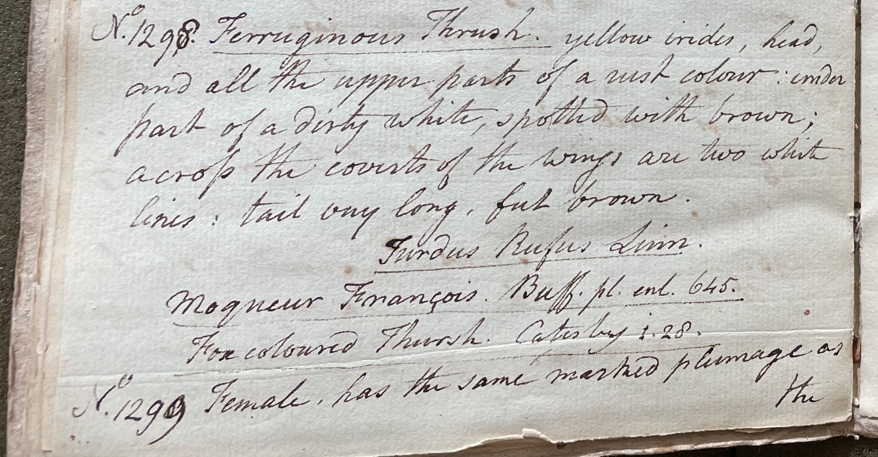
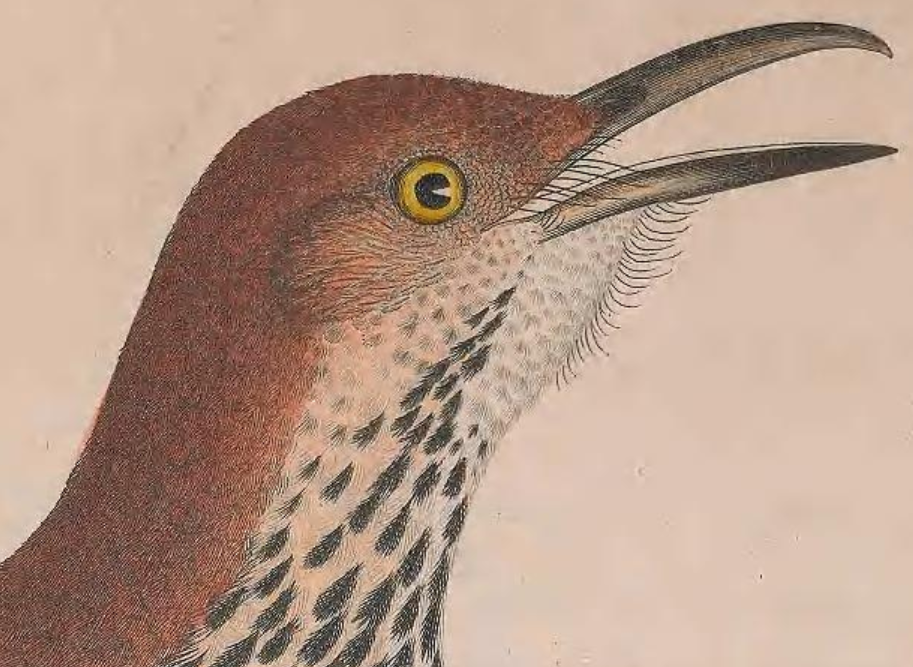
Peale wrote, in his 31st Lecture (ca. 1799): "No. 1298. Ferruginous Thrush. yellow irides, head and all the upper parts of a rust colour; under part of a dirty white, spotted with brownl across the coverts of the wings are two white lines; tail very long, feet brown. Turdus Rufus Linn. Moqueur François. Buff. pl. enl. 645. Fox coloured Thrush. Catesby i: 28. No. 1299. Female, has the same marked plumage as the male. These birds have delightful notes, not a great deal inferiour to the mocking bird [Mimus polyglottos]. They breed in the middle states, and retire farther south to winter." (Academy of Natural Sciences of Drexel University Archives, coll. 40)
Peale wrote, in "A Walk Through the Philad[elphi]a Museum" (1805–1806): "Ferruginous Thrush (T. Rufus) female like the Male. They sing delightfully, called the french mocking bird." (Historical Society of Pennsylvania, coll. 0481)
Peale wrote in a letter to his son, Rembrandt Peale (1778 –1860), on 8 May 1805: "I shall probably stay here [Carpenter Point, Maryland]—2 or 3 days more, and hope to spend my time to advantage by preserving some more of the Red Mocking Birds which are difficult to [be] had where birdcatchers can make a good sale of them' (APS Library, Mss.B.P31: Peale-Sellers Family Collection).
Alexander Wilson (1766-1813) described this species under the name "Ferruginous Thrush / Turdus rufus" in American Ornithology vol. 2 (Pl. 14), where "Peale's Museum No. 5285" was cited (Wilson 1810: 83). / https://www.biodiversitylibrary.org/item/175511#page/97/mode/1up (text) / https://www.biodiversitylibrary.org/item/175511#page/96/mode/1up (plate)
Specimen Type:
Dead/preserved
Current Common Name:
Brown Thrasher
Current Scientific Name
Mimidae | Toxostoma rufum