Object Status:
Extant
Accession Date:
By 1799
Primary Source Reference:
Charles Willson Peale, Lecture on Natural History 27. (ca. 1799). Academy of Natural Sciences of Drexel University Archives, coll. 40. / https://ansp.org/research/library/archives/0000-0099/coll0040/
Additional Source Text:
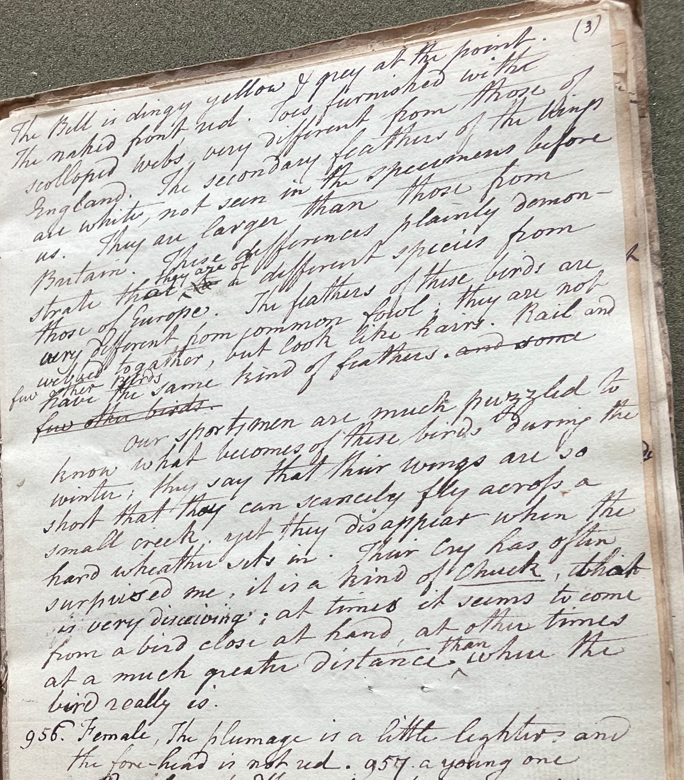
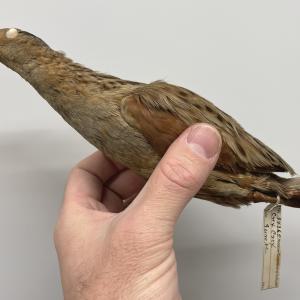
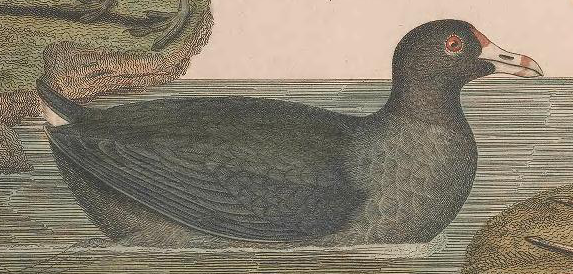
Charles Willson Peale (1741-1827) wrote, in his 27th Lecture (ca. 1799): "No. 955. American Coot or Mud-hen. The general colour is a dark lead, white under the tail. The Bill is dingy yellow & grey at the point. The naked front, red. Toes, furnished with scalloped webs, very different from those of England. The secondary feathers of the wings are white, not seen in the specimens before us. They are larger than those from Britain. These differences plainly demonstrate that they are of a different species from those of Europe." (Academy of Natural Sciences of Drexel University Archives, coll. 40)
Peale continued: "The feathers of these birds are very different from common fowl; they are not webbed together, but look like hairs. Rail and a few other birds have the same kind of feathers. Our sportsmen are much puzzled to know what becomes of these birds during the winter; they say that their wings are so short that they can scarcely fly across a small creek, yet they disappearwhen the hard wheather sets in. Their cry has often surprised me. It is a kind of chuck, that is very disceiving; at times it seems to come from a bird close at hand, at other times at a much greater distance than where the bird really is. 956. Female, the plumage is a little lighter and fore-head is not red. 957. a young one." (ANSP Archives, coll. 40)
Peale wrote, in "A Walk Through the Philad[elphi]a Museum" (1805–1806): "Coots inhabit almost every country: authors say they are in Greenland, Sweden, Norway, Russia, Siberia, Persia, and China. They are also in N & S America. observe the large scalloped webs of the feet of the American Mud-hens differing from that of Europe along side of them, yet authors call them the same. the latter the toes are only flat and broad. the difference of colour may be from different seasons of the year when taken. / Sportsmen are at a loss to know what becomes of those birds in the winter; their wings are so short that they can scarcely fly across a small creek. yet they disappear when cold weather begins. Their cry is a kind of Chuck, very deceiving; at times the bird seems close at hand, heard again, sounds as if at a great distance." (Historical Society of Pennsylvania, coll. 0481)
Alexander Wilson (1766-1813) described the American species under the name "Common Coot / Fulica atra" in American Ornithology vol. 9, published posthumously (Pl. 73). The editor, George Ord (1781–1866), cited "Peale's Museum, No. 4322" and wrote "The bird from which the foregoing description was taken, was shot in the Delaware, below Philadelphia, the 29th of October, 1813. It was an old male, an uncommonly fine specimen, and weighed twenty-three ounces avoirdupois. It is deposited in Peale's Museum" (Wilson 1814: 64). / https://www.biodiversitylibrary.org/item/175518#page/67/mode/1up (text) / https://www.biodiversitylibrary.org/item/175518#page/8/mode/1up (plate)
An unmounted female specimen of "Fulica atra (Coot)" from Florida was listed in "A Catalogue of Duplicate Specimens...", May 1822. [unpublished] American Philosophical Society Library (Mss.B.P31).
Specimen Type:
Dead/preserved
Current Common Name:
American Coot
Current Scientific Name
Rallidae | Fulica americana