Object Status:
Extant
Accession Date:
By 1799
Primary Source Reference:
Charles Willson Peale, Lecture on Natural History 32. (ca. 1799). Academy of Natural Sciences of Drexel University Archives, coll. 40. / https://ansp.org/research/library/archives/0000-0099/coll0040/
Additional Source Text:
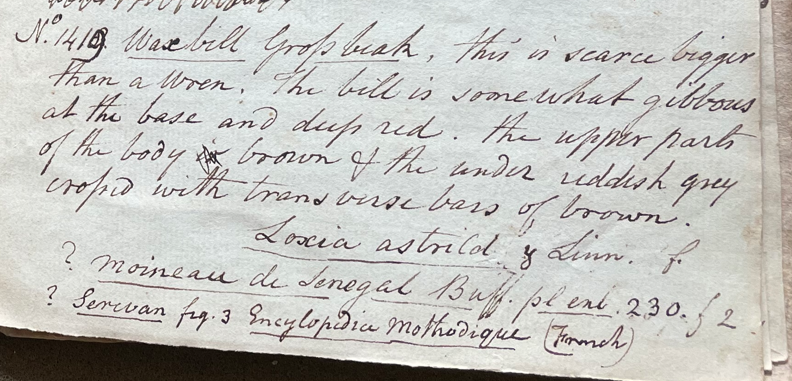
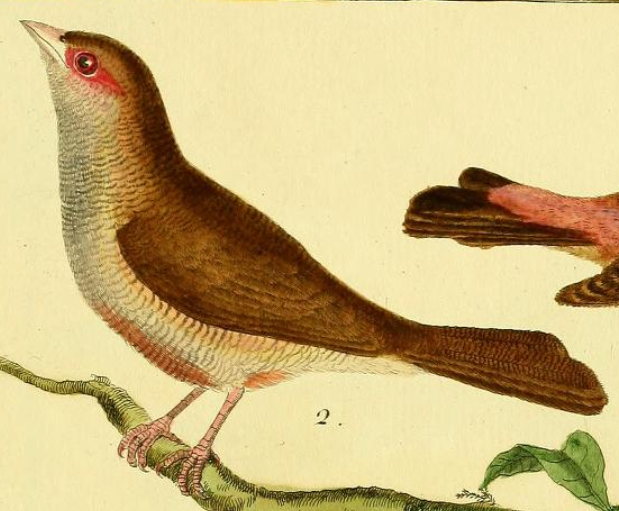
Charles Willson Peale (1741-1827) wrote, in his 32nd Lecture (ca. 1799): "No. 1419. Waxbill Grossbeak. This is scarce bigger than a wren. The bill is somewhat gibbous at the base and deep red. The upper parts of the body brown & under reddish grey crossed with transverse bars of brown. Loxia astrild Linn. ?Moineau de Senegal. Buff. pl. enl. 230. f. 2. ?Serevan fig. 3 Encyclopedia Methodique (French). (Academy of Natural Sciences of Drexel University Archives, coll. 40)
Peale continued: "No. 1420. Wax bill another Variety, which I think ought to be distinguished by another name, the distinguishing red line running through the eyes to the hind head is a good mark. The general plumage is brown, with fine transverse lines over the whole body. No. 1421. Female. The transverse lines are less distinct. There is a faint tinge of red on the under parts, but not so strong as Edwards has described it. It appears that authors find some variations of colours in the specimens that each have taken their descriptions from. Loxia Astrild Linn. Sénégallea rayé Buff. pl. enl. 157. No. 2. Waxbill Edwards No. 179 & 354. I think it best to call these after Buffon's Rayed Wax-bill … 1424. This appears to be a variety of 1420, with the cheeks of an orange red, and the upper tail coverts crimosen [sic] red, and I should suppose it also belong to Senegal, yet I found it among a small collection of birds brought from St. Dominique. I do not find it described." (ANSP Archives, coll. 40)
Specimen Type:
Dead/preserved
Current Common Name:
Common Waxbill
Current Scientific Name
Estrildidae | Estrilda astrild