Object Status:
Extant
Accession Date:
By 1799
Primary Source Reference:
Charles Willson Peale, Lecture on Natural History 34. (ca. 1799). Academy of Natural Sciences of Drexel University Archives, coll. 40. / https://ansp.org/research/library/archives/0000-0099/coll0040/
Additional Source Text:
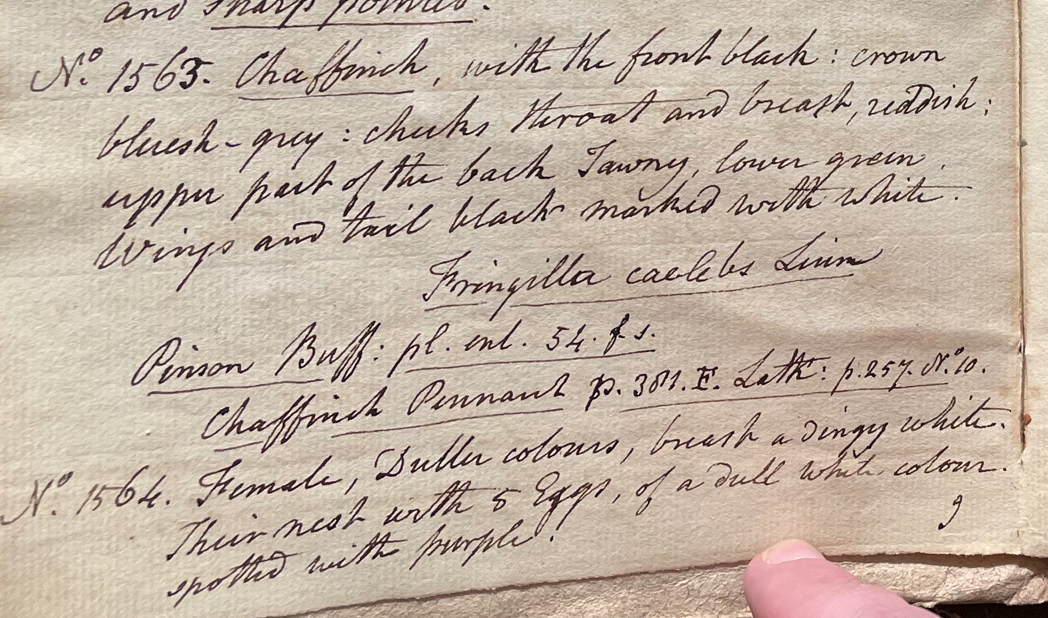
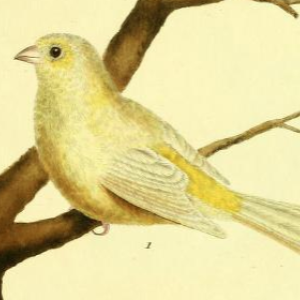
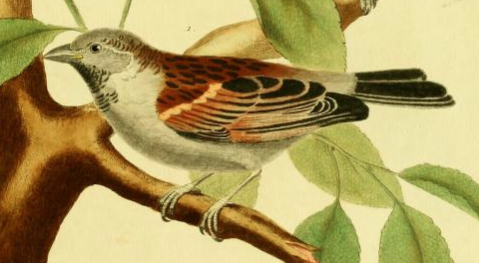
Charles Willson Peale (1741-1827) wrote, in his 34th Lecture (ca. 1799): "No. 1563. Chaffinch, with the front black; crown bluish=grey; cheeks, throat and breast, reddish; upper part of the back Tawny, lower green. Wings and tail black marked with white. Fringilla coelebs Linn. Pinson Buff. pl. enl. 54. f. 1. Chaffinch Pennant p. 381. F. Lath. p. 257. No. 10. No. 1564. Female, Duller colours, breast a dingy white. Their nest with 5 Eggs, of a dull white colour spotted with purple. I received these [specimens] from Britain, where they stay the whole year. By admirable and unusual instinct in Sweden the females collect in vast flocks at the latter end of September, desert their mates, and, passing through Schonin, Holstein, and Holland, visit several parts of Europe. They reach Holland about a fortnight after Michaelmas, and at that time afford great amuseument to the gentry at their country houses, in taking them while they set at tea in their pavilions." (Academy of Natural Sciences of Drexel University Archives, coll. 40)
Peale continued: "They spread nets among the plantations, and strew the ground with hemp-seed, by way of bait. The birds arrive, and porch by thousands on the trees; then light on the ground, hungry, and inattentive to the danger. The nets are closed by the pulling a cord by the persons in the pavilions; and multitudes are thus taken. Those which escape, continue their route to Flandus, France & Itally. The males continue in Sweden, and inliven its vigorous winter with their cheerful twitter. Towards the spring, they receive additional spirits; perch on every tree, and animate with their notes every […], expecting the arrival of Spring and their mates, who generally return in April. It is a hardy Bird, and will live almost on any seeds, is seldom subject to disease but in a Cage will have vermine if not sprinkled with wine two or three times a month. No. 1565 is a variety, the Chaffinch with the 2d covertures of the wings terminated with yellow. This bird is very common in Europe and is also at Madera in Africa." (ANSP Archives, coll. 40)
A mounted specimen of "Fringilla coelebs (Chaffinch)" from Europe was listed in "A Catalogue of Duplicate Specimens...", May 1822. [unpublished] American Philosophical Society Library (Mss.B.P31).
Specimen Type:
Dead/preserved
Current Common Name:
Chaffinch
Current Scientific Name
Fringillidae | Fringilla coelebs