Object Status:
Extant
Accession Date:
By 1799
Primary Source Reference:
Charles Willson Peale, Lecture on Natural History 32. (ca. 1799). Academy of Natural Sciences of Drexel University Archives, coll. 40. / https://ansp.org/research/library/archives/0000-0099/coll0040/
Additional Source Text:
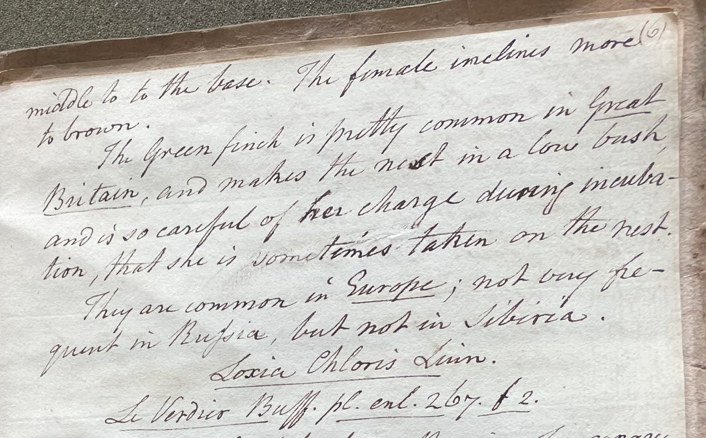
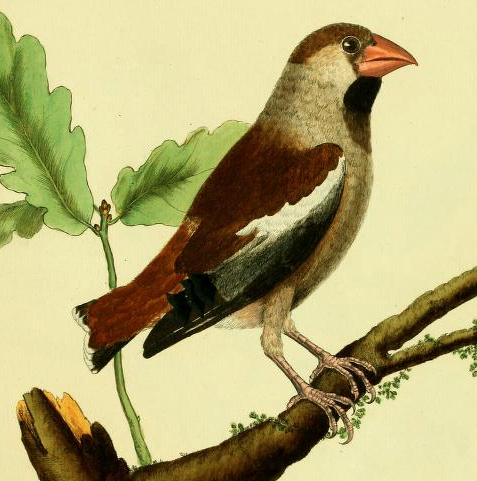
Charles Willson Peale (1741-1827) wrote, in his 32nd Lecture (ca. 1799): "No. 1412. Green Grossbeak. Latham says this is a well known bird. The general colour yellowish-green; the quils are edged with yellow, & the four outer tail feathers are yellow from the middle to the base. The female inclines more to brown. The green finch is pretty common in Great Britain, and makes the nest in a low bush, and is so careful of her charge during incubation that she is sometimes taken on the nest. They are common in Europe; not very frequent in Russia, but not in Sibiria. Loxia chloris Linn. Le Verdier Buff. pl. enl. 267. f. 2." (Academy of Natural Sciences of Drexel University Archives, coll. 40)
Peale wrote, in "A Walk Through the Philad[elphi]a Museum" (1805–1806): "The Hawfinch (L. Coccothraustes) and the green finch (L. Chloris) are birds of Europe." (Historical Society of Pennsylvania, coll. 0481)
Specimen Type:
Dead/preserved
Current Common Name:
European Greenfinch
Current Scientific Name
Fringillidae | Chloris chloris