Object Status:
Extant
Accession Date:
By 1799
Primary Source Reference:
Charles Willson Peale, Lecture on Natural History 17. (ca. 1799). Academy of Natural Sciences of Drexel University Archives, coll. 40. / https://ansp.org/research/library/archives/0000-0099/coll0040/
Additional Source Text:
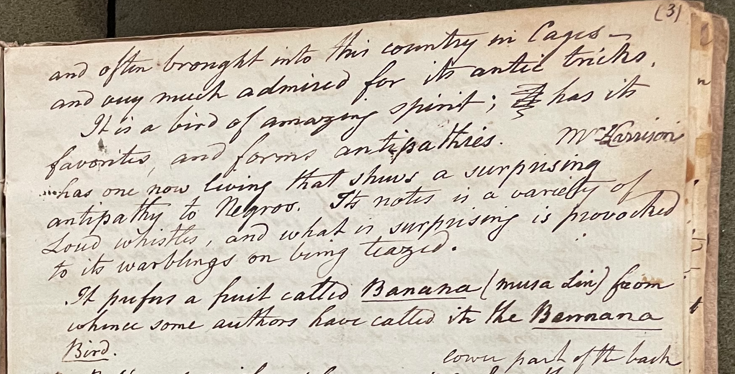
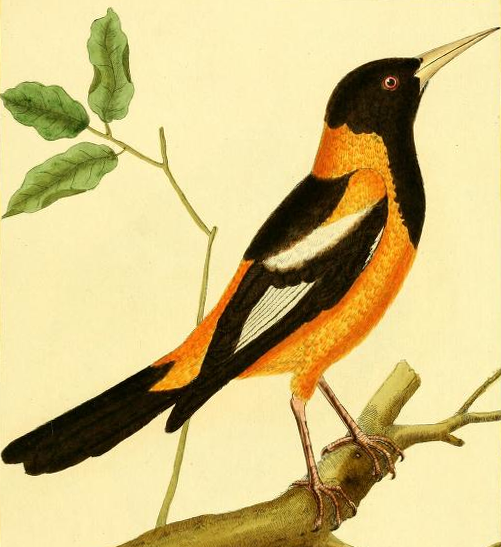
Charles Willson Peale (1741-1827) wrote, in his 17th Lecture (ca. 1799): "No. 197. Trouphiale. Head, throat, back, first coverture, & quills of the wings & tail, Black; the remainder of the body yellow; second covertures of the wings form a band of white. Oriolus icterus Linn. Trophiale Buff. pl. enl. 532. Some authors say that it is found in Carolina, but I believe rarely; it is a bird of South America, and often brought into this country in cages, and very much admired for its antic tricks. It is a bird of amazing spirit; has its favorites, and forms antipathies. Mr. Harrison has one now living that shews a surprising antipathy to Negros. Its notes is a variety of Loud whistles, and what is surprising is [that it is] provocked to its warblings on being teazed. It prefers a fruit called Banana (Musa Lin.) from whence some authors have called it the Bannana Bird." (Academy of Natural Sciences of Drexel University Archives, coll. 40)
A 'Trouphial (dead)' donated by James Goodwin on 24 May 1821 was recorded in the Peale Museum Accessions Book; and a separate note in a subscription ledger states that "James Goodwin [donated a] Trophial [on] June 5" 1821, but whether this refers to the same bird is unknown. (Historical Society of Pennsylvania, coll. 0481)
A mounted specimen of "Oriolus icterus (Icteric Oriole)" was listed in "A Catalogue of Duplicate Specimens...", May 1822. [unpublished] American Philosophical Society Library (Mss.B.P31).
On 16 February 1822, the donation of a "Banana Bird (Living) from S. America" by J. Shaw was entered into the Peale Museum Accessions Book, p. 118 (HSP, coll. 0481).
Notes:
Peale did not specify the origin of the specimen described in his lecture, but it seems likely to be Cayenne, French Guiana, a major South American trade center in the 18th century. In 1793, Raphaelle Peale (1774-1825) travelled to Cayenne to collect specimens for Peale's Museum. However, to the editor's (MRH) knowledge, there is no detailed inventory of the specimens he brought back, and there are many examples of specimens from northern South America that were donated by other people. For more discussion about Raphaelle's travels, see Lillian B. Miller, 1993, "Father and Son: The Relationship of Charles Willson Peale and Raphaelle Peale", The American Art Journal 25: 4-161. / https://doi.org/10.2307/1594599
Specimen Type:
Live (later taxidermied)
Current Common Name:
Venezuelan Troupial
Current Scientific Name
Icteridae | Icterus icterus