Object Status:
Extant
Accession Date:
By 1799
Primary Source Reference:
Charles Willson Peale, Lecture on Natural History 27. (ca. 1799). Academy of Natural Sciences of Drexel University Archives, coll. 40. / https://ansp.org/research/library/archives/0000-0099/coll0040/
Additional Source Text:
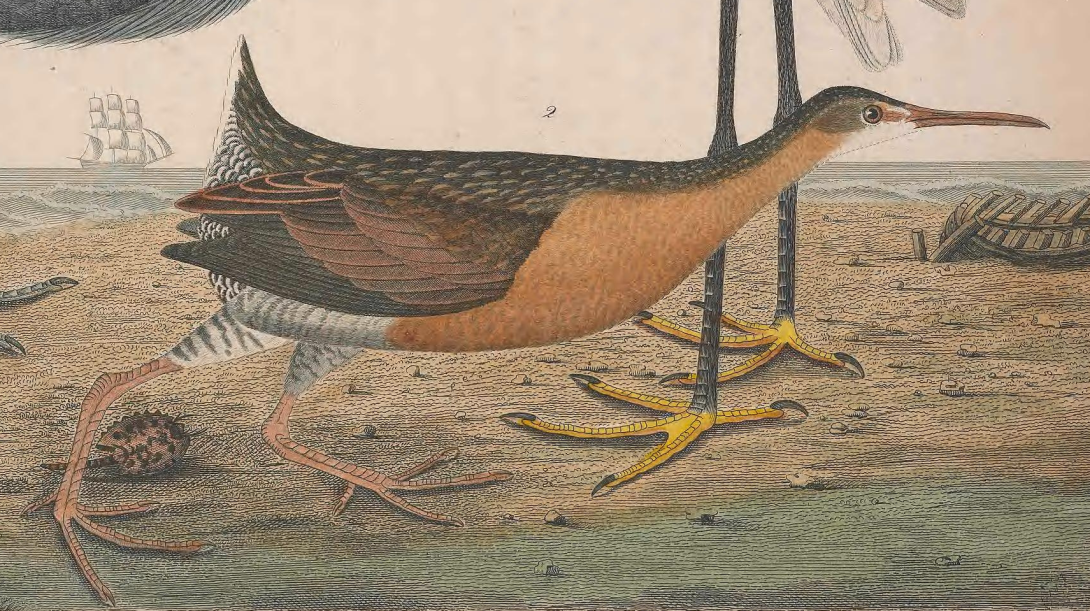
Charles Willson Peale (1741-1827) evidently had specimens of two similar species, Clapper Rail (Rallus crepitans) and King Rail (R. elegans), which he assumed were the female and male, respectively, of a single species. The earliest source is ambiguous as to which species is referenced. Peale wrote in his diary on 10 September 1793, during a collecting trip to Cape Henlopen, Delaware: "before Breakfast I mounted a mud-hen, this bird is the same as the bird in the Museum which I had called an uncommon Rail, very few are brought to Philada. market, yet they are very plenty in the marshes here, but very sildom [sic] more than one can be shot at one spot, two of them sometimes is seen togather or near each other, They are a very shy bird, and not easily killed, perhaps this arises from the number of Gunners in this village having made them so, and it may not be the same in other marshes— The Noise they make is something like the cackling of a hen from whence they may have got the name of Mud-hen" (Miller 1988: 60, Selected Papers, Vol. 2, part 1, Yale University Press).
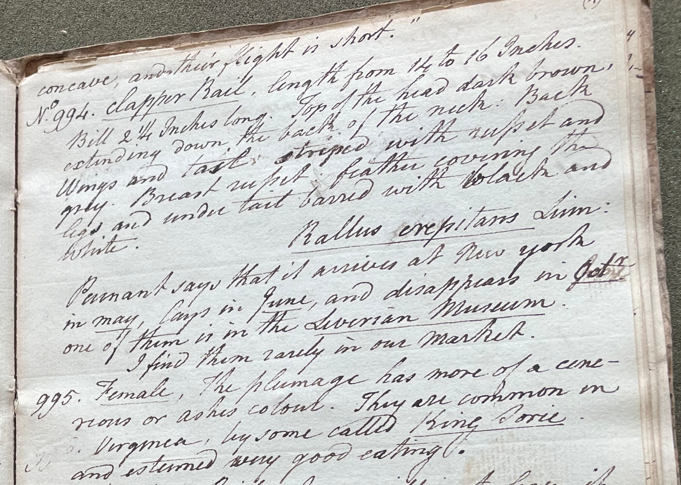
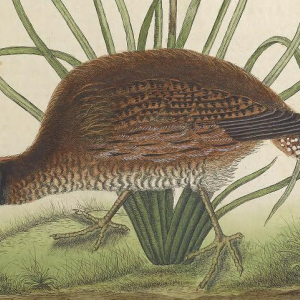
Male and female specimens described by Peale in his 27th Lecture (ca. 1799) were probably R. elegans and R. crepitans, respectively: "No. 994. Clapper Rail. Length from 14 to 16 Inches. Bill 2 ¼ Inches long. Top of the head dark brown, extending down the back of the neck. Back, wings and tail striped with russet and grey. Breast russet; feathers covering the legs and under tail barred with black and white. Rallus crepitans Linn. Pennant says that it arrives at New York in May, lays in June, and disappears in Octr. One of them is in the Leverian Museum. I find them rarely in our market. 995. Female. The plumage has more of a cenerious or ashen colour. They are common in Virginia, by some called King Sorie and esteemed very good eating." (Academy of Natural Sciences of Drexel University Archives, coll. 40)
In "A Walk Through the Philad[elphi]a Museum" (1805–1806), Peale distinguished three species of North American rails: "The Clapper Rail (R. crepitans) is the largest species — this and the land [rail] and water rail are all we have belonging to N. America." (Historical Society of Pennsylvania, coll. 0481)
Alexander Wilson (1766-1813) described this species under the name "Clapper Rail / Rallus crepitans" in American Ornithology vol. 7 (Pl. 62), where "Peale's Museum, No. 4400" was cited (Wilson 1813: 112). Like Peale, Wilson did not distinguish the species now known as C. crepitans and C. elegans.
Notes:
Peale's collecting efforts at Cape Henlopen were overlooked by compilers of Delaware bird records, prior to this study (Gene K. Hess, in litt. 10 February 2024). Walter Faxon, "Relics of Peale's Museum," Bulletin of the Museum of Comparative Zoology, 59, no. 3 (July 1915): 132, speculated about the provenance of MCZ 67829 (shown here), a data-deficient specimen from the Boston Museum collection: "Wilson's account of the Clapper Rail, Rallus crepitans Gmel., relates to that species, but his figure ... is a King Rail, Rallus elegans Aud., as Audubon pointed out. There are two large Rails in the Boston Museum collection, both of them R. elegans, although one is labelled R. crepitans, a name probably copied from the original Peale Museum label. This is very probably the individual that served as a model for Wilson, although its attitude is vitalized in the drawing."
Specimen Type:
Dead/preserved
Current Common Name:
King Rail
Current Scientific Name
Rallidae | Rallus elegans