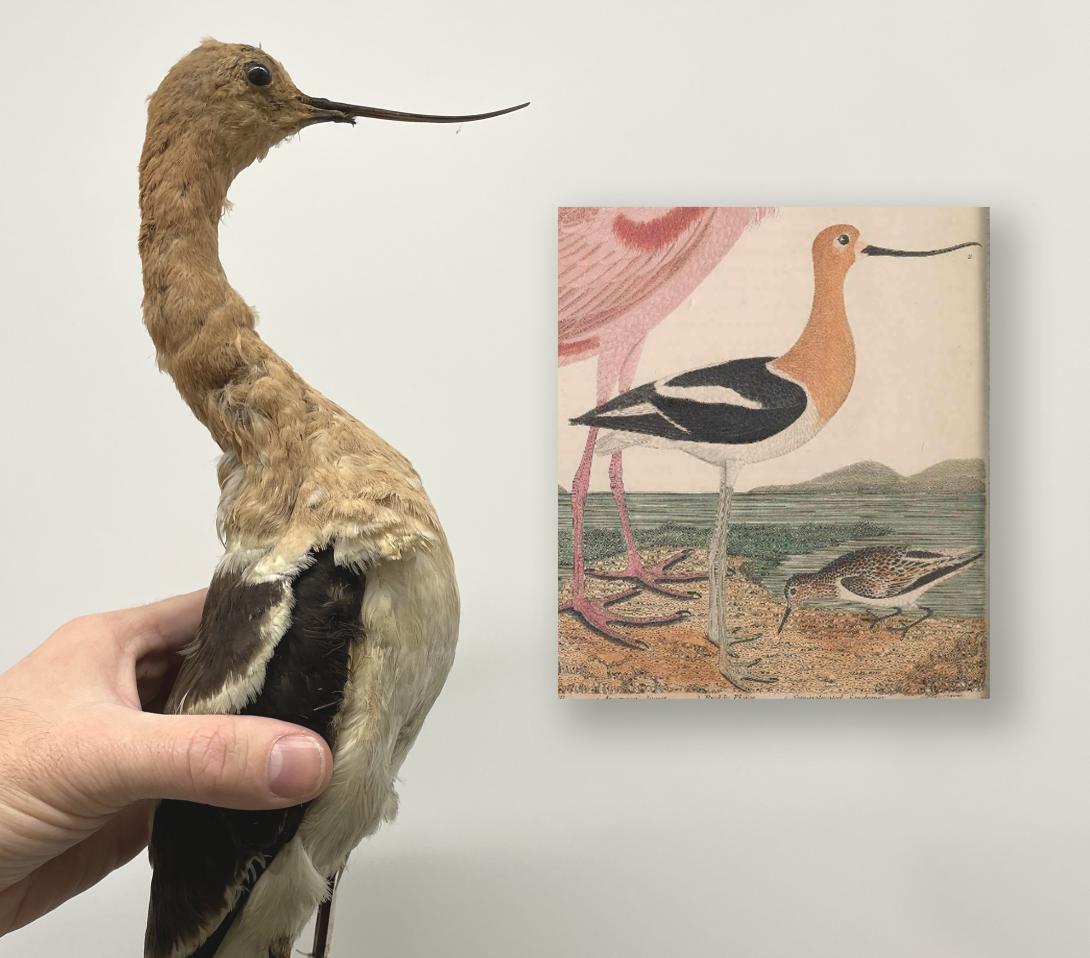
Object Status:
Unlocated
Accession Date:
By 6 September 1793
Primary Source Reference:
Charles Willson Peale, diary entry dated 6 September 1793; Selected Papers, 2, part 1: 58.
Additional Source Text:
Charles Willson Peale (1741-1827) wrote in his diary on 6 September 1793, during a collecting trip to Cape Henlopen, Delaware: "This whole day employed in mounting the birds killed yesterday. in the afternoon Titian went out and got me a bird called the Shomaker, the bill of it resembles an aul, and the manner of its feeding, changing its head from side to side, like the workman of the Trade of which it is named." The following day, he wrote: "the Shoemaker which Titian shot we had a part of him cooked for dinner breakfast, and found it excellent eating." (Miller 1988: 58, Selected Papers, Vol. 2, part 1, Yale University Press).
On 25 January 1794, a notice in Dunlap's American Daily Advertiser mentioned Peale's acquisition of "The Avosette, commonly called the Shoe-maker, because of its bill resembling a crooked awl."
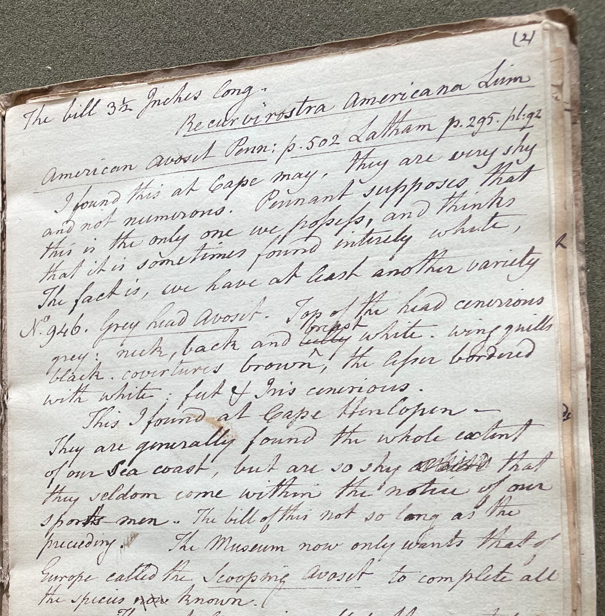
In his 27th Lecture, Peale wrote: "No. 945. American red neck Avoset. The head and neck is fawn colour finishing with a line of white on the back, and mingles with the white below the breast; wing quills black, secondaries white. the great wing coverts black & white. alternately […] white. Leggs blue. Its height standing, from the head to the ground 14 ½ Inches. The bill 3 ½ Inches long. Recurvirostra Americana Linn. American Avoset Penn. p. 502. Latham p. 295, pl. 92. I found this [specimen] at Cape May. They are very shy and not numerous. Pennant supposes that this is the only one we possess, and thinks that it is sometimes found intirely white." (Academy of Natural Sciences of Drexel University Archives, coll. 40)
Peale continued: "The fact is, we have at least another variety…No. 946, Grey head Avoset [i.e., adult in non-breeding plumage]. Top of the head cenerious grey; neck, back and breast white. wing quills black. Coverts are brown; the lesser bordered with white; feet & iris cenerious. This I found at Cape Henlopen. They are generally found the whole extent of our Sea coast, but are so shy that they seldom come within the notice of our sports-men. The bill of this not so long as the preceeding. The Museum now only wants that of Europe called the Scooping Avoset to complete all the species now known." (ANSP Archives, coll. 40)
Alexander Wilson (1766-1813) described this species under the name "American Avoset / Recurvirostra americana" in American Ornithology vol. 7 (Pl. 63), where "Peale's Museum, No. 4250" was cited (Wilson 1813: 126). / https://www.biodiversitylibrary.org/item/175507#page/148/mode/1up (text) / https://www.biodiversitylibrary.org/item/175507#page/144/mode/1up (plate)
Notes:
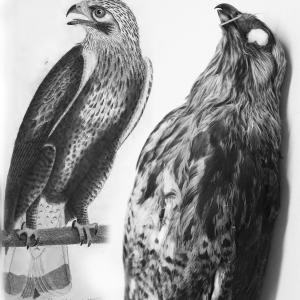
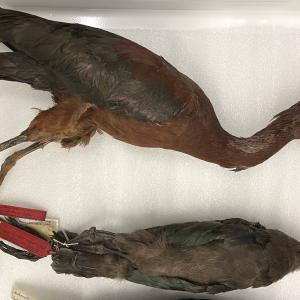
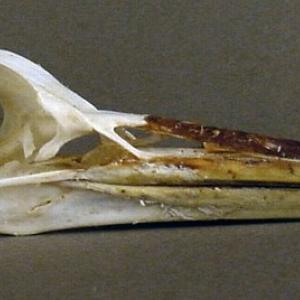
After Peale's Museum closed, a portion of Peale's bird collection was purchased in 1850 by Moses Kimball (1809–95), who displayed it at his "Boston Museum". An advertisement in the Boston Transcript, printed 1 October 1850, stated that Kimball had acquired "One Half of the celebrated Peale's Philadelphia Museum". The other half of Peale's birds had been sold to the circus promoter P. T. Barnum (1810–91) and would be subsequently destroyed in a fire at his "American Museum" in New York City in July 1865. When the Boston Museum closed, Kimball's Peale remnants passed temporarily to the Boston Society of Natural History, who disposed of them to Charles J. Maynard (1845-1929), a local taxidermist. The specimens were stored in a barn in Massachusetts for several years, then eventually were deposited at the Museum of Comparative Zoology (MCZ), Harvard University. By the time the collection was catalogued by Walter Faxon (1848-1920) at MCZ, in 1914, in virtually every case the original mounts and labels had been disassociated from the specimens, and an untold number were lost. Walter Faxon, "Relics of Peale's Museum," Bulletin of the Museum of Comparative Zoology, 59, no. 3 (July 1915): 132, speculated that MCZ 67831 (shown here) and 67832, data-deficient specimens from the Boston Museum collection, were "probably collected by Wilson on their former breeding-ground in [Cape May, New Jersey] ... One of these [MCZ 67831] seems to be the specimen figured by Wilson." Faxon's claim seems unlikely to be true, because Peale had specimens of this species in his collection as early as 1793, and he did not have space (or interest) to display duplicates. Furthermore, MCZ 67831 is posed differently than the bird in Wilson's figure. / https://www.biodiversitylibrary.org/page/6339801#page/182/mode/1up Wilson deposited many specimens at Peale's Museum, after completing his drawings, but the combined evidence from American Ornithology and the Peale Museum Accessions Book (Historical Society of Pennsylvania, coll. 0481) suggests that it was probably fewer than 50 skins, whereas many authors have assumed that all the "Peale numbers" cited in Wilson's work were those of his own specimens (e.g., "he contributed 279 specimens to the collection", Edward H. Burtt, Jr., and William E. Davis, Jr., 2013, Alexander Wilson: The Scot Who Founded American Ornithology, Belknap Press, p. 310). This assumption appears to be based on a misunderstanding — Wilson was citing the numbers to give credit to Peale, to acknowledge his contributions, not to stake a claim to his own specimen deposits. If Burtt & Davis (2013) were correct, the "Catalogue of Duplicate Specimens" (APS Library, Mss.B.P31) would be full of Wilson's specimen deposits—but this is not the case. No duplicate of American Avocet is listed. To the editor's (MRH) knowledge, there is no evidence that Wilson deposited an American Avocet at Peale's Museum. Peale's collecting efforts at Cape Henlopen were overlooked by compilers of Delaware bird records, prior to this study (Gene K. Hess, in litt. 10 February 2024). Witmer Stone (1866-1939) was evidently unaware of the extent of Peale's collection and his collecting effots at Cape May, while preparing his classic work, Bird studies at Old Cape May, vol. 1, Philadelphia: Delaware Valley Ornithological Club). Stone (1937: 508-509) assumed that Wilson's (1813) account was the earliest available for this species: "The older ornithologists have left us no further records". In his lecture, Peale (ca. 1799) noted: " I found this [specimen] at Cape May. They are very shy and not numerous."
Specimen Type:
Dead/preserved
Current Common Name:
American Avocet
Current Scientific Name
Recurvirostridae | Recurvirostra americana
Repository:
Museum of Comparative Zoology, Harvard University (MCZ 67831)