Object Status:
Extant
Accession Date:
By 1799
Primary Source Reference:
Charles Willson Peale, Lecture on Natural History 26. (ca. 1799). Academy of Natural Sciences of Drexel University Archives, coll. 40. / https://ansp.org/research/library/archives/0000-0099/coll0040/
Additional Source Text:
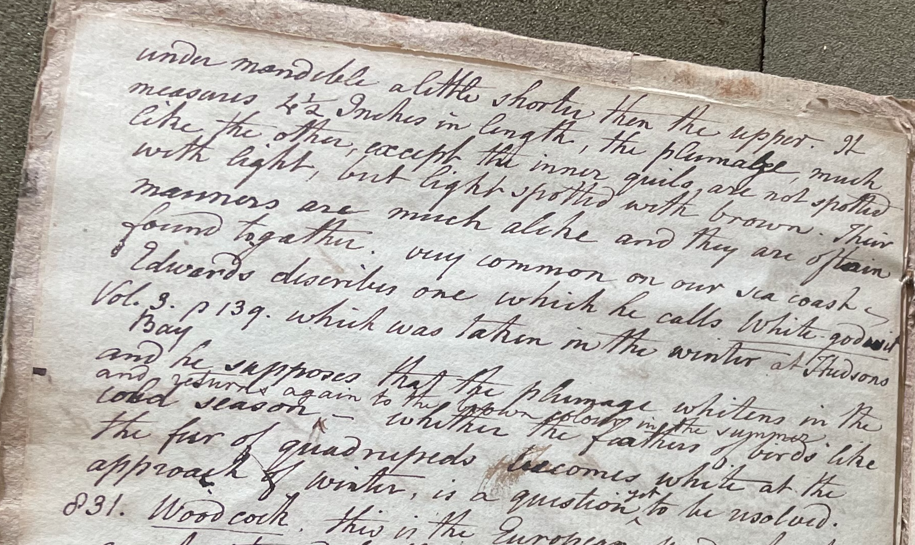
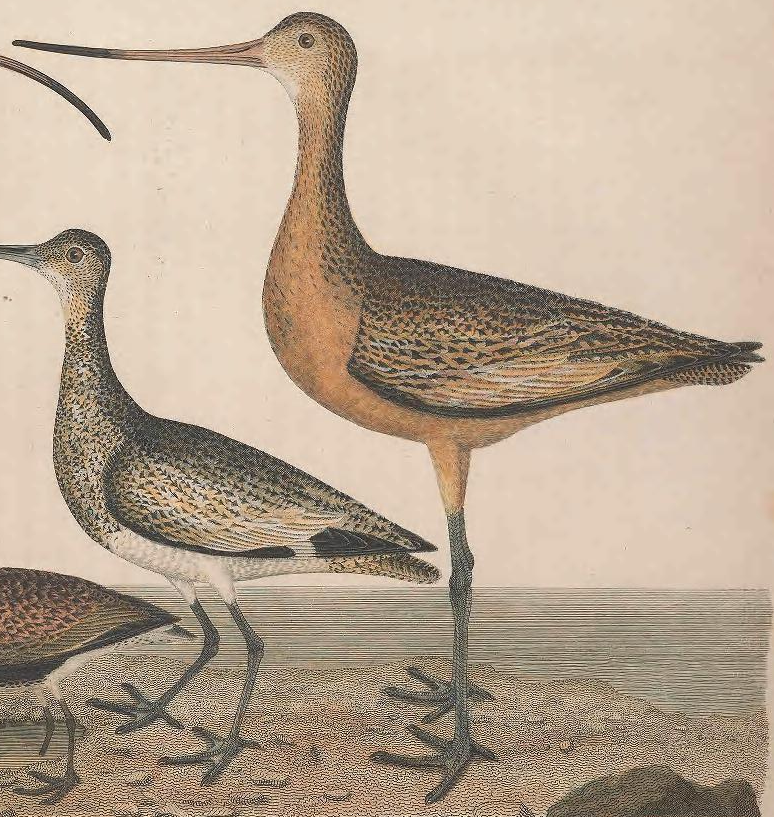
Charles Willson Peale (1741-1827) wrote, in his 26th Lecture (ca. 1799): "No. 830. This commonly called the small curlew; the beak is turned up contrary to the other, and the under mandible a little shorter than the upper. It [the bill] measures 4 ½ Inches in length; the plumage, much like the other, except the inner quils are not spotted with light, but light spotted with brown. Their manners are much alike and they are often found togather; very common on our sea coast. Edwards describes one which he calls White Godwit Vol. 3. p. 139. which was taken in the winter at Hudsons Bay and he supposes that the plumage whitens in the cold season and returns again to the brown color in the summer. Whether the feathers of birds like the fur of quadrupeds becomes white at the approach of winter, is a question yet to be resolved." (Academy of Natural Sciences of Drexel University Archives, coll. 40)
Peale wrote, in "A Walk Through the Philad[elphi]a Museum" (1805–1806): "Here is another bird belonging to our shores which is called a Curlew a smaller bird; but the beak is curved upwards, they are common our sea coasts, but appears not to be well known." (Historical Society of Pennsylvania, coll. 0481)
Alexander Wilson (1766-1813) described this species under the name "Great Marbled Godwit / Scolopax fedoa" in American Ornithology vol. 7 (Pl. 56), where "Peale's Museum, No. 4019" was cited (Wilson 1813: 30). / https://www.biodiversitylibrary.org/item/175507#page/38/mode/1up (text) / https://www.biodiversitylibrary.org/item/175507#page/29/mode/1up (plate)
Specimen Type:
Dead/preserved
Current Common Name:
Marbled Godwit
Current Scientific Name
Scolopacidae | Limosa fedoa