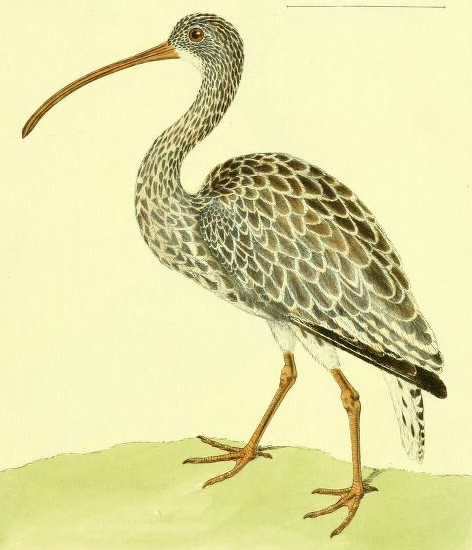
Object Status:
Extant
Accession Date:
By 30 August 1802
Primary Source Reference:
Charles Willson Peale, letter to Rubens Peale (1784-1865) dated 30 August 1802; Selected Papers, 2, part 1: 451.
Additional Source Text:
On 30 August 1802, Charles Willson Peale (1741-1827) sent a list of specimens to his son Rubens Peale (1784-1865), then in Europe, which were in need of replacement, having been "totally destroyed by dermest[id] beetles" or in otherwise poor condition. The elder Peale wrote: "Scolopax arquata Linn. Le Courlis Buff. pl. enl. 818." (Miller 1988: 451, Selected Papers, Vol. 2, part 1, Yale University Press).
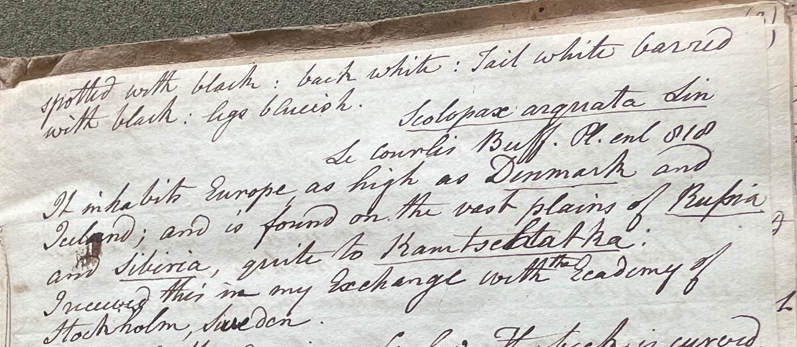
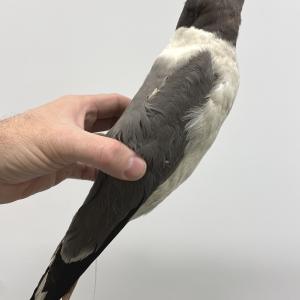
In his 26th Lecture, Peale wrote: "No. 827. Is the European Curlew, has a bill about 7 Ins long; head, and upper part of the wings, pale brown, spotted with black; back white; tail white brred with black; legs blueish. Scolopax arquata Linn. Le Courlis Buff. pl. enl. 818. It inhabits Europe, as high as Denmark and Iceland; and is found on the vast plains of Russia and Sibiria, quite to Kamtschatka. I received this in my exchange with the Ecademy of Stockholm, Sweden." (Academy of Natural Sciences of Drexel University Archives, coll. 40)
Peale wrote, in "A Walk Through the Philad[elphi]a Museum" (1805–1806): "There is a specific difference between the European Curlew (T. arquata) and the American Curlew, the under bill being much shorter in the latter, in proportion of the birds. — The plumage of each species are much alike but the American Curlew is considerably larger than the European." (Historical Society of Pennsylvania, coll. 0481)
Specimen Type:
Dead/preserved
Current Common Name:
Eurasian Curlew
Current Scientific Name
Scolopacidae | Numenius arquata