Object Status:
Extant
Accession Date:
26 August 1793
Primary Source Reference:
Charles Willson Peale, diary entry dated 26 August 1793; Selected Papers, 2, part 1: 55.
Additional Source Text:
Charles Willson Peale (1741-1827) wrote in his diary on 26 August 1793, during a collecting trip to Cape Henlopen, Delaware, that he and his son, Titian Ramsay Peale I (1780-1798), had collected a “few Gulls, & some snipe and a Water witch” (Miller 1988: 55, Selected Papers, Vol. 2, Part 2, Yale University Press).
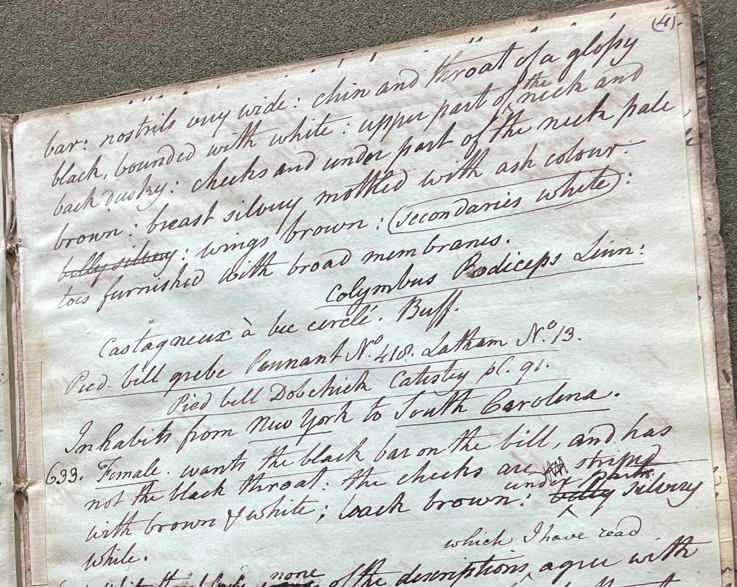
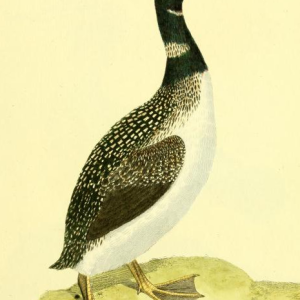
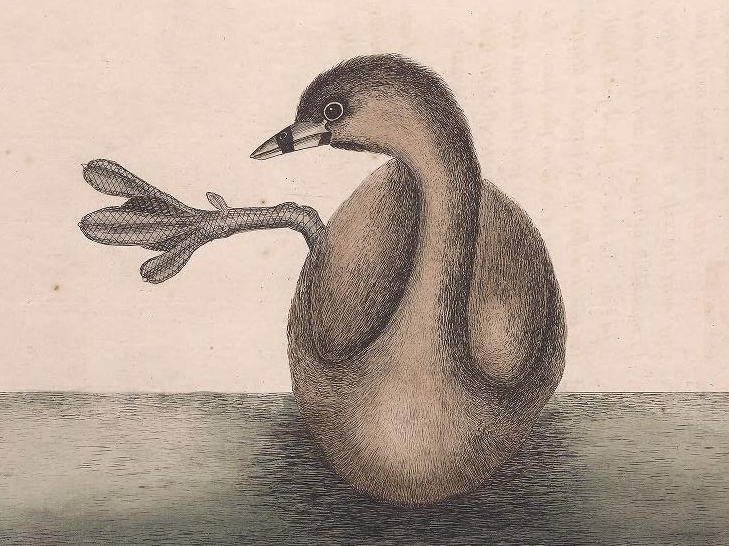
Peale wrote, in his 24th Lecture (ca. 1799): “632. Pied-bill Grebe. A strong arched bill, not unlike that of common Poultry; of an olive colour, crossed through the middle of both mandibles with a black bar; nostrils very wide; chin and throat of a glossy black, bounded with white; upper part of the neck and back dusky; cheeks and under part of the neck, pale brown; breast silvery mottled with ash colour; belly silvery; wings brown; secondaries white; toes furnished with broad membranes. Colymbus Podiceps Linn. Castagneux à bec circlé Buff. Pied bill grebe Pennant No. 418. Latham No. 13. Pied bill Doubchick Catesby pl. 91. Inhabits from New York to South Carolina. 633. Female. wants the black bar on the bill, and has not the black throat; the cheeks are striped with brown & white; back brown; belly under parts silver white.” (Academy of Natural Sciences of Drexel University Archives, coll. 40)
In “A Walk Through the Philad[elphi]a Museum” (Historical Society of Pennsylvania, coll. 0481), Peale (1805–1806) wrote: “The pied-bill Grebe (C. Podiceps) inhabits from New York to south Carolina. They are generally called water witches, as they dive instantly at the flash of a gun. It is remarkable that the first bird the Proprietor of this Museum shot was one of these birds. It was done by running nearer to the shore every time it dived & stopping when it rise each time it came up, at last being in a good distance the Instant its head appeared, pulling the trigger, before the water had run off its eyes, the shot reached it.” (Historical Society of Pennsylvania, coll. 0481)
Three unmounted specimens of “Colymbus podiceps (Pied bill G)” from Florida were listed in an unpublished “Catalogue of Duplicate specimens...”, May 1822. [unpublished] American Philosophical Society Library (Mss.B.P31).
Notes:
In fact, both sexes in nonbreeding plumage resemble the “Female” described by Peale. Peale's collecting efforts at Cape Henlopen were overlooked by compilers of Delaware bird records, prior to this study (Gene K. Hess, in litt. 10 February 2024). Witmer Stone, 1937: 83, Bird studies at Old Cape May, vol. 1 (Philadelphia: Delaware Valley Ornithological Club), who also overlooked Peale's collecting activities, stated that "Hen-bill diver" and "Hell-Diver" were two colloquial names for this species in Cape May.
Specimen Type:
Dead/preserved
Current Common Name:
Pied-billed Grebe
Current Scientific Name
Podicipedidae | Podilymbus podiceps