Object Status:
Extant
Accession Date:
By 1799
Primary Source Reference:
Charles Willson Peale, Lecture on Natural History 20. (ca. 1799). Academy of Natural Sciences of Drexel University Archives, coll. 40. / https://ansp.org/research/library/archives/0000-0099/coll0040/
Additional Source Text:
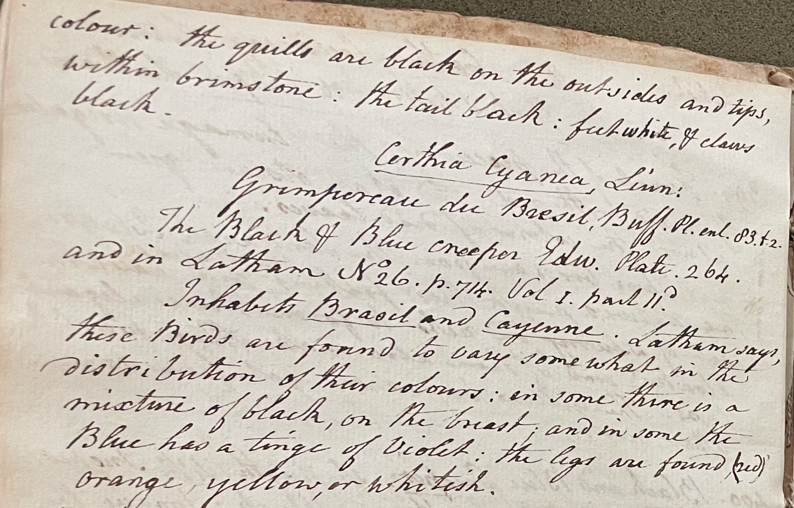
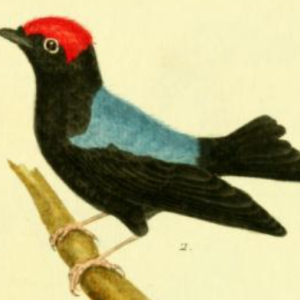
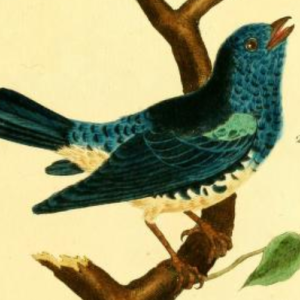
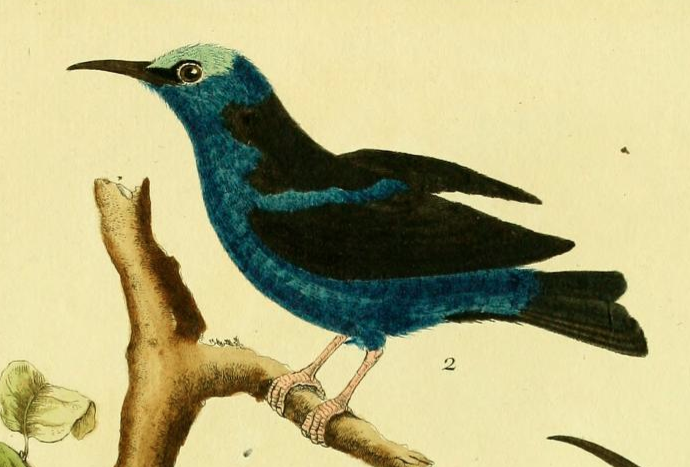
Charles Willson Peale (1741-1827) wrote, in his 20th Lecture (ca. 1799): "No. 400. Black and Blue Creeper. The length 4 ¼ Inches. Bill ¾ of an Inch in length, and Black; tongue the length of the bill, and ciliated, or divided into three at the end; the top of the head is beryl blue; the rest of the head, throat, fore part of the neck, brest, belly, sides, thighs, lower part of the back, upper tail and wing coverts, are of a fine violet Blue; on each side of the head is a black stripe, in which the eye is placed; the hind part of the neck, and upper part of the back, are velvet black; the upper wing and tail coverts are likewise black, but not so bright; the under wing coverts are brimstome colour; the quills are black on the outsides and tipes, within brimstone; the tail black; feet white, & claws black." (Academy of Natural Sciences of Drexel University Archives, coll. 40) Peale continued: "Certhia cyanea Linn. Grimpereau de Bresil, Buff. pl. enl. 83. t. 2. The Black & Blue creeper Edw. Plate 264. and in Latham No. 26. p. 714. Vol. I. Part IId. Inhabits Brasil and Cayenne. Latham says, these Birds are found to vary somewhat in the distribution of their colours; in some there is a mixture of black, on the breast; and in some, the Blue has a tinge of Violet; the legs are found red, orange, yellow, or whitish." (ANSP Archives, coll. 40)
Notes:
The origin of Peale’s specimen (Java) makes it likely to have been the Lineated Barbet P. lineatus, rather than the morphologically similar White-cheeked Barbet (P. viridis) of south India. The editor (MRH) has been unable to confirm the source of Peale’s specimens from Java, Indonesia, but there is ample reason to suspect that he received them from Thomas Horsfield (1773-1859), the physician and naturalist. In 1799, Horsfield, who was born and raised in southeast Pennsylvania, and educated at the University of Pennsylvania, took a medical post on the merchant ship China, which sailed to Java. He remained there until 1819, during which time he collected specimens on behalf of Sir Thomas Stamford Bingley Raffles (1781-1826), governor of the Dutch East Indies. In January 1799, before he left for Java, Horsfield visited Peale’s Museum and purchased a ticket “for the year 1799 which intitles [sic] the Purchaser to the use of the Museum every day while the Sun is above the Horizon. Each Ticket [cost] two Dollars.” His signature (“Thos. Horsfield”) appears in a Peale Museum Subscription Book (Historical Society of Pennsylvania, coll. 0481). / https://en.wikipedia.org/wiki/Thomas_Horsfield
Specimen Type:
Dead/preserved
Current Common Name:
Red-legged Honeycreeper
Current Scientific Name
Thraupidae | Cyanerpes cyaneus