Object Status:
Unlocated
Accession Date:
By 12 October 1792
Primary Source Reference:
Charles Willson Peale, letter to Thomas Hall of Moorfields, London, dated 12 October 1792; Selected Papers, 2, part 1: 43.
Additional Source Text:
Charles Willson Peale (1741-1827) sent a "Striped black & white bird" to Thomas Hall in London, on 12 October 1792, in exchange for European specimens (Miller 1988: 42, Selected Papers, Vol. 2, part 1, Yale University Press).
On 9 December 1792, Peale sent a "Black and White striped small Bird" to Christian Magus (Miller 1988: 44).
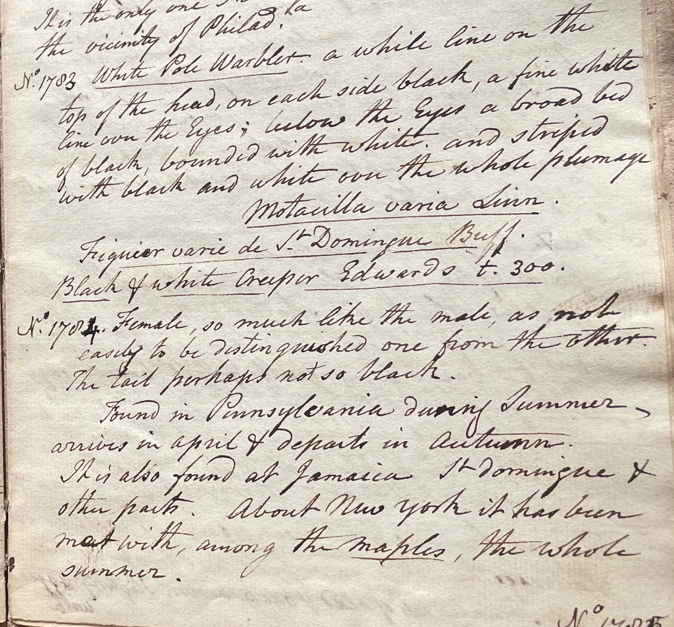
Peale wrote, in his 36th Lecture (ca. 1799): "No. 1783. White Pole Warbler. a white line on the top of the head, on each side black, a fine white line over the Eyes; below the Eyes a broad bed of black, bounded with white, and striped with black and white over the whole plumage. Motacilla varia Linn. Figuier varie de St. Dominque Buff. Black & White Creeper Edwards t. 300. No. 1784. Female, so much like the male as not easily to be distinguished one from the other. The tail perhaps not so black. Found in Pennsylvania during summer, arrives in April & departs in Autumn. It is also found at Jamaica, St. Dominque & & other parts. About New York it has been met with, among the Maples, the whole summer." Females of this species lack the black throat, and have buffy sides, which suggests that the specimens Peale described in his lecture were both males, and one was mis-sexed. (Academy of Natural Sciences of Drexel University Archives, coll. 40)
Peale listed "Black & White striped [Warbler] male & female" in a draft copy of "A Walk Through the Philad[elphi]a Museum" (1805–1806); the page of the final draft containing this species is not located.(Historical Society of Pennsylvania, coll. 0481)
An undated list of 21 bird specimens in Charles Willson Peale's (1741-1827) handwriting includes one "black & white striped head flycatcher" (American Philosophical Society Library, Mss.B.P31).
Alexander Wilson (1766-1813) described this species under the name "Black and White Creeper / Certhia maculata" in American Ornithology vol. 3 (Pl. 19), where "Peale's Museum, No. 7092" was cited (Wilson 1811: 23). / https://www.biodiversitylibrary.org/item/175516#page/29/mode/1up (text) / https://www.biodiversitylibrary.org/item/175516#page/8/mode/1up (plate)
An unmounted male specimen of "Certhia maculata (Black & White Creeper)" was listed in "A Catalogue of Duplicate Specimens...", May 1822. [unpublished] APS Library (Mss.B.P31).
Notes:
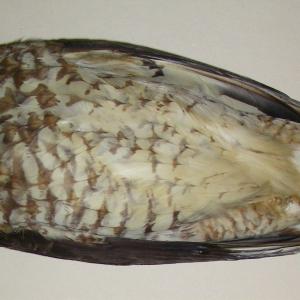
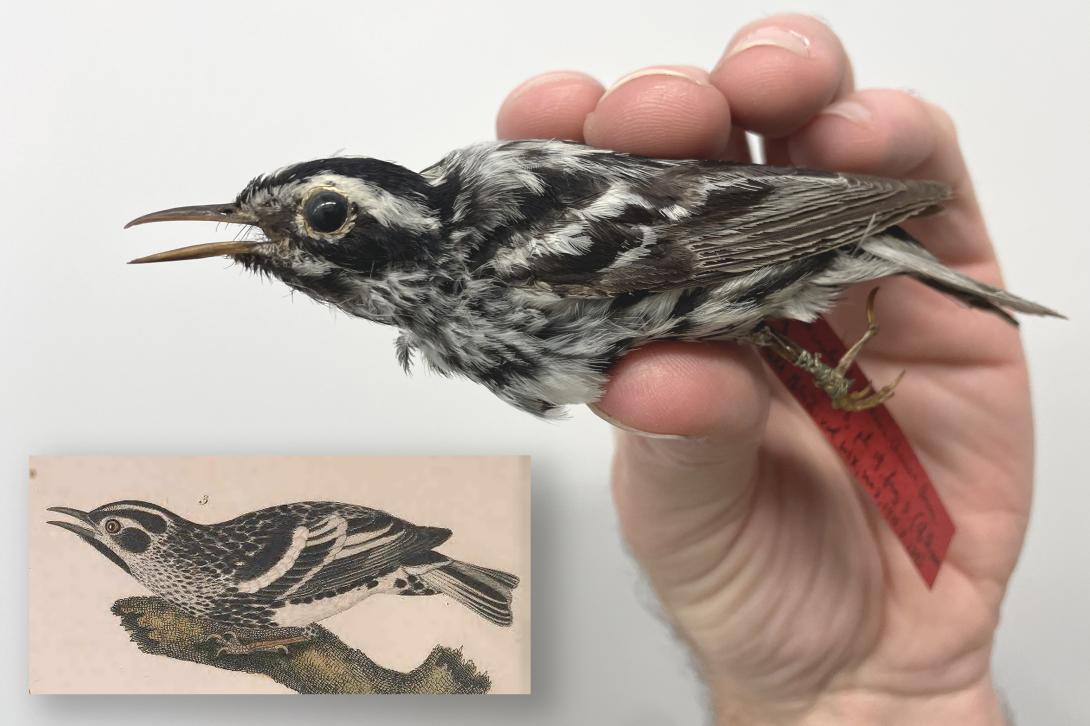
After Peale's Museum closed, a portion of Peale's bird collection was purchased in 1850 by Moses Kimball (1809–95), who displayed it at his "Boston Museum". An advertisement in the Boston Transcript, printed 1 October 1850, stated that Kimball had acquired "One Half of the celebrated Peale's Philadelphia Museum". The other half of Peale's birds had been sold to the circus promoter P. T. Barnum (1810–91) and would be subsequently destroyed in a fire at his "American Museum" in New York City in July 1865. When the Boston Museum closed, Kimball's Peale remnants passed temporarily to the Boston Society of Natural History, who disposed of them to Charles J. Maynard (1845-1929), a local taxidermist. The specimens were stored in a barn in Massachusetts for several years, then eventually were deposited at the Museum of Comparative Zoology (MCZ), Harvard University. By the time the collection was catalogued by Walter Faxon (1848-1920) at MCZ, in 1914, in virtually every case the original mounts and labels had been disassociated from the specimens, and an untold number were lost. Walter Faxon, "Relics of Peale's Museum," Bulletin of the Museum of Comparative Zoology, 59, no. 3 (July 1915): 139, speculated that MCZ 67868 (shown here), a data-deficient specimen from the Boston Museum collection, was "Wilson's figured type, I doubt not." This may be true, but Peale had specimens of this species in his collection by 1792, and had little room (or interest) to display duplicates. / https://www.biodiversitylibrary.org/page/6339801#page/189/mode/1up Wilson (1810: viii, vol. 2) previously stated that "no drawings have been, or will be made for this work, from any stuffed subjects, where living specimens of the same can be procured; yet the former serve a very important purpose; they enable the author to ascertain the real existence and residence of such subjects" / https://www.biodiversitylibrary.org/item/175511#page/14/mode/1up Wilson deposited many specimens at Peale's Museum, after completing his drawings, but the combined evidence from American Ornithology and the Peale Museum Accessions Book (Historical Society of Pennsylvania, coll. 0481) suggests that he deposited probably fewer than 100 skins total (and possibly as few as 40-50), whereas many authors have assumed that all the "Peale numbers" cited in Wilson's work were those of his own specimens (e.g., "he contributed 279 specimens to the collection", Edward H. Burtt, Jr., and William E. Davis, Jr., 2013, Alexander Wilson: The Scot Who Founded American Ornithology, Belknap Press, p. 310). This assumption appears to be based on a misunderstanding — Wilson was citing the numbers to give credit to Peale, to acknowledge his contributions, not to stake a claim to his own specimen deposits. If Burtt & Davis (2013) were correct, the "Catalogue of Duplicate Specimens" (APS Library, Mss.B.P31) would be full of Wilson's specimen deposits—but this is not the case. Only one duplicate of Black-and-white Warbler was listed—unmounted (i.e., unlike MCZ 67868)—and there is abundant evidence that Peale was using duplicates of this common species as currency for exchanges with foreign naturalists. To the editor's (MRH) knowledge, despite the similar pose of the specimen to Wilson's figure, there is no evidence that Wilson deposited a Black-and-white Warbler at Peale's Museum. Despite this uncertainty, the MCZ online database lists MCZ 67868 as the "Holotype of Certhia maculata" and the specimen was included in a recently funded grant proposal aimed at "Preserving the genomes of the type specimens in the MCZ (CSBR)" (National Science Foundation, NSF Collections in Support of Biological Research: Award #1946857). / https://mczbase.mcz.harvard.edu/guid/MCZ:Orn:67868
Specimen Type:
Dead/preserved
Current Common Name:
Black-and-white Warbler
Current Scientific Name
Parulidae | Mniotilta varia
Repository:
Museum of Comparative Zoology, Harvard University (MCZ 67868)