Object Status:
Extant
Accession Date:
By 1799
Primary Source Reference:
Charles Willson Peale, Lecture on Natural History 34. (ca. 1799). Academy of Natural Sciences of Drexel University Archives, coll. 40. / https://ansp.org/research/library/archives/0000-0099/coll0040/
Additional Source Text:
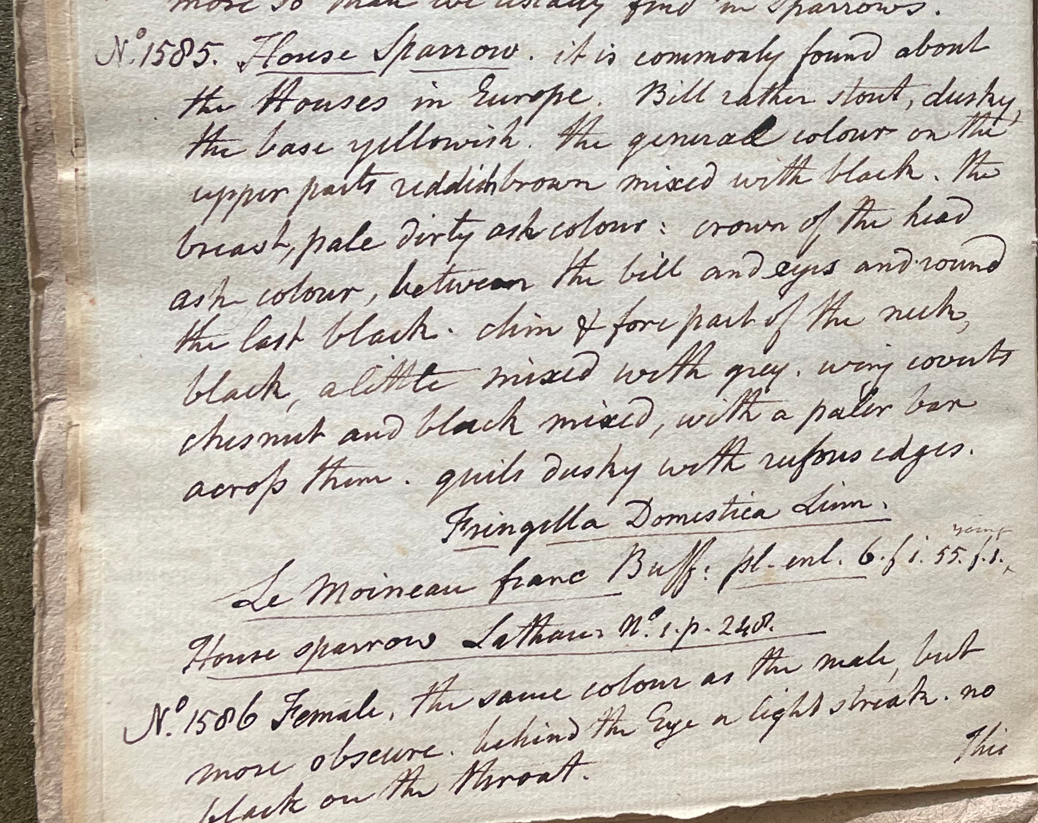
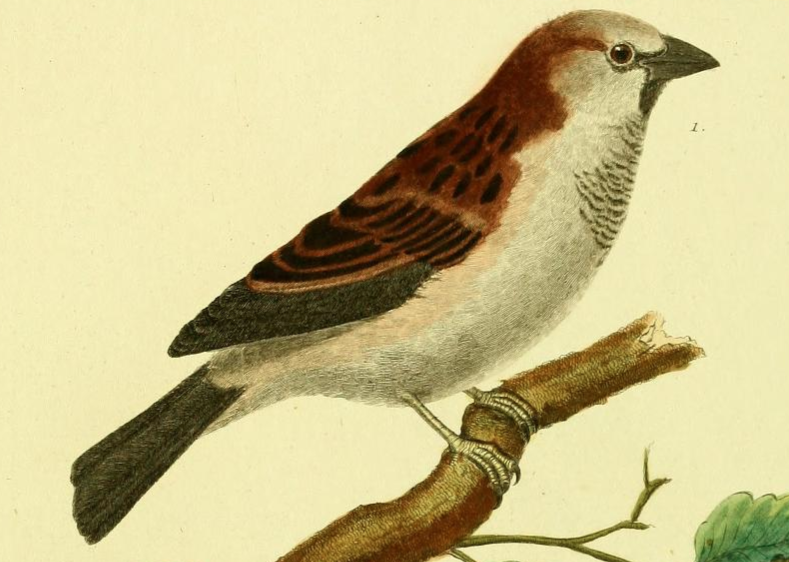
Charles Willson Peale (1741-1827) wrote, in his 34th Lecture (ca. 1799): "No. 1585. House Sparrow. It is commonly found about the Houses in Europe. Bill rather stout, dusky, the base yellowish. The general colour on the upper parts reddish brown mixed with black. The breast, pale dirty ash colour; crown of the head ash colour; between the bill and eyes and round the last black; chin & fore part of the neck, black, a little mixed with grey; wing coverts chesnut and black mixed with a paler bar across them; quils dusky with rufous edges. Fringilla domestica Linn. Le Moineau Franc Buff. pl. enl. 6. f. 1. young 55. f. 1. House Sparrow Latham No. 1. p. 248." (Academy of Natural Sciences of Drexel University Archives, coll. 40)
Peale continued: "No. 1586. Female, the same colour as the male, but more obscure; behind the Eye a light streak; no black on the throat. This species is found every where through Europe; also in Egypt, Senegal, Syria, and other parts of Africa & Assia. In England the fasten small pots to their houses for these birds to build in & this is the bird Mr. Buffon wishes to exterminate. He says in whatever county the sparrow is settled, it never is found in desert places, or at a distance from the residence of man. It likes neither woods nor plains. It is more frequent in towns than in villages; nor is it seen in hamlets or farms that are buried in the depth of forests. It follows society to live at their expense; and indolence and voracity lead it to subsist on the provisions of others." (ANSP Archives, coll. 40)
Peale continued: "Our granaries, our barns, our courtyards, our Pigeon-houses, and in short, all places where grain is spilt, are its favorite resort. It is extremely destructive; its plumage is entirely useless, its flesh indifferent food, its notes grating to the Ear, and its familiarity and petulance disgusting. But what will render them eternally troublesome and vexations, is not only their excessive multiplication, but their subtlety, their cunning and their obstinacy to abide in places which suit them. They are crafty and artful, easily distinguish the snares laid for them, and wear out the patience of those who try to catch them. It is only in seasons of scarcity and when the snow covers the ground, that the sport will succeed; and little impression can be made on a species which breeds thrice a year. Their nest consists of hay, lined with feathers." (ANSP Archives, coll. 40)
Peale continued: "If you destroy it, they will in 24 hours build another; if you plunder the eggs, which are 5 or 6, often more, they will in the course of eight or ten days lay others; if you drive them from the trees or the houses, they will resort in greater numbers to your granaries. In this manner Buffon goes on for 2 or 3 pages more describing the intelligence of these little birds, and his antipathy towards them, yet in the French Encyclopedia Methodique, I find this interresting account of the species before us, viz., sparrows when taken young, become extremely familiar and are susceptible of attachment; they have been seen to return faithfully at the voice of their master & enjoying the liberty granted them, have regularly returned from the garden when they had spent the day, to the habitation of those who raised them; they can likewise, but without much care, be taught to pronounce some words, and when young, their notes, which are naturally disagreeable, can be corrected by placing them near other Birds; but they oftener injure those of others, than improve their own." (ANSP Archives, coll. 40)
Specimen Type:
Dead/preserved
Current Common Name:
House Sparrow
Current Scientific Name
Passeridae | Passer domesticus