Object Status:
Extant
Accession Date:
By 1799
Primary Source Reference:
Charles Willson Peale, Lecture on Natural History 17. (ca. 1799). Academy of Natural Sciences of Drexel University Archives, coll. 40. / https://ansp.org/research/library/archives/0000-0099/coll0040/
Additional Source Text:
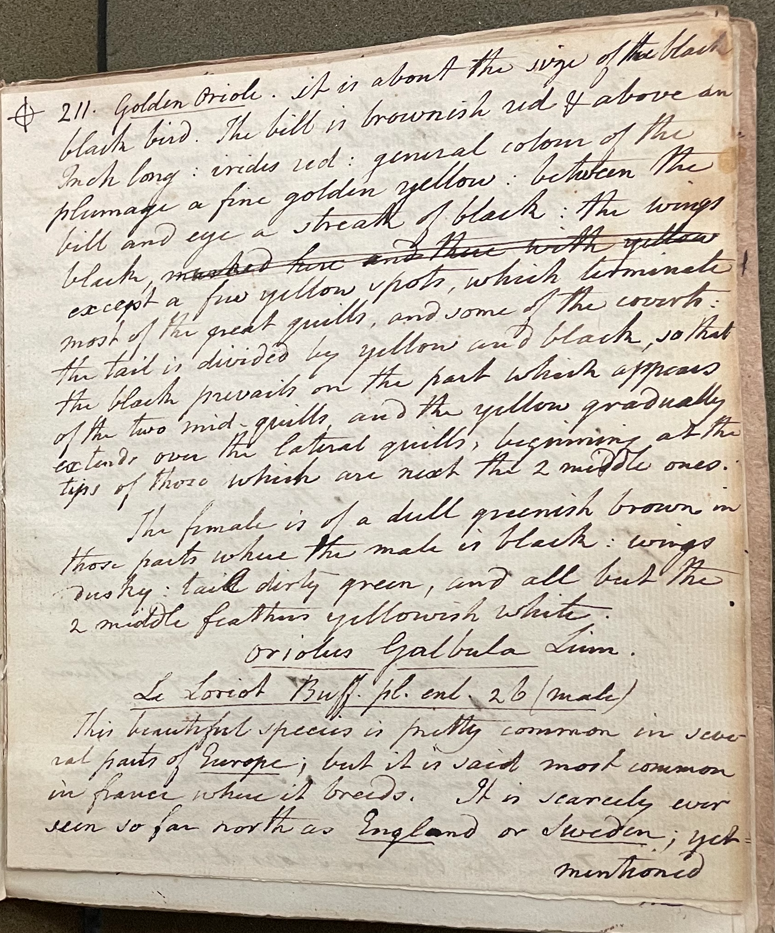
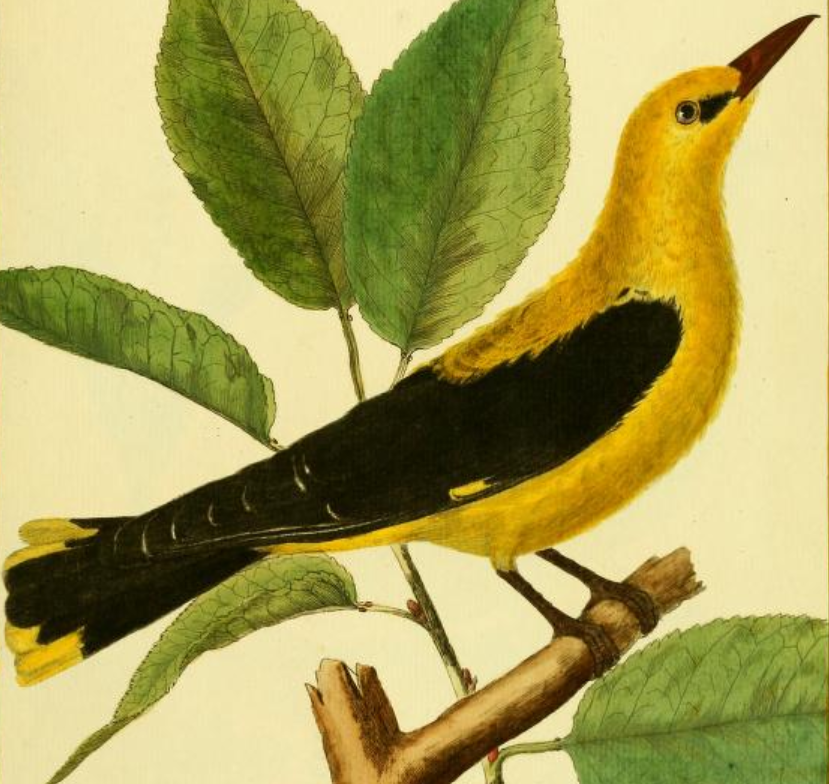
Charles Willson Peale (1741-1827) wrote, in his 17th Lecture (ca. 1799): "No. 211. Golden Oriole. It is about the size of the balck bird. The bill is brownish red & above an Inch long; irides red; general colour of the plumage a fine golden yellow; between the bill and eye a streak of black; the wings black, marked here and there with yellow except a few yellow spots, which terminate most of the great quills, and some of the coverts; the tail is divided by yellow and black, so that the black prevails on the part which appears of the two mid-quills, and the yellow gradually extends over the lateral quills, beginning at the tips of those which are next [to] the 2 middle ones. The female is of a dull greenish brown, on those parts where the male is black; wings dusky; tail dirty green, and all but the 2 middle feathers yellowish white. Oriolus galbula Linn. Le Loriot Buff. pl. enl. 26. (male)." (Academy of Natural Sciences of Drexel University Archives, coll. 40)
Peale continued: "This beautiful species is pretty common in several parts of Europe, but it is said most common in France, where it breeds. It is scarcely ever seen so far north as England or Sweden; yet mentioned as a bird of Russia, perhaps only of the warmer partsof it; comes twice in a year into Switzerland, and found also in Carniola; observed in Malta in September on its passage southward, and returns in the spring to the north through the same track. Hence it is supposed to winter in Africa and Assia, especially as some of them have been brought from China and Bengal, as well as the Cape of good-hope." (ANSP Archives, coll. 40)
Peale continued: "The nest is of curious construction like others of the oriole species. It is of the shape of a purse, fastened to the extreme or outmost twigs of tall trees, and composed of fibres of hemp or straw, mixed with fine dry stalks of grass, and lined within with moss and liverwort. The female is observed to be very tender of her young, fearing nothing for their defense; not infrequently will suffer herself to be taken with Eggs and nest, and continue to sit upon them in a gage till she dies. The flesh is accounted good eating, and sold in the poulter's shops at Naples." (ANSP Archives, coll. 40)
Peale wrote, in "A Walk Through the Philad[elphi]a Museum" (1805–1806): "The Golden Oriole (oriolus Galbula) belongs to Europe, asia & Africa."(Historical Society of Pennsylvania, coll. 0481)
Specimen Type:
Dead/preserved
Current Common Name:
Eurasian Golden Oriole
Current Scientific Name
Oriolidae | Oriolus oriolus