Object Status:
Extant
Accession Date:
By 1799
Primary Source Reference:
Charles Willson Peale, Lecture on Natural History 22. (ca. 1799). Academy of Natural Sciences of Drexel University Archives, coll. 40. / https://ansp.org/research/library/archives/0000-0099/coll0040/
Additional Source Text:
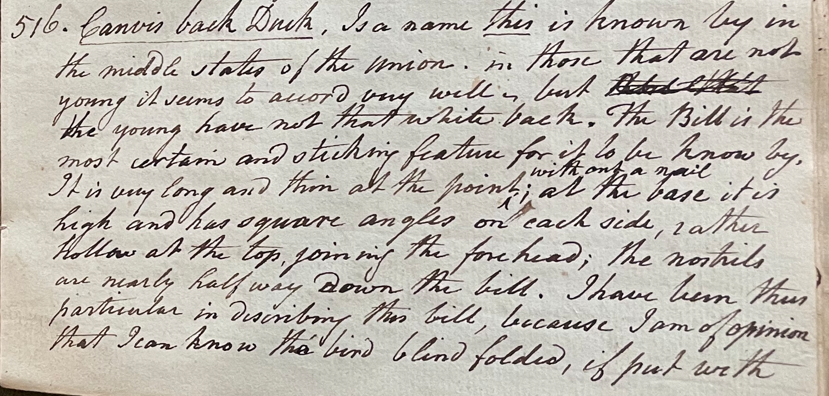
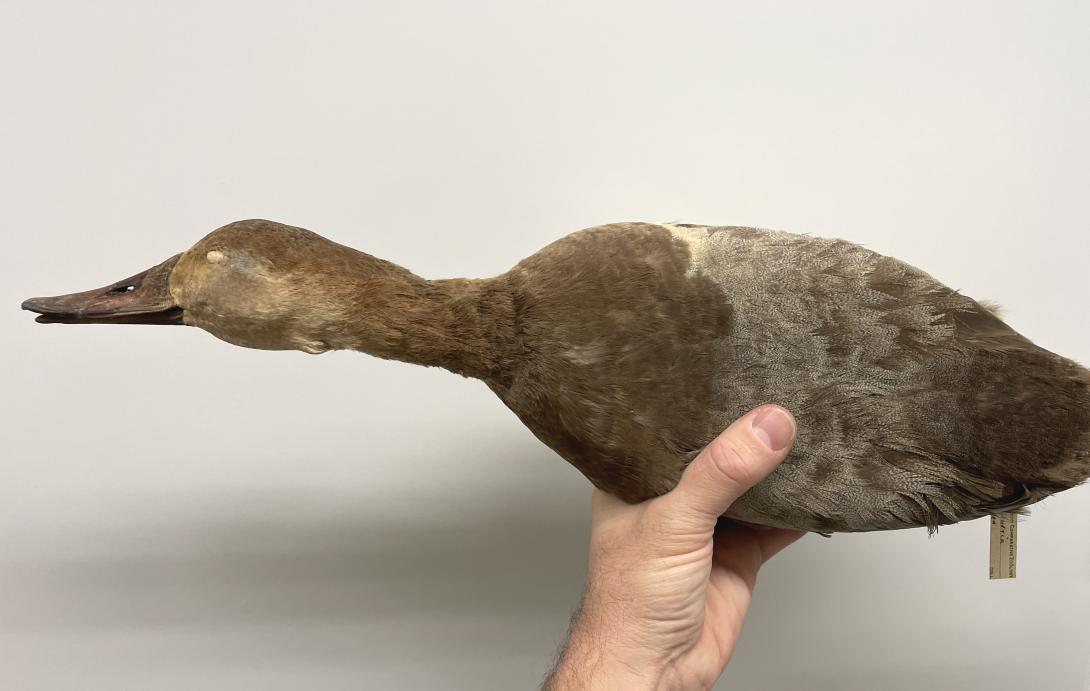
Charles Willson Peale (1741-1827), in his 22nd Lecture (ca. 1799), confused this species with the Common Pochard (Anas Ferina) of Europe, writing: "Canvis back Duck is a name this [species] is known by in the middle states of the union. In those that are not young it seems to accord very well, but the young have not that white back. The Bill is the most certain and striking feature for it to be known by. It is very long and thin at the point, without a nail; at the base, it is high and has square angles on each side, rather hollow at the top, joining the forehead; the nostrils are nearly halfway down the bill. I have been thus particular in describing the bill, because I am of the opinion that I can know the bird blind folded, if put with any quantity of wild fowl. the length of the bill, the height and square parts at the base are more determined marks to know it by than any other. Colours are: head and neck bright bay, lower part of neck & breast brown black; back, scapulars and coverts of the wings pale grey, streaked traversly with fine lines of black; primaries dusky; underparts of the body white; tail brown black; feet lead coloured. Anas Ferina Linn. Millouin Buff. pl. enl. 803. Pochard Pennant No. 491. Latham No. 68." (Academy of Natural Sciences of Drexel University Archives, coll. 40)
Peale continued: "517. Female. Latham says they are carried into the London market sometimes in considerable numbers, where they are known by the name of Dun Birds; and are esteemed excellent eating. In winter pass pretty far to the south, being found in Egypt, about Cairo. Come into France the end of October in small flocks from 20 to 40. Not known for certain if they breed in England. He says they feed on small fish & shells. I am well informed that our Canvis backs feed on vegetable substances; a little kind of knob found on grass brought up from the bottom of the Red Head & other Ducks. This I have seen on the shores of the Head of the Chessapeak where the greatest numbers of those fowls feed during the winter. The Canvis-back is esteemed by far the best water fowl for the table known amongst us; and Epicures place much of their happiness in the possession of them." (ANSP Archives, coll. 40)
An undated scrap of paper tucked into Peale's 21st lecture manuscript contains a scribbled list of duck specimens, including: "Canvis back D & female". (ANSP Archives, coll. 40)
Benjiamin Smith Barton (1766-1815), who visited Peale's Museum with his students, proclaimed that "The Canvas-Back here spoken of, in the United-States, is the Anas ferina of Linnaeus" (1806, Phila. Med. Journ. 2: 162).
Peale was initially of the same opinion, but reversed course and proposed that the American and European species were distinct in "A Walk Through the Philad[elphi]a Museum" (1805-1806): "…the Canvis [sic] back duck is most esteemed for the Table. Whether they are found in Europe is at least doubtful. The Pochard (a. Ferina) by some is thought to be the same, but a slight view of the bill will be sufficient to determine that they are a different species. A comparative view of the Beak of the Canvis-back with that of the Redhead Duck (a. Rufa) will confirm a knowledge not easily mistaken although the plumage of both species are very similar. The canvis back duck feeds on a little kind of knob that grows on grass which the red neck Duck brings up. This food very probably gives the flavor so admired by Epicurians." (Historical Society of Pennsylvania, coll. 0481)
Alexander Wilson (1766-1813) described this species under the name "Canvas-back Duck / Anas valisineria" in American Ornithology vol. 8, published posthumously (Pl. 70), where "Peale's Museum, No. 2816" was cited (Wilson 1814: 103). / https://www.biodiversitylibrary.org/item/175758#page/123/mode/1up (text) / https://www.biodiversitylibrary.org/item/175758#page/112/mode/1up (plate)
Specimen Type:
Dead/preserved
Current Common Name:
Canvasback
Current Scientific Name
Anatidae | Aythya valisineria