Object Status:
Extant
Accession Date:
By 1799
Primary Source Reference:
Charles Willson Peale, Lecture on Natural History 34. (ca. 1799). Academy of Natural Sciences of Drexel University Archives, coll. 40. / https://ansp.org/research/library/archives/0000-0099/coll0040/
Additional Source Text:
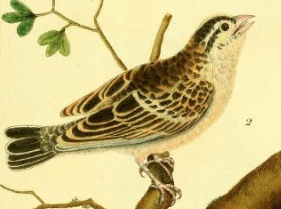
Charles Willson Peale (1741-1827) described a specimen in his 34th Lecture (ca. 1799) that was likely a female of this species: "No. 1613. This is a Sparrow which I purchased [from] a French gentleman who had traveled into Africa & South America, to collect subjects of Natural History—which of these countries it belongs to, I cannot with certainty determine. It has a considerable likeness [to] a female sparrow belonging to Brazil, of which Mr. Buffon has given a plate No. 291 [referring to Daubenton's Planches enluminées d'histoire naturelle 1765-1783, Paris]. The top of the head is black covered with small spots of white." (Academy of Natural Sciences of Drexel University Archives, coll. 40)
Notes:
This identification is based on Peale's description and reference to Martinet's plate no. 291, in the Planches enluminées (shown here), which depicts a male and female V. chalybeata.
Specimen Type:
Dead/preserved
Current Common Name:
Village Indigobird
Current Scientific Name
Viduidae | Vidua chalybeata