Object Status:
Extant
Accession Date:
By 1799
Primary Source Reference:
Charles Willson Peale, Lecture on Natural History 32. (ca. 1799). Academy of Natural Sciences of Drexel University Archives, coll. 40. / https://ansp.org/research/library/archives/0000-0099/coll0040/
Additional Source Text:
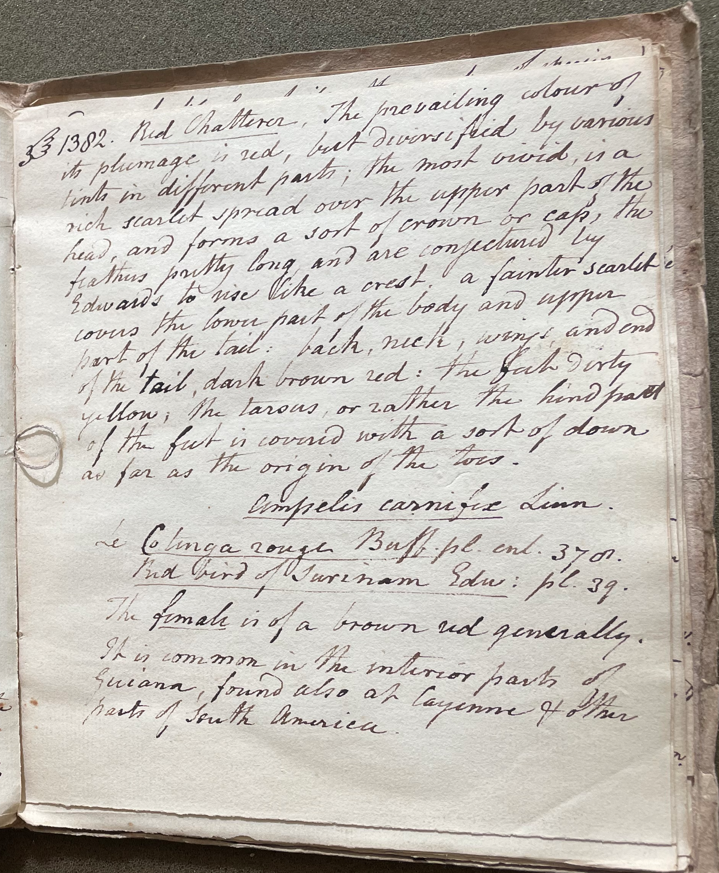
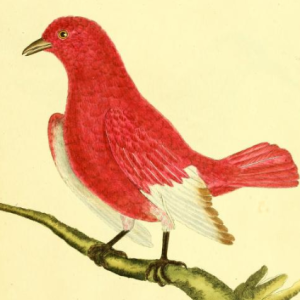
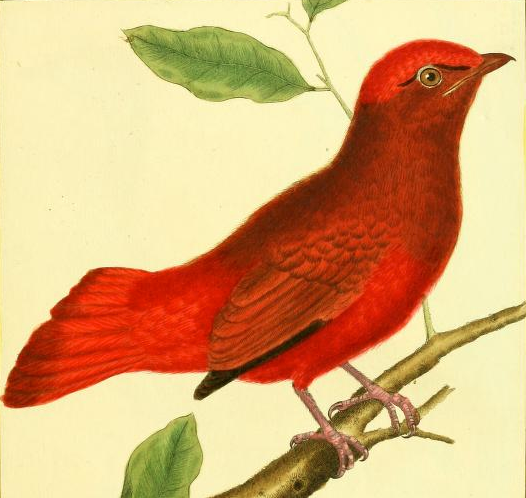
Charles Willson Peale (1741-1827) wrote, in his 32nd Lecture (ca. 1799): "No. 1382. Red Chatterer. The prevailing colour of its plumage is red, but diversified by various tints in different parts; the most vivid is a rich scarlet spread over the upper part of the head, and forms a sort of crown or cap, the feathers pretty long and are conjectured by Edwards to rise like a crest. a fainter scarlet covers the lower part of the body and upper part of the tail; back, neck, wings and end of the tail, dark brown red; the feet dirty-yellow; the tarsus or rather the hind part of the feet is covered with a sort of down as far as the origin of the toes. Ampelis carnifex Linn. Cotinga rouge Buff. pl. enl. 378. Red Bird of Surinam Edw. pl. 39. The female is of a brown red generally. It is common in the interior parts of Guiana, found also at Cayenne & other parts of South America." (Academy of Natural Sciences of Drexel University Archives, coll. 40)
Peale wrote, in "A Walk Through the Philad[elphi]a Museum" (1805–1806): "No. [blank] Red Chatterer (A. carnifix) although the general colour is Red, yet that vivid, or rich Scarlet crown or cap, is a distinguishing trait of this bird, as well as a sort of Down covering the hind part of the feet. They inhabit the interior parts of Cayenne." (Historical Society of Pennsylvania, coll. 0481)
Notes:
In 1793, Raphaelle Peale (1774-1825) travelled to Cayenne, French Guiana, to collect specimens for Peale's Museum. However, to the editor's (MRH) knowledge, there is no detailed inventory of the specimens he brought back, and there are many examples of specimens from northern South America that were donated by other people. For more discussion about Raphaelle's travels, see Lillian B. Miller, 1993, "Father and Son: The Relationship of Charles Willson Peale and Raphaelle Peale", The American Art Journal 25: 4-161. / https://doi.org/10.2307/1594599
Specimen Type:
Dead/preserved
Current Common Name:
Guianan Red Cotinga
Current Scientific Name
Cotingidae | Phoenicircus carnifex