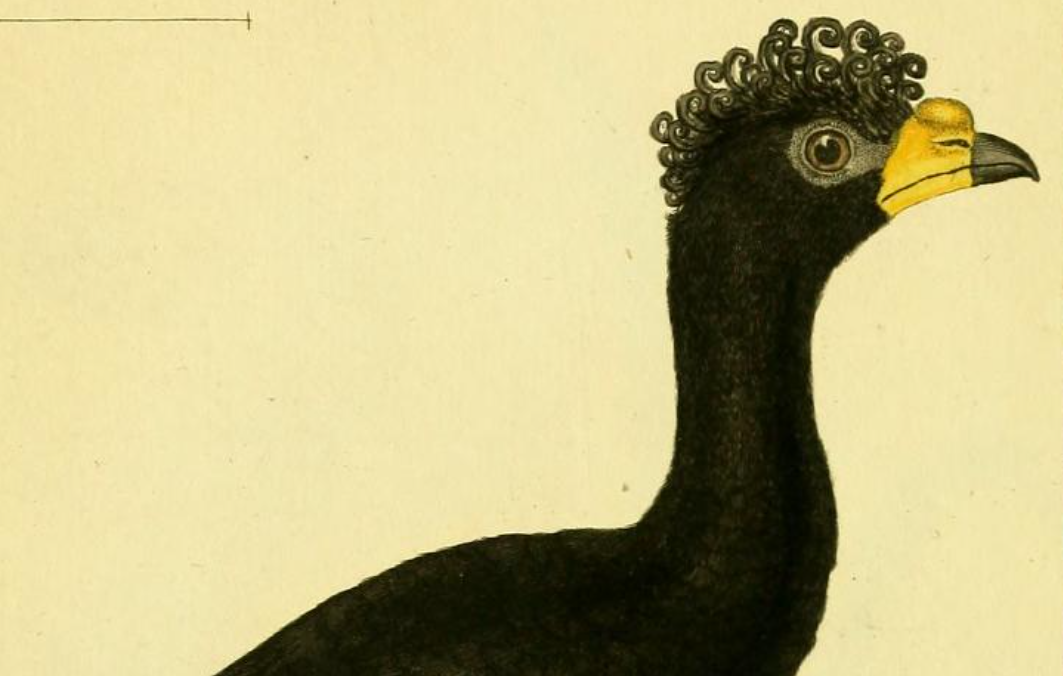
Object Status:
Extant
Accession Date:
By 21 May 1789
Primary Source Reference:
Pennsylvania Packet, 21 May 1789.
Additional Source Text:
On 21 May 1789, a notice in the Pennsylvania Packet (Philadelphia announced Charles Willson Peale's (1741-1827) acquisition of a "Powese", donated by Adrian Valck, Dutch Consul for Maryland and Virginia from 1784: "Its size is between that of the dunghill fowl and the turkey."
The same year,on 11 November 1789, another "Poweese" was donated by "Miss Campbell" and announced in the Freeman's Journal (Philadelphia). Peale confirmed in a letter in late 1789 that the male and female "Curacoa [birds were] still alive and very handsome" (Miller 1983: 592).
In 1792, Peale updated Valck on the status of his donated birds: "I am and shall be obliged to you for your air to my Museum— The [Powese] Curacao Bird is still alive and very handsome. but poor fellow without a mate, the loss of the female almost broke his heart, he would not eat a morsel for 4 Days after her death; and at last was temped to take to his food by an offer Mrs. Peale made him of some rice, every kind of food [before of] that could be thought of was before refused" (Miller 1988: 33, Selected Papers, Vol. 2, part 1, Yale University Press).
Peale wrote, in his 28th Lecture (ca. 1799): "No. 1046. Crested Curassow, is the name Latham gives it. They are easily tamed and being kepted in a domesticated state they may be subject to the like changes. Sir Hans Sloane says, that their plumage is variegated in different way, like that of common hens. Mr. Buffon has taken some pains to rectify the mistakes in the placing [of] this species of Birds, he says, "Some Naturalists would refer the Hocco's to the genus fo the Turkey, but it is easy to collect numerous and decisive differences which discriminate these kinds. In the Turkey the head is small and not feathered, which is also the case in the top of the neck; the bill bears a conical muscular protuberance, capable of being dilated and contracted; the legs are armed with spurs; the tail feathers can be spread like a fan, &c. whereas in the Hocco, the head is large, the neck sunk, and both are cloathed with feathers; on the bill is a round, hard, and almost bony swelling; and on the crown of the head a moveable crest, which seems to be peculiar to this bird, and which is raised and depressed at pleasure; but no person has ever asserted that it can expand its tail feathers like a fan. On dissection [of] the internal structure the differences are still more numerous. But if the Hocco be not a Turkey, the modern nomenclators had still less reason to suppose it a Pheasant; for besides those differences, which will readily be perceived externally and internally, there is a decisive one in the instincts of these birds." (Academy of Natural Sciences of Drexel University Archives, coll. 40)
Peale continued: "The Pheasant is always wild, though bred from its infancy, though treated kindly and fed with great attention, it never becomes reconciled to the domestic state; it is ever a restless prisoner, ever seeking the means of escape; it even abuses the companions of its slavery, and never associates with them. When it recovers its liberty, and is restored to the savage state, for which it seems to be formed, nothing can be more timorous or distrustful; every new object is viewed with a suspicious aspect; the least noise alarms it, and the slightest motion disturbs its quiet; even the shadow of a branch shaken by the wind is sufficient to make it take wing. On the contrary, the Hucco is a calm bird, secure and even stupid; which perceives no danger, or at least makes no exertion to shun it; it seems to forget itself, and to be careless of its own existence." (ANSP Archives, coll. 40)
Peale continued: "Aublet shot nine of them in the same flock with the same piece, which he loaded as often as required. We may suppose that such a bird must be sociable; that it will readily accommodate itself to the other domestic fowls; and that it can be easily tamed. It becomes so tame as to rub with its bill on the door to gain admission; to pull the servants by the cloaths when they neglect it; to follow its master everywhere; or, if not allowed, it waits anxiously for his return, and, on seeing him again, shows every sign of joy and affection. It is difficult to conceive [of] habits more opposite; and I should imagine that no naturalist, or even nomenclator, if he had been acquainted with them, would have ventured to refer these two birds to the same genus." The preceding lengthy passage was taken from Buffon, as noted by Peale in the left margin. (ANSP Archives, coll. 40)
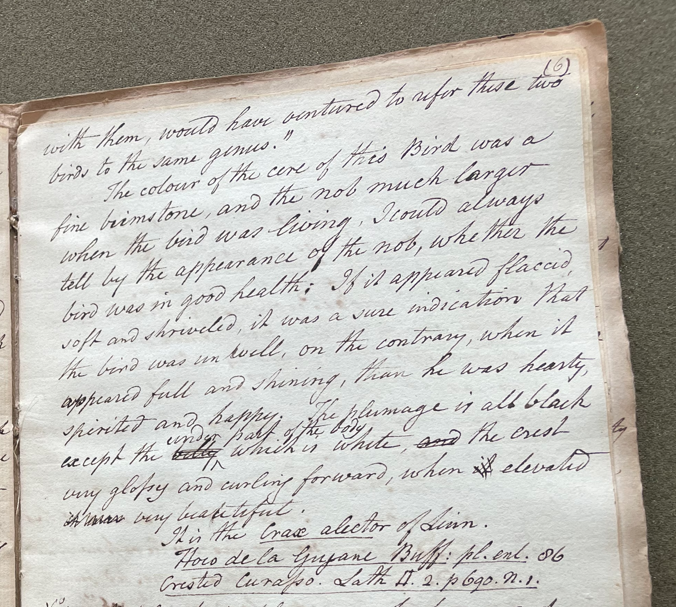
Peale continued: "The colour of the cere of this Bird was a fine brimstone, and the nob much larger when the bird was living. I could always tell by the appearance of the nob, whether the bird was in good health. If it appeared flaccid, soft and shriveled, it was a sure indication that the bird was unwell; on the contrary, when it appeared full and shining, then he was hearty, spirited and happy. The plumage is all black except the under part of the body, which is white, the crest very glossy and curling forward, when elevated very beautiful. It is the Crax alector of Linn. Hoco de la Guiane Buff. pl. enl. 86. Crested Curasso. Lath II. 2. P. 690. n. 1." (ANSP Archives, coll. 40)
Rubens Peale (1784-1865) wrote to his father from London, on 1 June 1803, about a list of specimens wanted by German naturalist Lopold de Fichtel (1770-1810), to exchange for specimens of German and Hungarian birds: "Crax Alector or Crested Curassow. Crax Globicem or Globose Curassow [=Crax rubra Linnaeus 1758], and others which he will mention in his letter to you" (Miller 1988: 529, Selected Papers, Vol. 2, part 1, Yale University Press). This suggests that Peale may have had multiple specimens of each (i.e., duplicates to trade).
Peale wrote, in "A Walk Through the Philad[elphi]a Museum" (1805–1806): "[Here are] the crested Curassow (C. Alector) and Red Curassow (C. Alector Rubra). The yellow cere very probable these are male & female, such is the opinion of some authors. The yellow lump at the base of the bills indicates the state of health in them; when is full and smooth in bird is in good health, but if it is [shrivled] up the reverse." (Historical Society of Pennsylvania, coll. 0481)
On 6 June 1809, Jeremiah Anderson's donation of "Two living Crax Alector from the West Indies" was recorded in the Peale Museum Accessions Book, p. 41 (Historical Society of Pennsylvania, coll. 0481). These were apparently the same birds noticed in Poulson's American Daily Advertiser on August 23, 1809: "Two Curacoa [Curassow] Birds (living) called Poweese." This species does not occur natively in the West Indies, so it seems likely that the birds were brought on a vessel that passed through the West Indies en route to Philadelphia.
On June 1823, L. Clapier, Esqr. was given a one-year membership for donating a living specimen; and on 7 July 1823, H. Pratt, Esqr. donated three living specimens from Alvarado, Colombia. Both were identified as "poweese Crax alector" in the Peale Museum Accessions Book, pp. 123 and 124, respectively (Historical Society of Pennsylvania, coll. 0481).
A mounted specimen of "Crax alector (Crested Curassow)" was listed in "A Catalogue of Duplicate Specimens...", May 1822. [unpublished] American Philosophical Society Library (Mss.B.P31).
Notes:
The common name “Poweese” was used by residents of Suriname according to Albert von Sack, 1810, A narrative of a voyage to Surinam..., p. 256 (London: W. Bulmer): “Amongst the birds that live on fruits and seeds, the Poweese is the most esteemed in the colony; it belongs to the pheasant kind, but is near the size of a turkey, and of a slender shape ; its head is ornamented with a curled crest of feathers, the colour of the bird is black, the beak and legs yellow. The poweese is easily tamed, feeds with the other poultry, and in taste is very much like that of a turkey.” / https://archive.org/details/b22011079/page/256/mode/2up?q=poweese
Specimen Type:
Live (later taxidermied)
Current Common Name:
Black Curassow
Current Scientific Name
Cracidae | Crax alector
Category:
Collection: