Object Status:
Extant
Accession Date:
By 1799
Primary Source Reference:
Charles Willson Peale, Lecture on Natural History 28. (ca. 1799). Academy of Natural Sciences of Drexel University Archives, coll. 40. / https://ansp.org/research/library/archives/0000-0099/coll0040/
Additional Source Text:
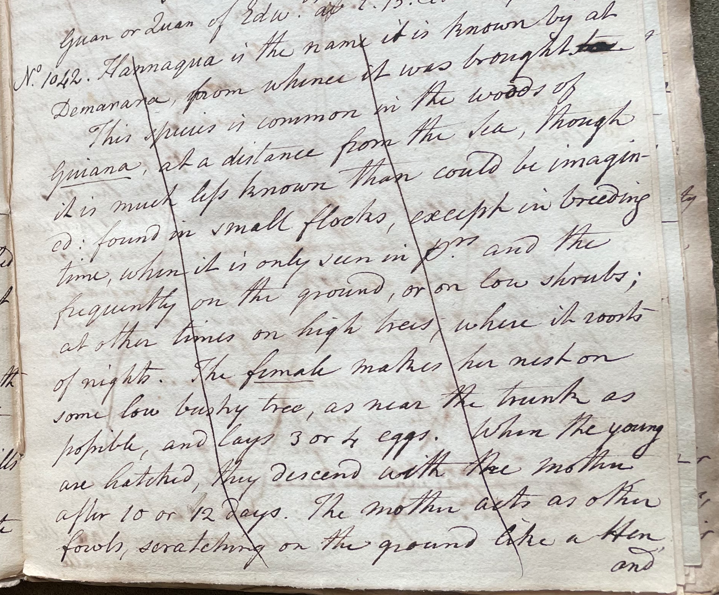
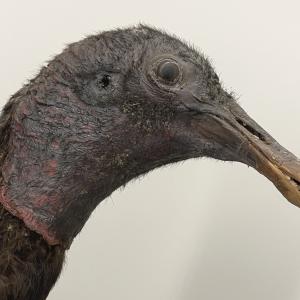
Charles Willson Peale (1741-1827) wrote, in his 28th Lecture (ca. 1799): "No. 1042. Hannaqua is the name it is known by at Demarara, from whence it was brought. This species is common in the woods of Guiana, at a distance from the sea, though it is much less known than could be imagined; found in small flocks, except in breeding time, when it is only seen in prs. and [then] frequently on the ground, or on low shrubs; at other times on high trees, where it roosts [at] night. The female makes her nest on some low brushy tree, as near the trunk as possible, and lays 3 or 4 eggs. When the young are hatched, they descend with the mother after 10 or 12 days. The mother acts as other fowls, scratching on the ground like a Hen, and brooding the young, which quit their nurse the moment they can [shift] for themselves. They have 2 broods in a year; one in December or January, the other in May or June." (Academy of Natural Sciences of Drexel University Archives, coll. 40)
Peale continued: "The windpipe of this bird has a singular construction, passing along the neck to the entrance of the breast, where it rises on the outside of the flesh, and, after going a little way downwards, returns, and then passes into the cavity of the lungs. It is keept in its place on the outside by a muscular ligament, which is […] quite to the breast-bone. This is found to be the case in both male and female and plainly proves that it differs from a bird called the Yacon, which Mr. Buffon supposes to be the female of, which no such circumvolution of the windpipe in either sex. It is the Penelope Marail of Linn. Paraka of Cayane Buff. pl. enl. 338. Marail Turkey Lath. p. 694 722." (ANSP Archives, coll. 40)
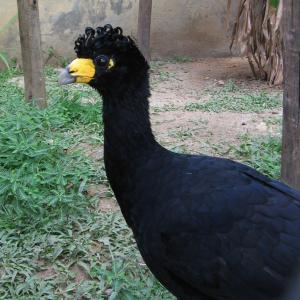
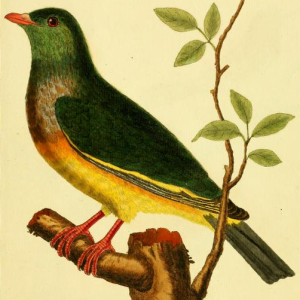
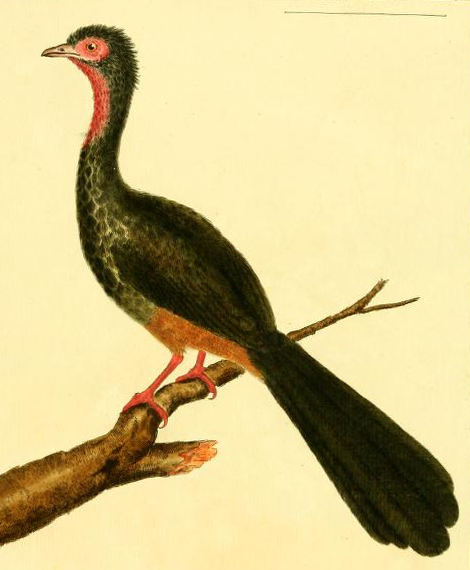
In a subsequent draft of this lecture, Peale wrote: "No. 1056.a. Parraka, commonly called Hannequaw. Size of a small fowl, and resembles it in bill, legs, and body; length about 23 Inches. Bill dark rufous; eyes brown; the general colour of the plumage is brown on the back; and lighter underneath; the top of the head is dark and the feathers somewhat long, but not so as to form a real crest; the wings are short; the tail consists of 12 feathers, is even at the end, and near a foot long, and generally carried pendant; feet dark; claws like those of a fowl. Phasianus Parraka Linn. Parraka Buffn. & Latham. It is pecular in its internal structure in respect to the windpipe; which, instead of entering directly the breast, as in most birds, passes over the side of the left clavicle, and on the out side of the fleshy part of the brest, being covered only with the skin, then taking a turn upwards, passes over the right clavicle into the breast, and is distributed through the lungs in the usual way. The female has not this circumvolution of the windpipe." (ANSP Archives, coll. 40)
Peale continued: "They are found in unfrequented woods fo the internal parts of Cayenne, Guiana, and many parts of South America. At sun-rise sets up a very loud cry, which is thought to be the loudest of all birds in the New World; at which time the eyes appear red, as does a small skin under the breast, which is not at all seen, except when the bird makes such exertions, or is angry. This cry is very like the word Parraqua; and is repeated many times together; and often many cry at once, or answer one another, but most in breeding-time, which is twice in the year; at each time laying 4 to 6 eggs; making the nest in low branches, or stumps of trees, and behaving with their chickens in the same manner as hens. They feed on grain, seeds, and herbs; but feed the young in the nest with worms and small insects. These, with many other birds, inhabit the woods by day, coming out into the green savannas morning and evening to feed, at which times they are chiefly killed by the natives and [other] inhabitants. They are brought up tame, and their flesh is much esteemed." [A footnote mentions that some of this information was sourced from Latham.] (ANSP Archives, coll. 40)
Peale wrote, in "A Walk Through the Philad[elphi]a Museum" (1805–1806): "Parraka inhabits the thicker Woods of South America. Its cry is like the word Parraka, and said to be loudest of all Birds of that country. They are remarkably familiar in the domesticated state." (Historical Society of Pennsylvania, coll. 0481)
Notes:
"Paraka" is a common German name for this species. Peale did not specify the origin of the specimen described in his lecture, but it seems likely to be Cayenne, French Guiana, a major South American trade center in the 18th century. In 1793, Raphaelle Peale (1774-1825) travelled to Cayenne to collect specimens for Peale's Museum. However, to the editor's (MRH) knowledge, there is no detailed inventory of the specimens he brought back, and there are many examples of specimens from northern South America that were donated by other people. For more discussion about Raphaelle's travels, see Lillian B. Miller, 1993, "Father and Son: The Relationship of Charles Willson Peale and Raphaelle Peale", The American Art Journal 25: 4-161. / https://doi.org/10.2307/1594599
Specimen Type:
Dead/preserved
Current Common Name:
Little Chachalaca
Current Scientific Name
Cracidae | Ortalis motmot