Object Status:
Extant
Accession Date:
By 1799
Primary Source Reference:
Charles Willson Peale, Lecture on Natural History 34. (ca. 1799). Academy of Natural Sciences of Drexel University Archives, coll. 40. / https://ansp.org/research/library/archives/0000-0099/coll0040/
Additional Source Text:
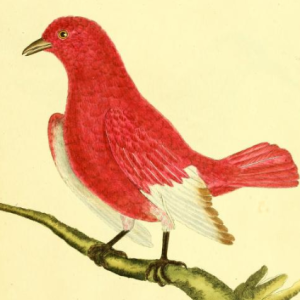
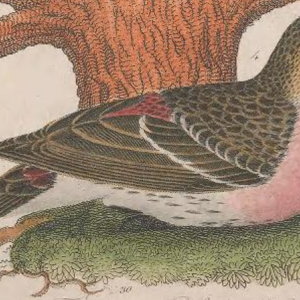
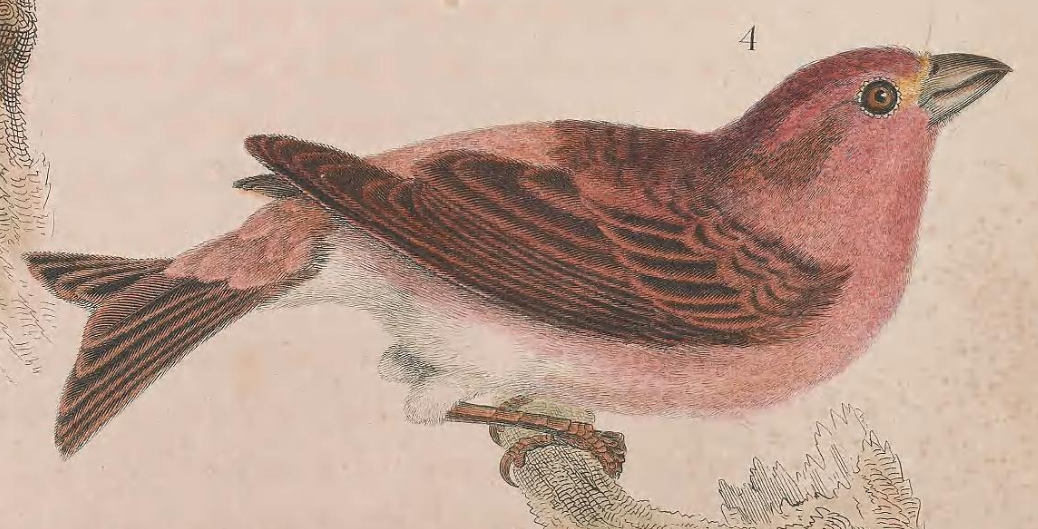
Charles Willson Peale (1741-1827) wrote, in his 34th Lecture (ca. 1799): "No. 1583. Purple finch. the head, breast & lower part of the back a redish purple; back, wings [brown], the feathers edged with purple. Wing quils & tail dark brown edged with faint red—near the tail below dingy white. Fringilla purpurea Linn. Purple Finch Latham & Pennant. No. 1584. Female is brown, striped with black & sallow edges on the back, breast striped with brown & white. Catesby says when they first appear in Carolina (which is usially in November) they feed on the Berries of Juniper, and in February they destroy the swelling buds of fruit trees." (Academy of Natural Sciences of Drexel University Archives, coll. 40)
Peale continued: "They assemble in small flights, and retire at the approach of winter. There is something contradictory in this account. Does the winter commence after February in Carolina? I should rather suppose that if they destroy the young buds in February and had first visited there in November, that of course they must winter in Carolina. They are a rare bird in Pennsylvania. I never met with them, but twice; about 10 years past I found one in the market, and in the month [sic] of 1800 considerable flocks were found in the vicinity of this City. Their bills are considerably thick, rather more so than we usially find in sparrows." (ANSP Archives, coll. 40)
Peale wrote, in "A Walk Through the Philad[elphi]a Museum" (1805–1806): "Purple-finch (F. Purpurea) since this Museum had a beginning, we have meet with them but twice – in 1800 large flights of them came within the destrect of Philadelphia. Catesby says, when they first appear in Carolina (which is usually in Nov) they feed on the berries of Juniper; and in February they destroy the swelling buds of fruit Trees — They assemble in small flights, and retire at the approach of winter. / here is something contradictory in this Account. Does the winter commence after February in Carolina? we should rather suppose, that they destroy the young buds in february and had first visited them in November then of course they must winter in Carolina. / Their Bills are considerably thick; rather more so than common Sparrows." (Historical Society of Pennsylvania, coll. 0481)Alexander Wilson (1766-1813) described this species under the name "Purple Finch / Fringilla purpurea" in American Ornithology vol. 1 (Pl. 7), where "Peale's Museum No. 6504" was cited (Wilson 1808: 119). / https://www.biodiversitylibrary.org/item/175530#page/145/mode/1up (text) / https://www.biodiversitylibrary.org/item/175530#page/132/mode/1up (plate)
Wilson (1812) also described the species under the same name in American Ornithology vol. 5 (Pl. 42), this time without a Peale Museum citation. / https://www.biodiversitylibrary.org/item/175520#page/103/mode/1up (text) / https://www.biodiversitylibrary.org/item/175520#page/98/mode/1up (plate)
Two mounted female specimens of "Fringilla purpurea (Purple F.)" were listed in "A Catalogue of Duplicate Specimens...", May 1822. [unpublished] American Philosophical Society Library (Mss.B.P31).
Specimen Type:
Dead/preserved
Current Common Name:
Purple Finch
Current Scientific Name
Fringillidae | Haemorhous purpureus