Object Status:
Extant
Accession Date:
By 1799
Primary Source Reference:
Charles Willson Peale, Lecture on Natural History 24. (ca. 1799). Academy of Natural Sciences of Drexel University Archives, coll. 40. / https://ansp.org/research/library/archives/0000-0099/coll0040/
Additional Source Text:
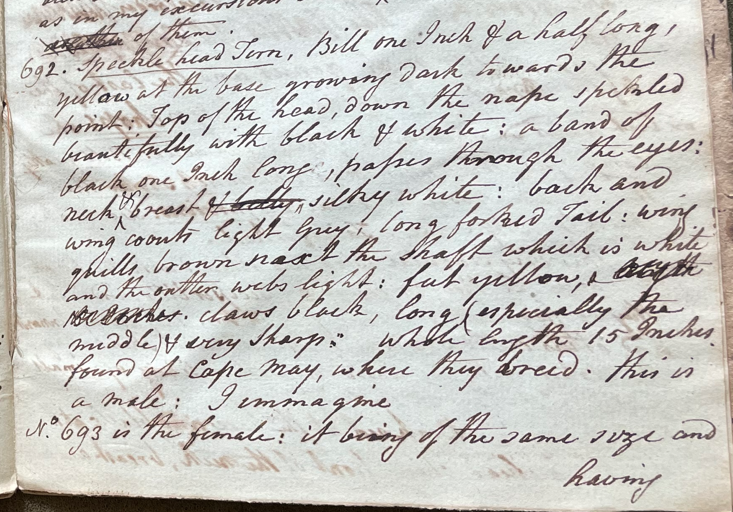
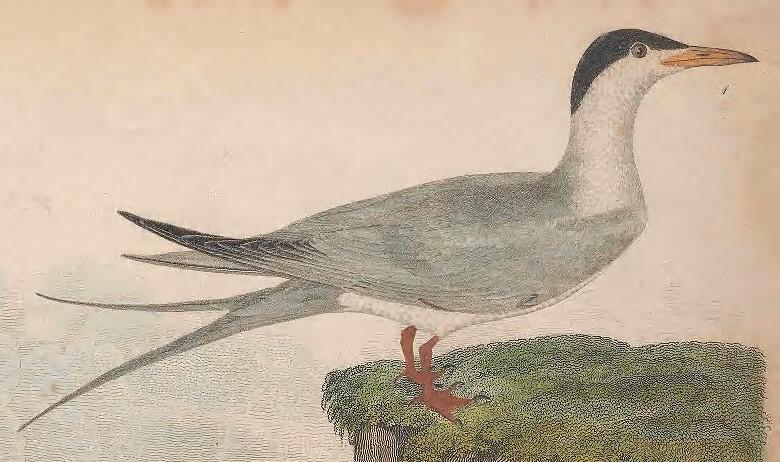
Charles Willson Peale (1741-1827) wrote, in his 24th Lecture (ca. 1799): "No. 692. Speckle head Tern. Bill one Inch & a half long, yellow at the base, growing dark towards the point. Top of the head, down the nape speckled beautifully with black & white; a band of black one Inch long, passes through the eyes; neck & breast & belly, silky white; back and wing coverts light grey; long forked Tail; wing quills brown next the shaft which is white, and the outer wens light; feet yellow; claws black, long (especially the middle) & very sharp; whole length 15 Inches; found at Cape May, where they breed. this is a male. I imagine No. 693 is the female; it being of the same size and having a dark line passing through the eyes; the Head, back, and wing a light grey; neck & breast & belly white; the forks of the tail not quite so long as the preceeding."
Alexander Wilson (1766-1813) described this species under the name "Great Tern / Sterna hirundo" in American Ornithology vol. 7 (Pl. 60), where "Peale's Museum, No. 3485" was cited (Wilson 1813: 76). / https://www.biodiversitylibrary.org/item/175507#page/90/mode/1up (text) / https://www.biodiversitylibrary.org/item/175507#page/73/mode/1up (plate)
Two unmounted specimens of "Sterna hirundo (Great Tern)" from Florida were listed in "A Catalogue of Duplicate Specimens...", May 1822. [unpublished] American Philosophical Society Library (Mss.B.P31).
Thomas Nuttall (1786-1859) cited "Phil. Museum, No. 3485" when he distinguished the American species from the Common Tern Sterna hirundo, giving it the name "Great Tern ... Sterna forsteri" in 1834, A manual of the ornithology of the United States and of Canada, vol. 2, p. 274. / https://www.biodiversitylibrary.org/item/28918#page/292/mode/1up
Notes:
Witmer Stone (1866-1939) was evidently unaware of the extent of Peale's collection and his collecting effots at Cape May and Delaware, in the late 18th century, when preparing his classic work, Bird studies at Old Cape May, Philadelphia: Delaware Valley Ornithological Club). In his second volume, Stone (1937: 578) considered it "remarkable [that] it bred, for a time at least, on the Virginia shore and possibly in southern New Jersey." That assumption was based on several 19th century specimens that were collected on the New Jersey coast, in May and June (i.e., the breeding season), which are now preserved in the Academy of Natural Sciences of Drexel University (ANSP) in Philadelphia. Peale's lecture (ca. 1799) evidently contains the only 18th century record from Cape May county: "...found at Cape May, where they breed."
Specimen Type:
Dead/preserved
Current Common Name:
Forster's Tern
Current Scientific Name
Laridae | Sterna forsteri