Object Status:
Extant
Accession Date:
By 1805
Primary Source Reference:
Charles Willson Peale, Lecture on Natural History 22. (ca. 1799). Academy of Natural Sciences of Drexel University Archives, coll. 40. / https://ansp.org/research/library/archives/0000-0099/coll0040/
Additional Source Text:
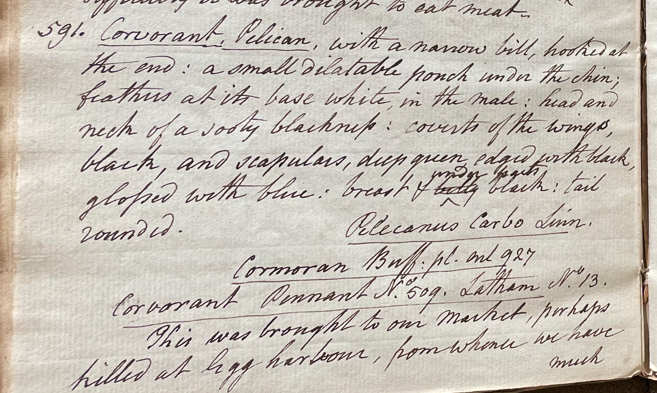
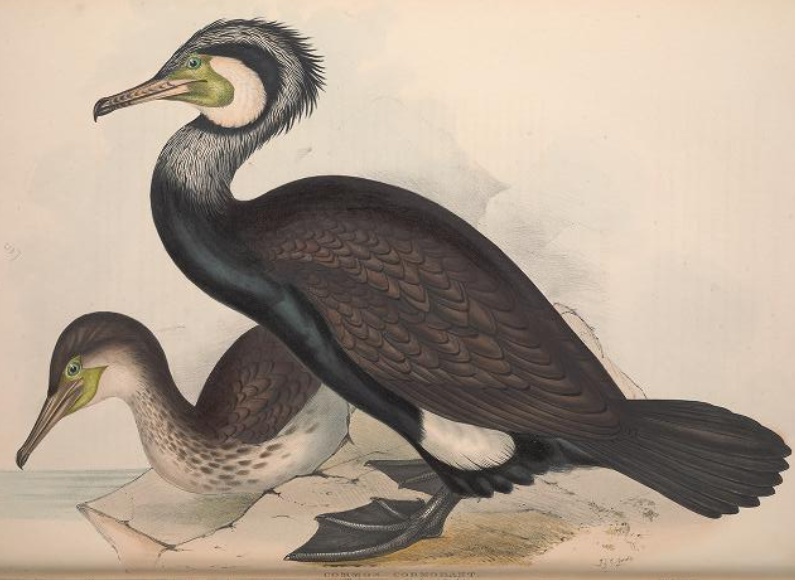
Charles Willson Peale (1741-1827) wrote, in his 22nd Lecture (ca. 1799): “591. Corvorant [sic] Pelican, with a narrow bill, hooked at the end; a small dilatable pouch under the chin; feathers at its base white, in the male; head and neck of a sooty blackness; coverts of the wings, black, and scapulars, deep green, edged with black, glossed with blue; breast & belly under parts black; tail rounded. Pelecanus carbo Linn. Cormoran Buff. pl. enl. 927. Corvorant Pennant No. 509. Latham No. 13." (Academy of Natural Sciences of Drexel University Archives, coll. 40)
Peale continued: "This [specimen] was brought to our market, perhaps killed at Egg Harbour, from whence we have much of our wild game. Extends over all parts of the northern hemisphere, even to Greenland, where it continues all the year. The natives use the Jugular pouch as a bladder to float their darts after they are slung. The skins are used in cloathing; the flesh is eaten; but the Eggs are so fetid as to be rejected, even by the very Greenlanders. These birds are taken either by darts on the water; by snares dropt down the precipices, and placed before their haunts; or, in winter, they are taken while asleep upon the Ice. Are found in all the temperate latitudes of the Russian empire, and immense numbers on the shores of the Caspian sea. Reach even to Kamtschatka." (ANSP Archives, coll. 40)
Peale continued: "Pennant says he believes this to be the kind which the Chinese train for fishing. They keep numbers, which sit on the edge of their boats; and, on a signal given, plunge under water, and bring up their prey, which they are unable to swallow, by reason of a ring placed by their masters round their necks. 592. I take this to be the female because it has not light feathers joining the pouch, which Mr. Pennant describes as a character of the male. The breast, and underparts of this lighter and is striped. If not of a different sex, it is at least a variety, and therefore it has a place in the museum. It was also obtained in our Market." (ANSP Archives, coll. 40)
Peale wrote, in "A Walk Through the Philad[elphi]a Museum" (1805–1806): "The Cormorant (P. Carbo) also is a voracious bird, and by a management of his appetite, men have contrived to make them serviceable in catching fish, especially practiced in China, hunger gives them activity, they become dull and lasey when their craving appetite is satisfied, to make them fish, a ring is put round their neck to prevent them swallowing, so that they are obliged to bring the fish in their bill to their Master, and it is only when they have caught a sufficiency that they are allowed to fish for themselves, they can remain a long time under water and as they move with the velosity of an arrow they almost always rise with a fish across their beak, which they throw up in the air and catch it head foremost, so that the fins does not obstruct it going dow their throat, which is very large considering the size of their neck." (Historical Society of Pennsylvania, coll. 0481)
An unmounted male specimen of "Pelicanus carbo (Cormorant)" from Florida was listed in "A Catalogue of Duplicate Specimens...", May 1822. [unpublished] American Philosophical Society Library (Mss.B.P31).
Notes:
Peale’s description is a better match to Double-crested Cormorants (P. auritus) than Great Cormorant (P. carbo), although both occur in eastern North American and there is no evidence that he distinguished them.
Specimen Type:
Dead/preserved
Current Common Name:
Double-crested Cormorant
Current Scientific Name
Phalacrocoracidae | Phalacrocorax auritus