Object Status:
Extant
Accession Date:
By 1799
Primary Source Reference:
Charles Willson Peale, Lecture on Natural History 30. (ca. 1799). Academy of Natural Sciences of Drexel University Archives, coll. 40. / https://ansp.org/research/library/archives/0000-0099/coll0040/
Additional Source Text:
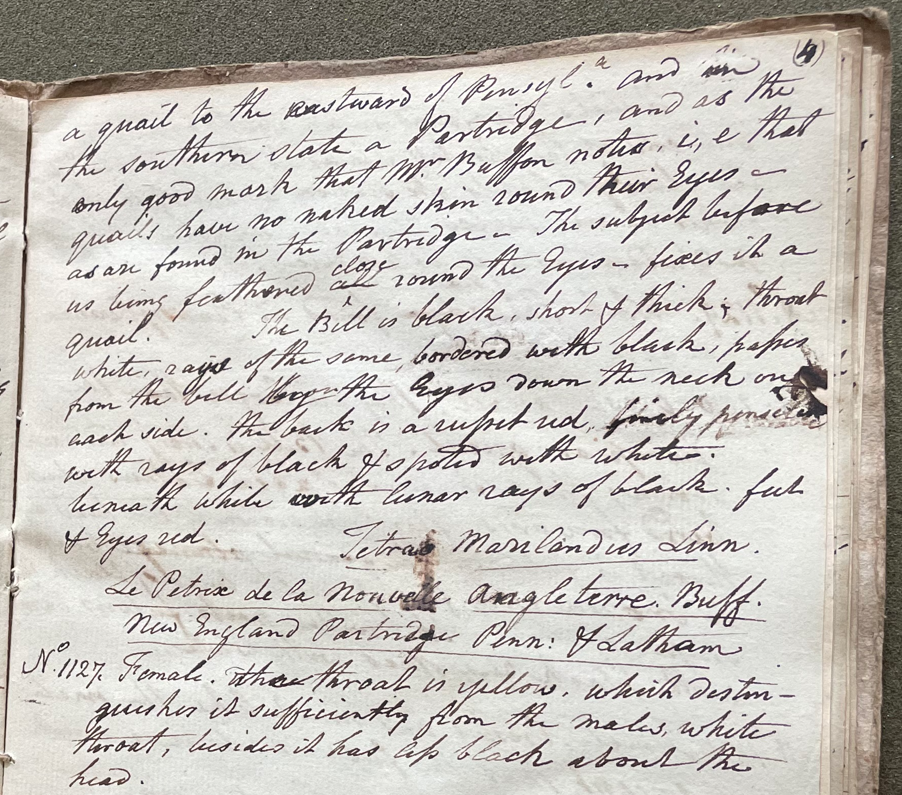
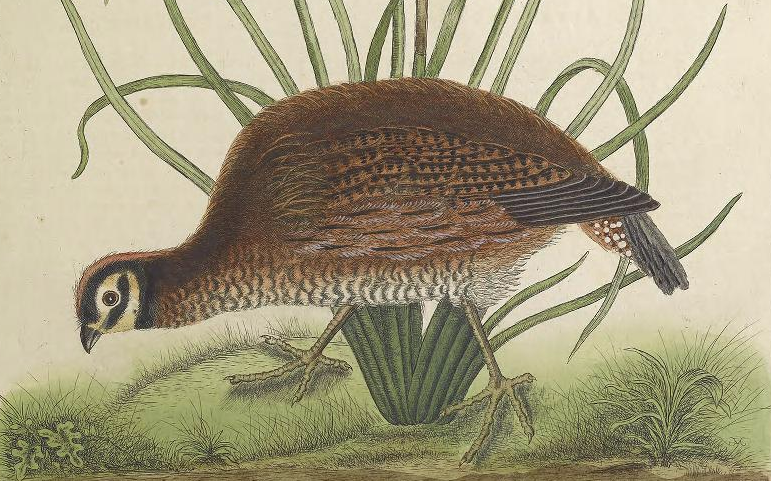
Charles Willson Peale (1741-1827) wrote, in his 30th Lecture (ca. 1799): "No. 1126. American Quail. The distinction between partridges and quail are very trifling, therefore Linnaeus has not separated them. Buffon attempts to show some distinctions, which do not all agree in the same bird. The bird before us is called a quail to the eastward of [Pennsylvania], and in the southern states a Partridge, and as the only good mark that Mr. Buffon notes, i.e., that quails have no naked skin round their eyes, as are found in the partridge, the subject before us being feathered close round the eyes, fixes it [as] a quail. The bill is black, short & thick; throat white; rays of the same, bordered with black, passes from the bill [over] the eyes, down the neck on each side. The beak is a russet red, finely penciled with rays of black & spotted with white; beneath white with lunar rays of black; feet & eyes red. Tetrao marilandus Linn. Le Perdix de la Nouvelle Angleterre. Buff. New England Partridge Penn. & Latham." (Academy of Natural Sciences of Drexel University Archives, coll. 40)
Peale continued: "No. 1127. Female. the throat is yellow, which distinguishes it sufficiently from the males' white throat; besides it has less black about the head. No. 1128 is a variety, very rare; black throat and forepart of the head; a deeper red on the back of the head and lower part of the neck; the body above and below beautifully speckled with red, black & white; feet pale. It was found in Maryland. Quails are found in an abundance from one end of the United States to the other, and always holds its station as one of the best dishes on our tables. Kalm says they are found in Sweden as well as America. No. 1129. White Partridge Quail, found in Pennsylvania, a rare bird." (ANSP Archives, coll. 40)
Peale wrote to Samuel L. Mitchill (1764-1831) on 26 July 1803: "The character which Mr. Buffon makes, of the nakedness around the Eyes of the Partridge is certainly very striking, therefore ours is not a Partridge, but is a Quail" (Miller 1988: 586, Selected Papers, Vol. 2, part 1, Yale University Press).
Peale wrote, in "A Walk Through the Philad[elphi]a Museum" (1805–1806): "Quails have no spurs — their orbits (?) are covered with feathers. [Here is an] American quail (T. Marylandus) they are common throughout the United States. In some states are called Partridges. The throat of the male is white & that of the female is yellow. here is one found in Maryland with a black throat; the plumage throughout darker than the common quail. The white one is an accidental variety." (Historical Society of Pennsylvania, coll. 0481)
An anonymous donation of a "White Quail from Anapolis" (presumably leucistic) on 10 December 1806 was recorded in the Peale Museum Accessions Book (HSP, coll. 0481).
Two mounted specimens (male, female) of "Tetrao virginianus (Amn P.)" were listed in "A Catalogue of Duplicate Specimens...", May 1822. [unpublished] American Philosophical Society Library (Mss.B.P31).
An undated list of 21 bird specimens in Peale's handwriting includes an unidentified "Quail F[emale]" (American Philosophical Society Library, Mss.B.P31).
Notes:
This species also appeared under the name “Quail, or Partridge / Tetrao virginianus” in American Ornithology vol. 6, but Peale’s Museum was not cited in that account (Wilson 1812, Pl. 47).
Specimen Type:
Dead/preserved
Current Common Name:
Bobwhite Quail
Current Scientific Name
Phasianidae | Colinus virginianus