Object Status:
Extant
Accession Date:
By 12 October 1792
Primary Source Reference:
Charles Willson Peale, letter to Thomas Hall of Moorfields, London, dated 12 October 1792; Selected Papers, 2, part 1: 42.
Additional Source Text:
Charles Willson Peale (1741-1827) sent a "Flicker or Yellow hammer" in a shipment of specimens to Thomas Hall in London on 12 October 1792, in exchange for European specimens (Miller 1988: 42, Selected Papers, Vol. 2, part 1, Yale University Press).
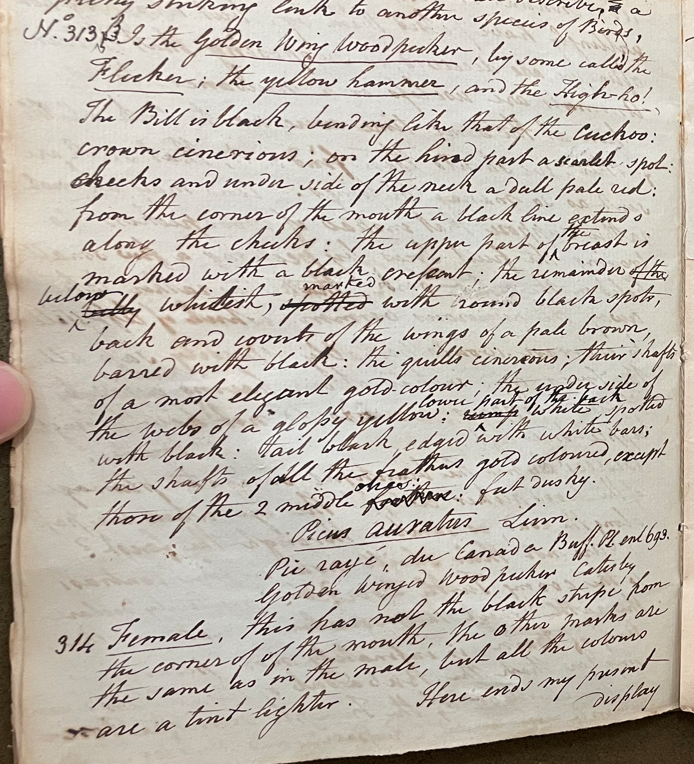
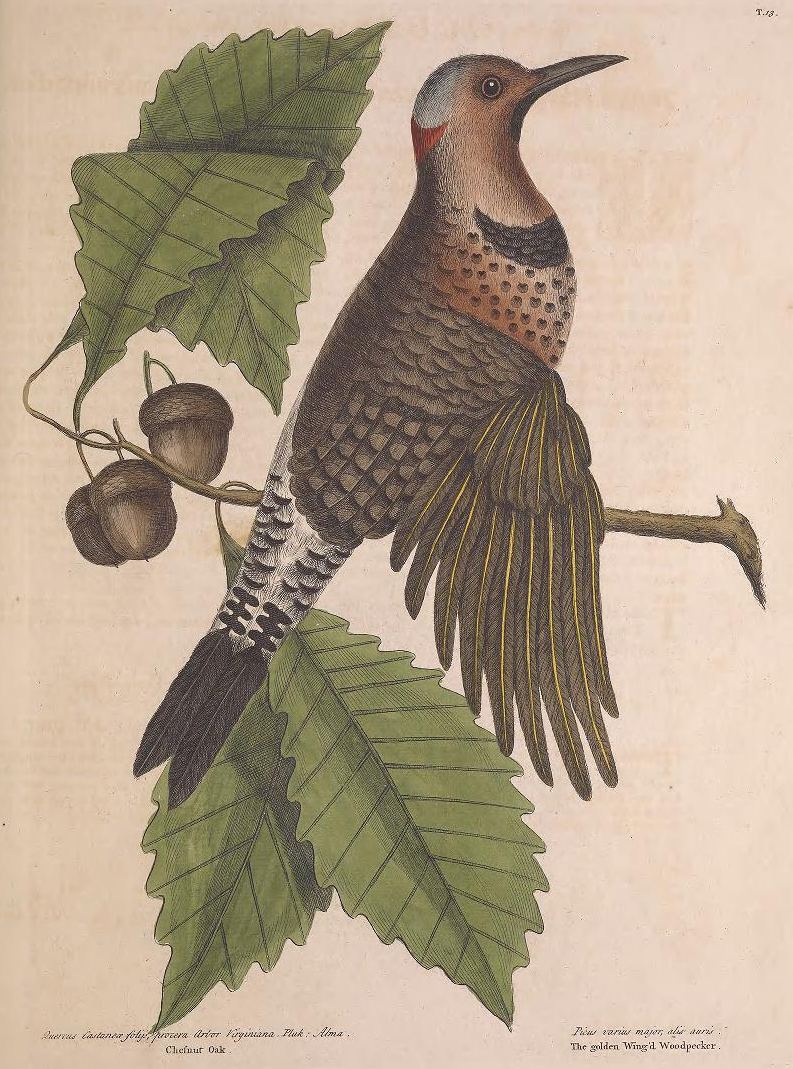
In his 19th Lecture, Peale wrote: "No. 313. Is the Golden Wing Woodpecker, by some called the Flicker; the Yellow hammer, and the High-ho! The Bill is black, bending like that of the cuckoo; crown cinerious; on the hind part a scarlet spot; cheeks and under side of the neck a dull pale red; from the corner of the mouth a black line extends along the cheeks; the upper part of the breast is marked with a b;acl crescent; the remainder of the belly below whitish, spotted marked with round black spots; back & coverts of the wings of a pale brown, barred with black; the quills cinereous; their shafts of a most elegant gold-colour; the underside of the webs of a glossy yellow; lower part of the back white, spotted with black; tail black, edged with white bars; the shafts of all the feathers gold coloured, except those of the 2 middle ones; feet dusky. Picus auratus Linn. Pic rayé, due Canada Buff. pl. enl. 693. Golden Winged Woodpecker Catesby." (Academy of Natural Sciences of Drexel University Archives, coll. 40)
Peale continued: "314. Female, this has not the black stripe from the corner of the mouth. The other marks are the same as in the male, but all the colours are a tint lighter." In a footnote, Peale added: "Besides the bill being more curved than the common character of woodpeckers, its stomack is constructed to receive and be nourished with grain. I have examined many and have generally found within them seeds, as well as worms. They have none of that strong smell so distinguishable in this genus of Birds. They are esteemed good Eating, which is not the case in other woodpeckers." (ANSP Archives, coll. 40)
Peale wrote, in "A Walk Through the Philad[elphi]a Museum" (1805–1806): "The Golden Winged Woodpecker (P. Auratus) often Called Yellow hammer or flicker is the only one of the tribe which will eat grain as well as worms, also that which is considered fit to be eaten. They are found throughout the United States." (Historical Society of Pennsylvania, coll. 0481)
An undated list of 21 bird specimens in Peale's handwriting includes a "Flicker Male" and "D[itt]o Female" (American Philosophical Society Library, Mss.B.P31).
Alexander Wilson (1766-1813) described this species under the name "Gold-winged Woodpecker / Picus auratus" in American Ornithology vol. 1 (Pl. 3), where "Peale's Museum No. 1938" was cited (Wilson 1808: 45). / https://www.biodiversitylibrary.org/item/175530#page/63/mode/1up (text) / https://www.biodiversitylibrary.org/item/175530#page/62/mode/1up (plate)
Specimen Type:
Dead/preserved
Current Common Name:
Northern Flicker
Current Scientific Name
Picidae | Colaptes auratus