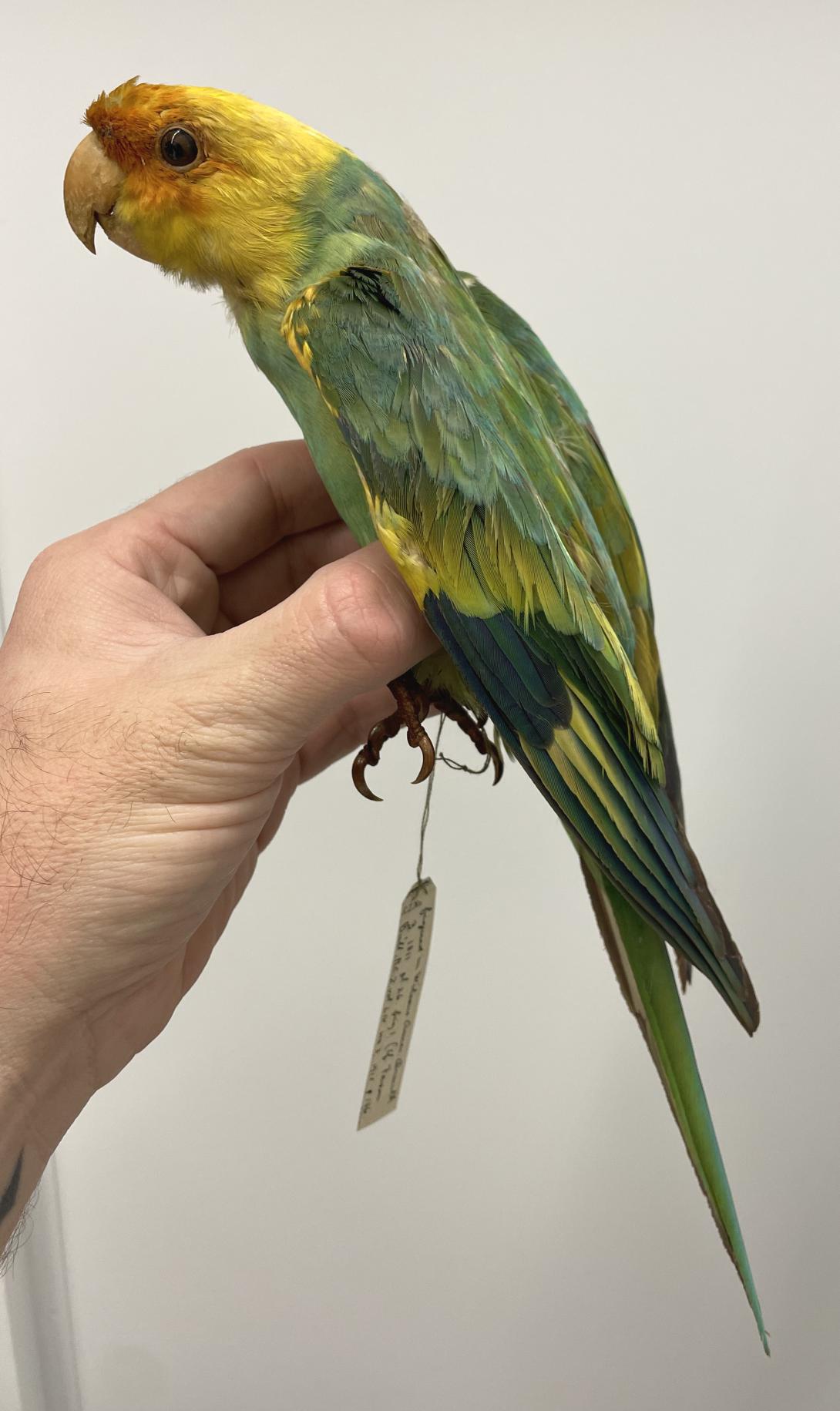
Object Status:
Unlocated
Accession Date:
By 1792
Primary Source Reference:
Charles Willson Peale, broadside, 1792 (see Miller 1988: 16, Selected Papers, Vol. 2, part 1, Yale University Press
Additional Source Text:
In a 1792 broadside, Charles Willson Peale (1741-1827) wrote of this species: "I have not yet been able to procure any specimens of the paroquets which are in our western country, and whether they are like those obtained in the southern parts of America, I do not know" (Miller 1988: 16, Selected Papers, Vol. 2, part 1, Yale University Press).
Peale wrote, in his 15th Lecture (ca. 1799): "[No.] 123. Carolina Parrot. Size about 13 inches long. Bill yellowish white; both that and the eyes surrounded with a naked, pale, ash coloured skin. Iris yellow; forehead of the heard orange; back part of the head, nape, and throat, yellow; body green; thighs the same, but those near the joint orange; edge of the wing orange; wing coverts above and the lesser coverts beneath green; the greater [coverts] brown; quills brown on the inside, yellow on the outside at the base, then green, with the tips inclining to blue and green; legs and claws brassy. Psittacus [carolinensis] La Perruche de la Carolina Buff. pl. enl. [499]. This [species] is found in Carolina, Virginia, and in Louisiana. It is fond of the seed of Cyprus. It eats fruit to get at the seed, and consequently are very destructive in orchards. They are also to be found in flocks in the back parts of Pennsylvania during the summer season. Catesby says some few of them breed in Carolina, but most of them retire farther south. Their entrails he says are certain and speedy poison to […]." (Academy of Natural Sciences of Drexel University Archives, coll. 40)
Peale wrote, in "A Walk Through the Philad[elphi]a Museum" (1805–1806): "We have but one specie of Parrot belong to North America—This is that small Parrot with the Aurora coloured head named the Carolina Parrot. It sometimes breed in that country, but most of them go further south, They migrate to the Western Countries of Pennsylvania." (Historical Society of Pennsylvania, coll. 0481)
Alexander Wilson (1766-1813) described this species under the name "Carolina Parrot / Psittacus carolinensis" in American Ornithology vol. 3 (Pl. 26). Wilson (1811: 89) cited "Peale's Museum, No. 762" and subsequently wrote that "a number of these birds, in all their grades of progressive change from green to yellow, have been deposited in Mr. Peale's museum" (Wilson 1811: 98–99). / https://www.biodiversitylibrary.org/item/175516#page/109/mode/1up (text) / https://www.biodiversitylibrary.org/item/175516#page/108/mode/1up (plate)
Two unmounted male specimens of "Psittacus carolinensis (Carolina Parrot)" from Florida were listed in "A Catalogue of Duplicate Specimens...", May 1822. [unpublished] American Philosophical Society Library (Mss.B.P31).
Notes:
After Peale's Museum closed, a portion of Peale's bird collection was purchased in 1850 by Moses Kimball (1809–95), who displayed it at his "Boston Museum". An advertisement in the Boston Transcript, printed 1 October 1850, stated that Kimball had acquired "One Half of the celebrated Peale's Philadelphia Museum". The other half of Peale's birds had been sold to the circus promoter P. T. Barnum (1810–91) and would be subsequently destroyed in a fire at his "American Museum" in New York City in July 1865. When the Boston Museum closed, Kimball's Peale remnants passed temporarily to the Boston Society of Natural History, who disposed of them to Charles J. Maynard (1845-1929), a local taxidermist. The specimens were stored in a barn in Massachusetts for several years, then eventually were deposited at the Museum of Comparative Zoology (MCZ), Harvard University. By the time the collection was catalogued by Walter Faxon (1848-1920) at MCZ, in 1914, in virtually every case the original mounts and labels had been disassociated from the specimens, and an untold number were lost. Walter Faxon, "Relics of Peale's Museum," Bulletin of the Museum of Comparative Zoology, 59, no. 3 (July 1915): 128, speculated that MCZ 67853, a data-deficient specimen from the Boston Museum collection (shown here), was the "Original of Wilson’s figure." Faxon's claim may be true, but the pose of the bird is not identical to the bird in Wilson's plate, and Peale evidently had specimens of this species in his collection by 1792. In an exhibit at MCZ, which the editor (MRH) visited in November 2023, the following information was displayed below an original print of Wilson's plate: "Wilson's parrot Poll (a Carolina Parakeet), his faithful companion, was used as the model for the parrot seen here and is now specimen [MCZ 67853]". The same claim was repeated by Nancy Pick, 2004, The Rarest of the Rare: The Stories Behind the Harvard Museum of Natural History (Harper). However, this cannot be true because the body of Poll was not preserved, according to Wilson (1811: 97): "...poor Poll, having one morning about daybreak wrought her way through the cage, while I was asleep, instantly flew overboard, and perished in the Gulf of Mexico." / https://www.biodiversitylibrary.org/item/175516#page/117/mode/1up Furthermore, Wilson (1811: 91) kept multiple individuals of this species in captivity, as he acknowledged: "To a Parakeet which I wounded and kept for some considerable time I very often offered apples, which it uniformly rejected; but burrs, or beech nuts, never. To another very beautiful one which I brought from New Orleans, and which is now sitting in the room beside me [in Philadelphia], I have frequently offered this fruit, and also the seeds separately, which I never knew it to taste." According to transcripts of a lost diary, he also "parted, with great regret, with [another] parakeet, [having given it] to the gentlemen of the tavern [in Louisville]" (George Ord, Supplement to the American ornithology of Alexander Wilson, 1825: clix). To the editor's (MRH) knowledge, there are no sources that specify which (if any) of the specimens that Wilson said "have been deposited in Mr. Peale's museum" were deposited by himself. Therefore, although MCZ 67853 may have been mounted in Peale's Museum, there is no evidence that it was Wilson's pet, nor the model for his plate.
Specimen Type:
Dead/preserved
Current Common Name:
Carolina Parakeet
Current Scientific Name
Psittacidae | Conuropsis carolinensis
Repository:
Museum of Comparative Zoology, Harvard University (MCZ 67853)