Object Status:
Unlocated
Accession Date:
By 4 September 1793
Primary Source Reference:
Charles Willson Peale, diary entry dated 30 August 1793. American Philosophical Society Library, Peale-Sellers Family Collection (Mss.B.P31).
Additional Source Text:
Charles Willson Peale (1741-1827) wrote in his diary on 30 August 1793, during a collecting expedition to Cape Henlopen, Delaware: "... at Breakfast [Titian] brought me 3 black bets, a bird with black wings head, and down the back of their necks the other parts white, and having extreme long legs quite naked, a curious looking bird, the dressing of those birds, and some others Titian shot after breakfast kept [us] busily employed until after night set in" (Miller 1988: 57, Selected Papers, Vol. 2, part 1, Yale University Press).
On 25 January 1794, a notice in Dunlap's American Daily Advertiser mentioned Peale's acquisition of "The Long-Legs, commonly called the Black-bet, having perhaps the longest legs, in proportion to the size of the bird, of any of the feathered tribe."
On 30 April 1797, Peale sent a "Black bet, or long legs" to Étienne Geoffrey Saint-Hilaire (1772-1844) in Paris (Miller 1988: 198), with the following note: "Black-bet the common name here, is not full feathered but as I cannot visit the sea shore soon. I preferred sending it such as it is—however another variety of it and the Avositta with some other waders may form a future package" (Miller 1988: 199).
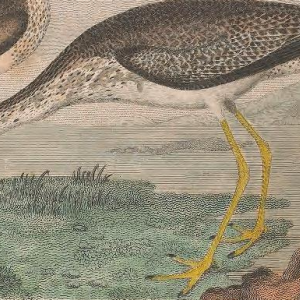
Peale wrote, in his 36th Lecture (ca. 1799): "923. Long legged Plover. Buffon says, "this is among birds what the Jerboa is among the Quadrupeds: its legs, which are thrice as long as the body, present a monstrous disproportion. Such extravagant and random productions of Nature exhibit the traces of her magnificent and boundless plan; and, like shades in a picture, they heighten by their contrast the beauty of the scene. The enormous length of this bird's legs will hardly allow it to reach the earth with its bill to gather its food; they are also slender, weak, and tottering; and its 3 toes are disproportionatelly small, and give a base too narrow for its tall body. Hence the names of this bird in the Ancient and modern languages refer to the softness and pliancy of its legs, and to their extreme length." (Academy of Natural Sciences of Drexel University Archives, coll. 40) Peale continued: "I subscribe to Mr. Buffon's comparison of it to the Jerboa on account of the length of their legs. And that it is one of the productions of Nature, which exhibit traces of her magnificent and boundless plan, that heighten by contrast the beauty of the scene; but that it is a random production, or presents the appearance of monstrous disproportion, is not concordant to the Ideas of Infinite Wisdom, excited by a survey of those works to which our capacities are adequate; whose fitness of parts and wonderful provision, flash the conviction of perfection on the most inattentive observer." (ANSP Archives, coll. 40) Peale continued: "Whether large, small, tall or slender; whether short or thick, with long or short legs, or no legs at all; whether crawling on the ground, flitting thro' the air, swimming in the waters or floating on the surface; whether their lives extend to a century, a year or half an hour; in all these varieties of Animals, by the little we are able to judge of their feelings, they are as perfect and as happy in their respective situations as Man. When we see Animals that live months without food, without requiring it; when we know that some can support life, for a great length of time even enclosed in glass or stone; when we consider that some are nourished by that which is poison to others; in fine the further we extend our observations, the more we must be convinced of the Folly to find fault with works which we want Wisdom to comprehend." (ANSP Archives, coll. 40)
Peale continued: "Buffon says, 'we are little acquainted with the habits of this bird, whose species is scanty and rare.' He might well say so, as he describes it having a slow and laborious pace, when in fact, it runs fast, and is very active in picking up its food, which it is enabled to do with a neck fully proportioned to the length of its legs. They usually resort in marshes and their shallow ponds, and feed on worms; their long legs perfectly fit them to wade in such places. The front of the head is white, and extends along the forepart of the neck & breast; the top of the head in black extending in a line on the back of the neck joining the glossy black & wings; it has a white spot over each eye; the tail is light gray; the feet & legs are red. Charadrius Himantopus Linn. Le […] Buff. 924. Female. the back is not so black as the male, but inclining to brown. These birds at Cape Henlopen are called black-bets, and on the opposite shore, Cape May, Lawyers. The singularity of the latter, excited my enquiry. Thus explained, that they made a neat bustle and chattering noise, like Lawyers." (ANSP Archives, coll. 40)
Peale wrote, in "A Walk Through the Philad[elphi]a Museum" (1805–1806): "…the Long legged Pluver (C. Himantopus) is the most curious. Buffon says, 'This is among birds what the Jerboa is among Quadrupeds. (See the Lecture No. 26.). These birds at Cape Henlopen are called black bets, and on the opposite shore, Cape may Lawyers. the latter, thus explained: they make a great bustle and Chattering noise, like Lawyers." (Historical Society of Pennsylvania, coll. 0481)
An undated list of 21 bird specimens in Peale's handwriting includes one "Black-bet or long-legs" (American Philosophical Society Library, Mss.B.P31).
Alexander Wilson (1766-1813) described this species under the name "Long-legged Avocet / Recurvirostra himantopus" in American Ornithology vol. 7 (Pl. 58), where "Peale's Museum, No. 4210" was cited (Wilson 1813: 48). / https://www.biodiversitylibrary.org/item/175507#page/60/mode/1up (text) / https://www.biodiversitylibrary.org/item/175507#page/56/mode/1up (plate)
An unmounted specimen of "Recurvirostra himantopus (Long Leg'd Avocet)" was listed in "A Catalogue of Duplicate Specimens...", May 1822. [unpublished] American Philosophical Society Library (Mss.B.P31).
Notes:
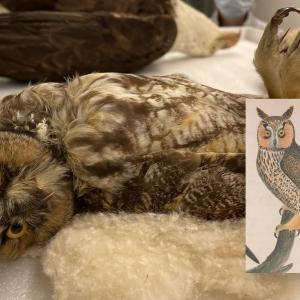
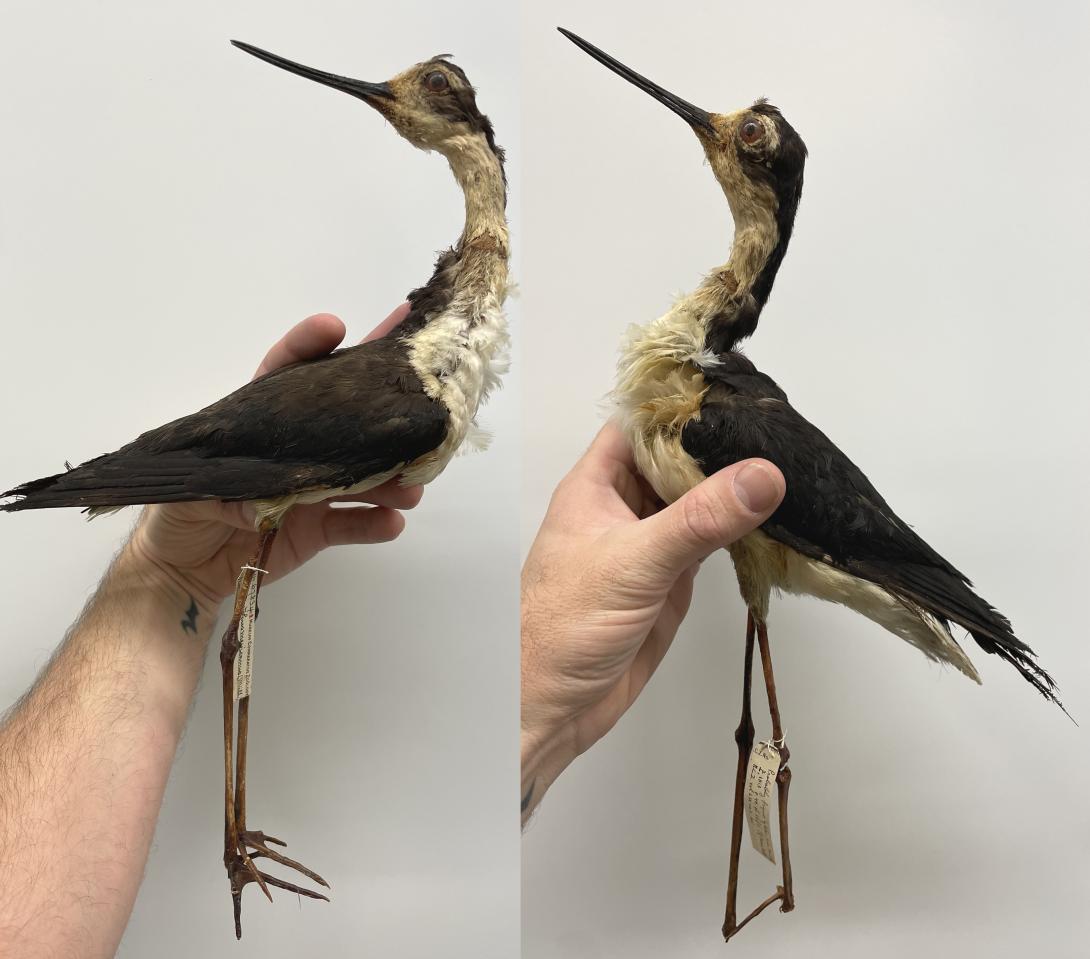
After Peale's Museum closed, a portion of Peale's bird collection was purchased in 1850 by Moses Kimball (1809–95), who displayed it at his "Boston Museum". An advertisement in the Boston Transcript, printed 1 October 1850, stated that Kimball had acquired "One Half of the celebrated Peale's Philadelphia Museum". The other half of Peale's birds had been sold to the circus promoter P. T. Barnum (1810–91) and would be subsequently destroyed in a fire at his "American Museum" in New York City in July 1865. When the Boston Museum closed, Kimball's Peale remnants passed temporarily to the Boston Society of Natural History, who disposed of them to Charles J. Maynard (1845-1929), a local taxidermist. The specimens were stored in a barn in Massachusetts for several years, then eventually were deposited at the Museum of Comparative Zoology (MCZ), Harvard University. By the time the collection was catalogued by Walter Faxon (1848-1920) at MCZ, in 1914, in virtually every case the original mounts and labels had been disassociated from the specimens, and an untold number were lost. Walter Faxon, "Relics of Peale's Museum," Bulletin of the Museum of Comparative Zoology, 59, no. 3 (July 1915): 132, speculated that MCZ 67833 and 67834, two data-deficient specimens from the Boston Museum collection (shown here), were collected by Wilson in Cape May, New Jersey: "One of them [MCZ 67833] is probably the specimen drawn by Wilson." This may be true, but Peale had specimens of this species in his collection as early as 1793, and neither specimen matches the pose seen in Wilson's figure. / https://www.biodiversitylibrary.org/page/6339801#page/182/mode/1up Wilson deposited many specimens at Peale's Museum, after completing his drawings, but the combined evidence from American Ornithology and the Peale Museum Accessions Book (Historical Society of Pennsylvania, coll. 0481) suggests that he deposited probably fewer than 100 skins total (and possibly as few as 40-50), whereas many authors have assumed that all the "Peale numbers" cited in Wilson's work were those of his own specimens (e.g., "he contributed 279 specimens to the collection", Edward H. Burtt, Jr., and William E. Davis, Jr., 2013, Alexander Wilson: The Scot Who Founded American Ornithology, Belknap Press, p. 310). This assumption appears to be based on a misunderstanding — Wilson was citing the numbers to give credit to Peale, to acknowledge his contributions, not to stake a claim to his own specimen deposits. If Burtt & Davis (2013) were correct, the "Catalogue of Duplicate Specimens" (APS Library, Mss.B.P31) would be full of Wilson's specimen deposits—but this is not the case. Only one duplicate of Black-necked Stilt was listed, and it was unmounted (i.e., unlike MCZ 67833). To the editor's (MRH) knowledge, there is no evidence that Wilson deposited a Black-necked Stilt at Peale's Museum. Peale's collecting efforts at Cape Henlopen were overlooked by compilers of Delaware bird records, prior to this study (Gene K. Hess, in litt. 10 February 2024). Witmer Stone (1866-1939) was also unaware of the extent of Peale's collection and his collecting efforts at Cape May, while preparing his classic work, Bird studies at Old Cape May, vol. 1, Philadelphia: Delaware Valley Ornithological Club). Thus, Stone (1937: 510) assumed that Wilson's (1810) account was the earliest available for this species. His suspicion that "Wilson seems to have gotten the local names of this and the preceding bird [i.e., American Avocet, Recurvirostra americana] confused as he called the Avocet the "Lawyer" whereas that name belonged to the Stilt, the Avocet being known as the "Blue Stocking" (Stone 1937: 512) is substantiated in Peale's unpublished accounts.
Specimen Type:
Dead/preserved
Current Common Name:
Black-necked Stilt
Current Scientific Name
Recurvirostridae | Himantopus mexicanus
Repository:
Museum of Comparative Zoology, Harvard University (MCZ 67833 and 67834)