Object Status:
Extant
Accession Date:
By 1799
Primary Source Reference:
Charles Willson Peale, Lecture on Natural History 26. (ca. 1799). Academy of Natural Sciences of Drexel University Archives, coll. 40. / https://ansp.org/research/library/archives/0000-0099/coll0040/
Additional Source Text:
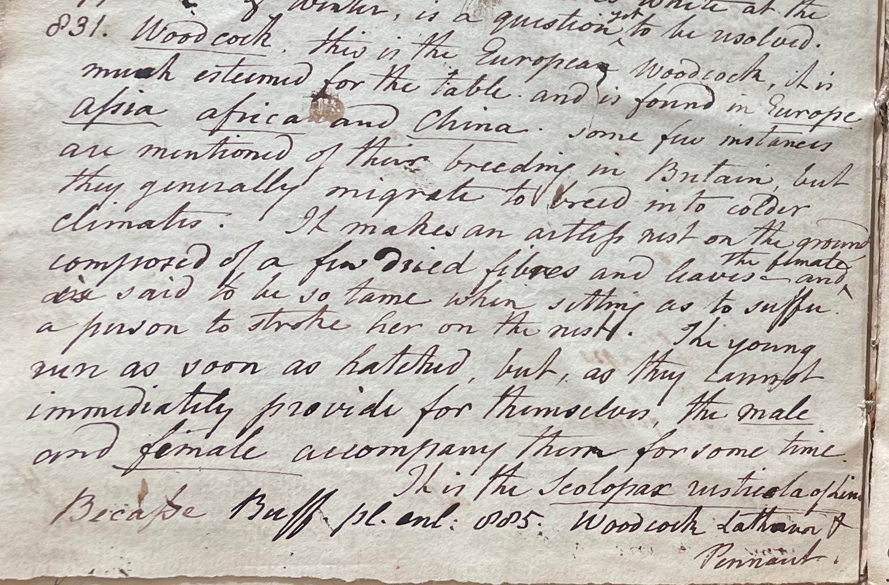
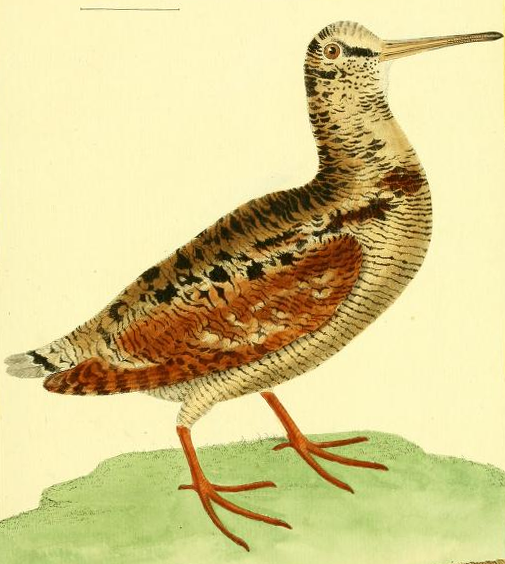
Charles Willson Peale (1741-1827) wrote, in his 26th Lecture (ca. 1799): "831. Woodcock. This is the European Woodcock; it is much esteemed for the table and is found in Europe, Assia, Africa and China. Some few instances are mentioned of their breeding in Britain, but they generally migrate to breed into colder climates. It mkes an artless nest on the ground, composed of a few dried fibres and leaves, and the female is said to be so tame when sitting as to suffer a person to strike her on the nest. The young run as soon as hatched, but, as they cannot immediately provide for themselves, the male and female accompany them for some time. It is the Scolopax rusticola of Linn. Becasse Buff. pl. enl. 885. Woodcock Latham & Pennant." (Academy of Natural Sciences of Drexel University Archives, coll. 40)
Peale continued: "It is said there is 3 varieties of this bird in Europe, the 2 others are one of a Dun colour and the other pure white, specimens of which are in the Leverian Museum. Latham, speaking of this bird, says "few need be told that its flesh is delicious, and much sought after; and, that nothing may be lost, the entrails are not drawn out, being thought a necessary appendage as sauce to the bird." (ANSP Archives, coll. 40)
Peale wrote, in "A Walk Through the Philad[elphi]a Museum" (1805–1806): "The English Woodcock and the American are here placed together, and plainly shew they are different species by their plumage as well as by their size." (Historical Society of Pennsylvania, coll. 0481)
Specimen Type:
Dead/preserved
Current Common Name:
Eurasian Woodcock
Current Scientific Name
Scolopacidae | Scolopax rusticola