Object Status:
Extant
Accession Date:
By 1799
Primary Source Reference:
Charles Willson Peale, Lecture on Natural History 23. (ca. 1799). Academy of Natural Sciences of Drexel University Archives, coll. 40. / https://ansp.org/research/library/archives/0000-0099/coll0040/
Additional Source Text:
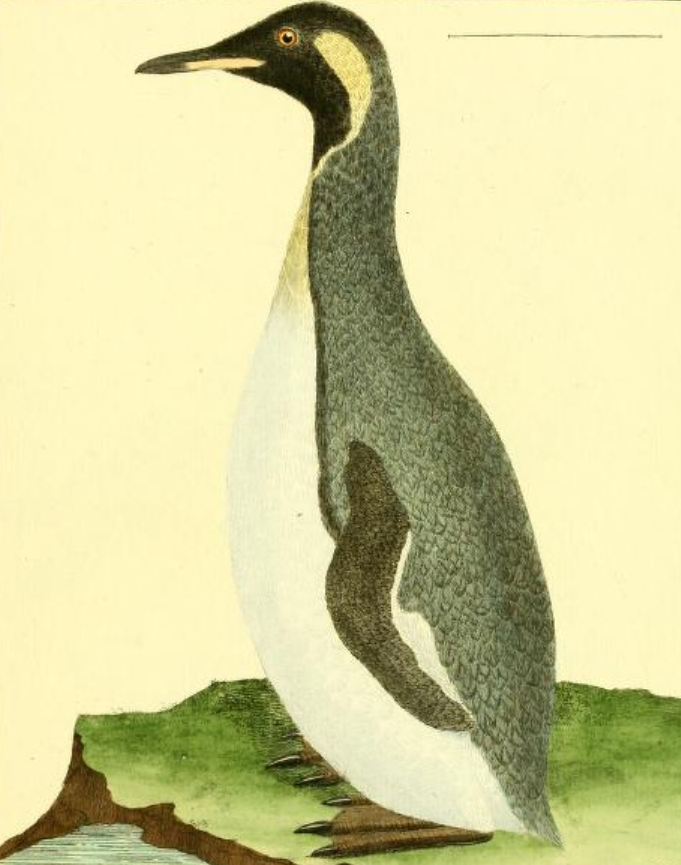
Charles Willson Peale (1741-1827) wrote, in his 23rd Lecture (ca. 1799): "Patagonian Pinguin. This is [the] largest of the genus yet known, about 4 feet in length; the bill is 4 Inches and a half long, more slender in proportion than in any of the species, and bends towards the top; the upper mandible is black; the under is orange at the base, and black at the tip. The tongue is half the length of the bill, and armed on each side with spikes, turning backward; the irides hazel; the head, throat, and hind part of the neck, are of a deep brown; the back of a deep ash colour, each feather blueish at the tip; the under parts pure white; on each side of the head, beginning under the eye, and behind it, is a broad stripe of fine yellow; this advances forward as it proceeds down the neck, where it grows narrower and paler, and at last blends itself with the white on the breast. Aptenodytes Patachonica Linn. Manchot des Isles Malouines Buff. pl. enl. 975. Patagonian Pinguin Latham No. 2. Pennant." (Academy of Natural Sciences of Drexel University Archives, coll. 40)
Peale continued: "This species was met with in Falkland Islands, and has also been seen in Kerguelen's land, New Georgia, and New Guinea. Monsr. Bougainville caught one, which soon became so tame as to follow and know the person who had the care of it; it feed on flesh, fish, and bread, but after a time grew lean, pined away, and died. The chief food, when at large, is thought to be fish; the remains of which, as well as crabs, shell-fish, and molluscae, were found in the stomack. This species is the fattest of the tribe; most so in January, when they moult. Supposed to lay and sit in October. [They] are met with in the most deserted places. Their flesh is black, though not very unpalatable." (ANSP Archives, coll. 40)
Peale wrote, in "A Walk Through the Philad[elphi]a Museum" (1805–1806): "The Patagonian Pinguin (a. Patachonica) is the largest of the genus yet known, inhabiting the Falkland Islands &c. said to be the fattest of the tribe" (Historical Society of Pennsylvania, coll. 0481).
A "King Pinguin" was donated by Captain Biddle on 13 September 1815, as recorded in the Peale Museum Accessions Book (HSP, coll. 0481).
Notes:
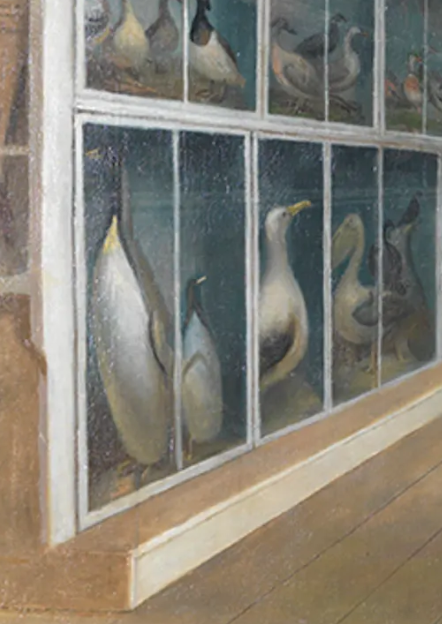
A specimen of this species is visible in the Peales' watercolor painting of the Long Room interior at the Pennsylvania State House, executed ca. 1820, in the floor-level display case to the right of the doorway (Detroit Institute of Arts, 57.262). / https://lewis-clark.org/people/charles-willson-peale/peales-museum/ The same specimen (shown here) is visible in Charles W. Peale's oil painting, "The Artist in His Museum", 1822 (Pennsylvania Academy of Fine Art, 1878.1.2).
Specimen Type:
Dead/preserved
Current Common Name:
King Penguin
Current Scientific Name
Spheniscidae | Aptenodytes patagonicus