Object Status:
Extant
Accession Date:
By 1799
Primary Source Reference:
Charles Willson Peale, Lecture on Natural History 36. (ca. 1799). Academy of Natural Sciences of Drexel University Archives, coll. 40. / https://ansp.org/research/library/archives/0000-0099/coll0040/
Additional Source Text:
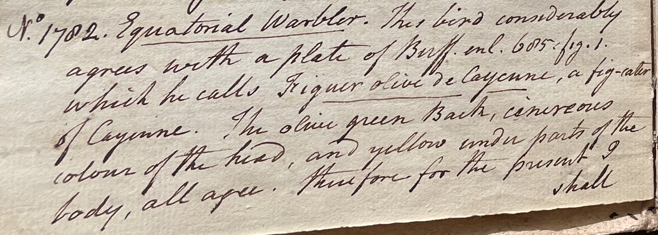
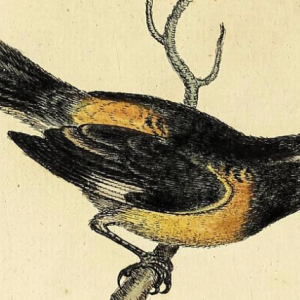
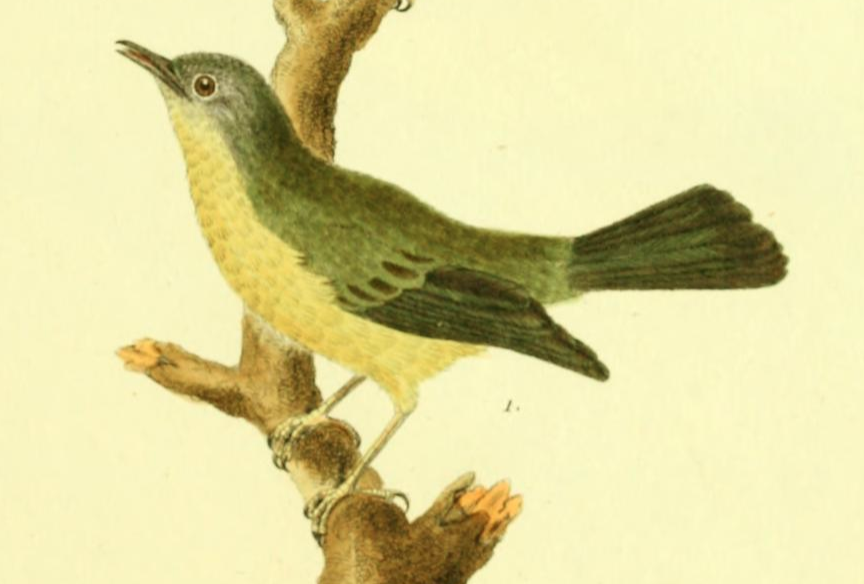
Charles Willson Peale (1741-1827) wrote, in his 36th Lecture (ca. 1799): "No. 1782. Equatorial Warbler. This bird considerably agrees with a plate of Buff. [pl.] enl. 685. f. 1. which he calls Figuer olive de Cayenne, a fly-catcher of Cayenne. The olive-green Back, cinereous colour of the head, and yellow under parts of the body, all agree. Therefore for the present I shall leave it under this name, annexing the Linnaean name Motacilla aequinoctialis. It is the only one I have yet meet with; found in the vicinity of Philad[elphi]a." (Academy of Natural Sciences of Drexel University Archives, coll. 40)
Peale (1805–1806) also listed "Equatorial W. (M. aequinoctialis) rare" in a draft copy of "A Walk Through the Philad[elphi]a Museum" (Historical Society of Pennsylvania, coll. 0481). The page of the final draft containing this species is not located.
Notes:
The immature (first winter) female Mourning Warbler is the closest match to Peale’s description, and it is uncommonly found in Philadelphia. The adult male of this species appeared under the name “Mourning Warbler / Sylvia philadelphia” in American Ornithology vol. 2 (1810, Pl. 14), which was based on another rare specimen, collected “on the border of a marsh, within a few miles of Philadelphia” (Wilson 1810: 101). / https://www.biodiversitylibrary.org/item/175511#page/115/mode/1up Wilson apparently overlooked Peale’s specimen, if indeed it was the species now known as Mourning Warbler, nor is there evidence that he deposited his own "Mourning Warbler" specimen in Peale's Museum.
Specimen Type:
Dead/preserved
Current Common Name:
Mourning Warbler
Current Scientific Name
Parulidae | Geothlypis philadelphia