Object Status:
Extant
Accession Date:
By 1799
Primary Source Reference:
Charles Willson Peale, Lecture on Natural History 19. (ca. 1799). Academy of Natural Sciences of Drexel University Archives, coll. 40. / https://ansp.org/research/library/archives/0000-0099/coll0040/
Additional Source Text:
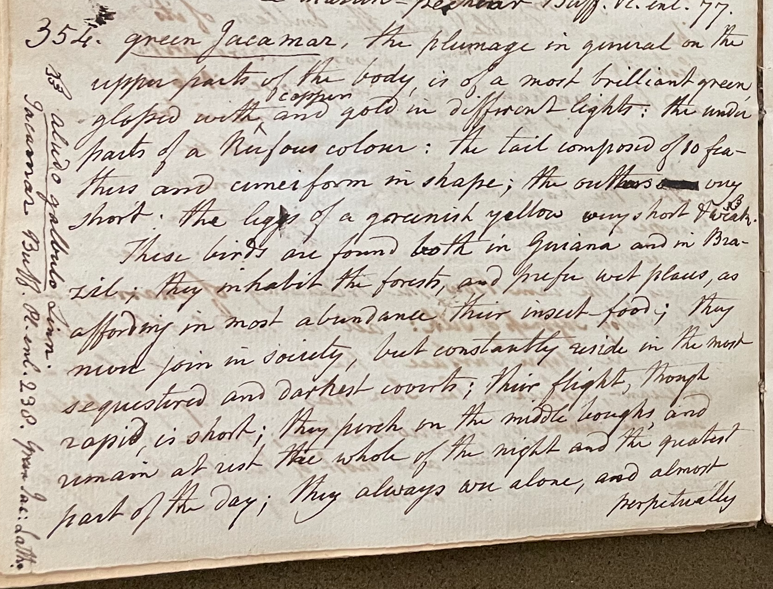
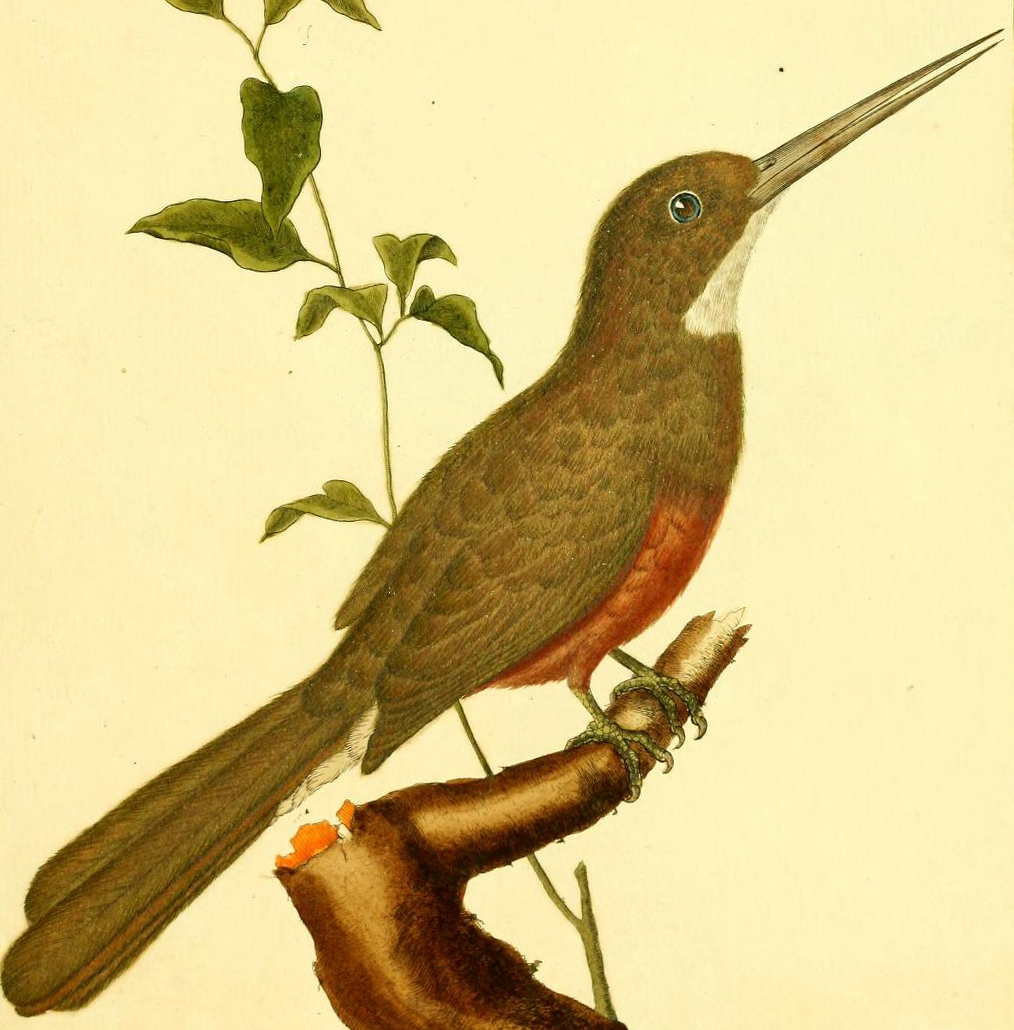
Charles Willson Peale (1741-1827) wrote, in his 19th Lecture (ca. 1799): "354. green Jacamar. the plumage in general on the upper parts of the body is of a most brilliant green, glossed with copper and gold in different lights; the under parts of a Rufous colour; the tail composed of 10 feathers and cuneiform in shape; the outers very short; the legs of a greenish yellow, very short & weak. Alcedo galbula Linn. Jacamar Buff. pl. enl. 238. Green Jac. Latham. These birds are found both in Guiana and in Brazil; they inhabit the forests, and prefer wet places, as affording in most abundance their insect food; they never join in society, but constantly reside in the most sequestered and darkest coverts; their flight, though rapid, is short; they perch on the middle boughs and remain at rest the whole of the night and the greatest part of the day; they always are alone, and almost perpetually tranquil; yet there is a number in the same district, that make responces in a feeble broken warble but which is tolerably pleasant. Piso says that their flesh, though hard, is eaten in Brasil." (Academy of Natural Sciences of Drexel University Archives, coll. 40)
Peale wrote, in "A Walk Through the Philad[elphi]a Museum" (1805–1806): "Next akind to this family kingfishers is the genus Galbula. Jacamars a small family, all brilliant. Here we see … the Green Jacamars — from South America. They feed on Insects. […] No. 2236 & 2237. Green Jacamar (G. viridis)." (Historical Society of Pennsylvania, coll. 0481)
An unmounted specimen of "Galbula viridis (Green Jacamar)" was listed in "A Catalogue of Duplicate Specimens...", May 1822. [unpublished] American Philosophical Society Library (Mss.B.P31).
Notes:
Peale did not specify the origin of his specimen, but it seems likely to be Cayenne, French Guiana, a major South American trade center in the 18th century. In 1793, Raphaelle Peale (1774-1825) travelled to Cayenne to collect specimens for Peale's Museum. However, to the editor's (MRH) knowledge, there is no detailed inventory of the specimens he brought back, and there are many examples of specimens from northern South America that were donated by other people. For more discussion about Raphaelle's travels, see Lillian B. Miller, 1993, "Father and Son: The Relationship of Charles Willson Peale and Raphaelle Peale", The American Art Journal 25: 4-161. / https://doi.org/10.2307/1594599
Specimen Type:
Dead/preserved
Current Common Name:
Green-tailed Jacamar
Current Scientific Name
Galbulidae | Galbula galbula