Object Status:
Extant
Accession Date:
23 January 1792
Primary Source Reference:
Dunlap's American Daily Advertiser, 23 January 1792.
Additional Source Text:
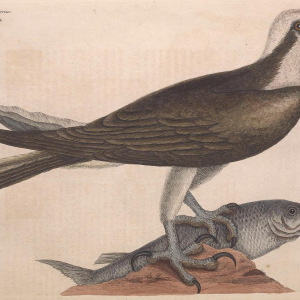
A notice appeared in Dunlap's American Daily Advertiser (Philadelphia) on 23 January 1792, the New-York Daily Gazette (New York) on 28 January 1792, and the Argus (Boston) on 10 Feb 1792, announcing Charles Willson Peale's (1741-1827) acquisition of "The Noddy, a bird remarkable for its falling into a deep sleep the minute it alights on a vessel, common in the West Indies." The specimen was donated by Mr. Samuel Purveyance [Purviance] of Baltimore.
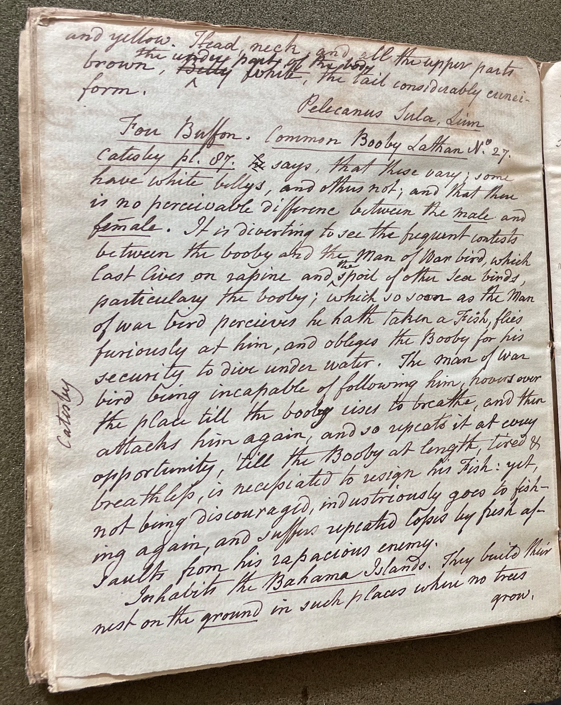
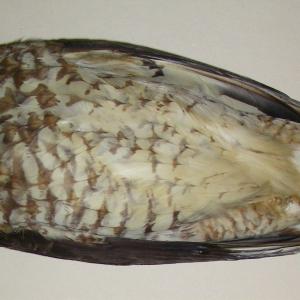
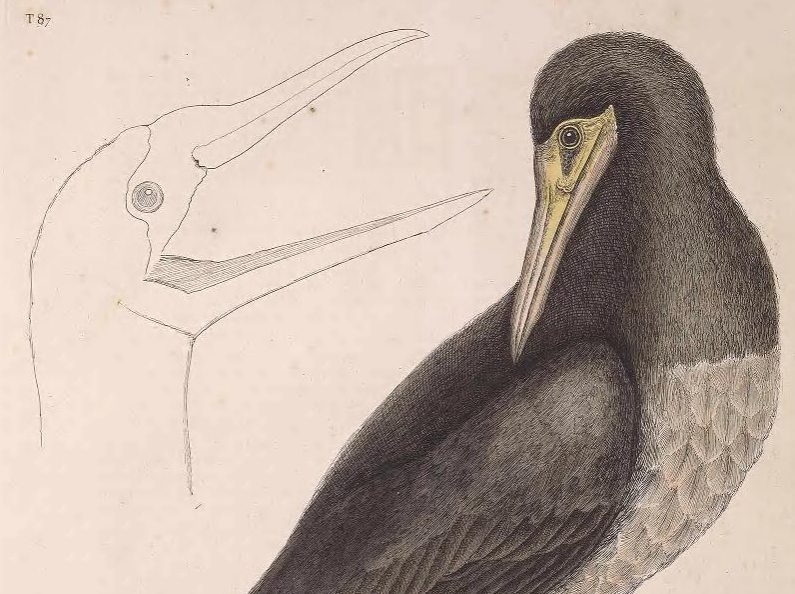
However, a description of the "Noddy" in Peale's 23rd Lecture (ca. 1799) does not match the Brown Noddy (Anous stolidus) but rather a juvenile Brown Booby: "595. Noddy. I place it with this name because it agrees with one under that name in Catesby except that it has not the white crown. I do not find any a description of it in any of the authors. It differs from the preceeding [i.e., Brown Booby] by its pale brown pluage, with a russet reflection; the under rather lighter than the upper parts; tail cuneiform; the bill dark; feet yellow; parts round the heard not so much covered with feathers as in the other.(Academy of Natural Sciences of Drexel University Archives, coll. 40)
Peale also described an adult: "[No.] 594. Common Booby, length 2 feet 6 Inches. The bill nearly 4 and a half Inches long, toothed at the Edges, white; space round the eyes and chin bare of feathers, and covered with a yellowish skin; irides gray and yellow. Head, neck, and all the upper parts brown, and under parts of the body white, the tail considerably cuneiform. Pelecanus Sula Linn. Fou Buffon. Common Booby Latham No. 27. Catesby pl. 87. (ANSP Archives, coll. 40)
Peale continued: "[Catesby] says, that these vary; some have white bellys, and other not; and that there is no perceivable difference between the male and female. It is diverting to see the frequent contents between the booby and the Man of War bird, which last lives on rapine and the spoil of other sea birds, particularly the booby; which so soon as the Man of War bird perceives he hath taken a Fish, flies furiously at him, and obliges the Booby for his security to dive under water. The Man of War bird being incapable of following him, hovers over the place till the booby rises to breathe, and then attacks him again, and so repeats it at every opportunity, till the Booby at length, tired & breathless, is necessiated to resign his Fish; yet, not being discouraged, industriously goes to fishing again, and suffer repeated losses by fresh assaults from his rapacious enemy. Inhabits the Bahama Islands. They build the nest on the ground in such places where no trees grow, but make them on the last whenever they can be found. The flesh is black and fishy, but is eatable." (ANSP Archives, coll. 40)
Peale wrote, in "A Walk Through the Philad[elphi]a Museum" (1805–1806): "The manners of these other birds have brought on them the name of Booby (P. Sula) for although their bills are strong & their wings long, yet they will neither defend themselves, or fly from danger: on the Islands that [Brisson] visited the Sailors could catch with their Hands or knock down with their sticks as many as they pleased to take. From the various accounts of Mariners that have found them in great numbers on the Coasts of south America & who have observed their manners, say that they are the most stupid of Water fowl." (Historical Society of Pennsylvania, coll. 0481)
Specimen Type:
Dead/preserved
Current Common Name:
Brown Booby
Current Scientific Name
Sulidae | Sula leucogaster