Object Status:
Extant
Accession Date:
30 May 1799
Primary Source Reference:
Charles Willson Peale, diary entry dated 30 May 1799; Selected Papers, 2, part 1: 241.
Additional Source Text:
Charles Willson Peale (1741-1827) wrote in his diary on 30 May 1799, during a collecting trip to Cape May, New Jersey: "I shot a … crested fly-catcher" (Miller 1988: 241, Selected Papers, Vol. 2, part 1, Yale University Press).
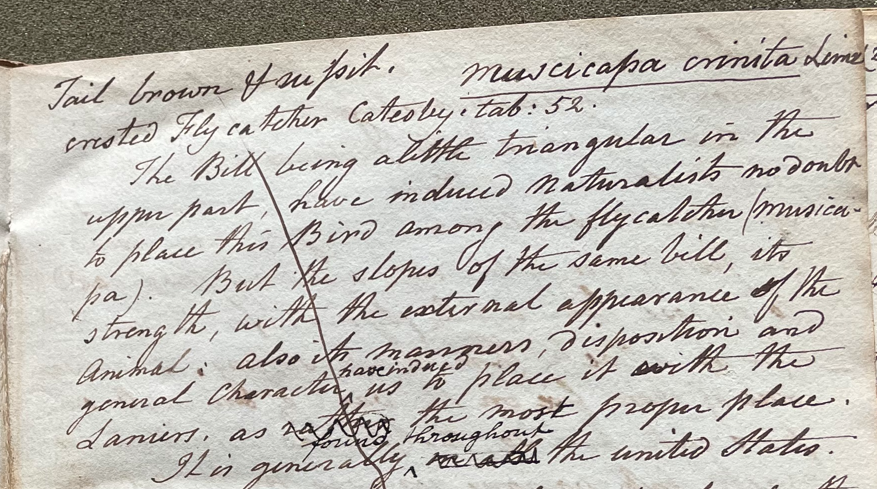
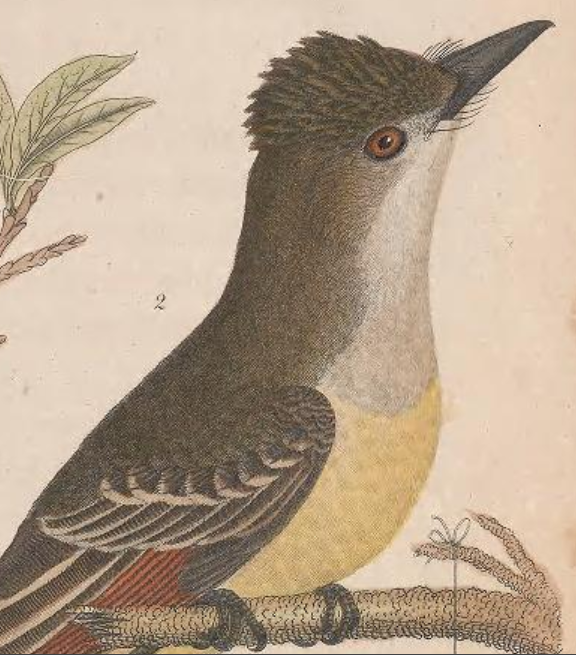
In his 15th Lecture, Peale wrote: "No. 97. Crested Flycatcher. Top of the head and back dull green; throat & breast lead colour; the under part of the body of pale yellow; covert wing feathers brown bordered with white; pinion quils bordered with russet; tail brown & russet. Muscicapa crinita Linn. Crested Flycatcher Catesby tab. 52. / The bill being a little triangular in the upper part, have induced naturalists no doubt to place this Bird among the flycatchers (Muscicapa). But the slopes of the same bill, its strength, with the external appearance of the Animal; also its manners, disposition and general character, have induced us to place it with the Laniers, as the most proper place. It is generally found throughout the United States." (Academy of Natural Sciences of Drexel University Archives, coll. 40)
Peale evidently changed his mind about the classification of this species, then added it to his 35th Lecture: "No. 1664. Crested Flycatcher. an erected crest. head, back & coverts of the wings olive colour. wings & tail brown edged with russet. neck & breast lead colour, beneath brimstone yellow. Gobe-mouche huppé de virginie Buffon pl. enl. 569. f. 1. Muscicapa Crinita Linne. No. 1665. Female. no material difference of colour between this and the male. Pennant says they breed in New York and Carolina and departs in autumn. Its note extremely brawling, as if enmity with all other birds. Makes its nest of snake skins & hair, in holes of trees." (ANSP Archives, coll. 40)
Peale wrote, in "A Walk Through the Philad[elphi]a Museum" (1805–1806): "The Crested flycatcher (Muscicapa Crinita) is found in our thickest woods, plumage alike of Male & female." (Historical Society of Pennsylvania, coll. 0481)
Alexander Wilson (1766-1813) described this species under the name "Great Crested Flycatcher / Muscicapa crinita" in American Ornithology vol. 2 (Pl. 13), where "Peale's Museum No. 6645" was cited (Wilson 1810: 75). / https://www.biodiversitylibrary.org/item/175511#page/87/mode/1up (text) / https://www.biodiversitylibrary.org/item/175511#page/77/mode/1up (plate)
Two unmounted specimens of "Muscicapa crinita (Great Crested Flycatcher)" were listed in "A Catalogue of Duplicate Specimens...", May 1822. [unpublished] American Philosophical Society Library (Mss.B.P31).
Notes:
Witmer Stone (1866-1939) was evidently unaware of the extent of Peale's collection and his collecting effots at Cape May, while preparing his classic work, Bird studies at Old Cape May, Philadelphia: Delaware Valley Ornithological Club). In his second volume, Stone (1937: 678) was unable to provide even one 19th century record of this species in Cape May.
Specimen Type:
Dead/preserved
Current Common Name:
Great Crested Flycatcher
Current Scientific Name
Tyrannidae | Myiarchus crinitus