Object Status:
Extant
Accession Date:
By 1799
Primary Source Reference:
Charles Willson Peale, Lecture on Natural History 15. (ca. 1799). Academy of Natural Sciences of Drexel University Archives, coll. 40. / https://ansp.org/research/library/archives/0000-0099/coll0040/
Additional Source Text:
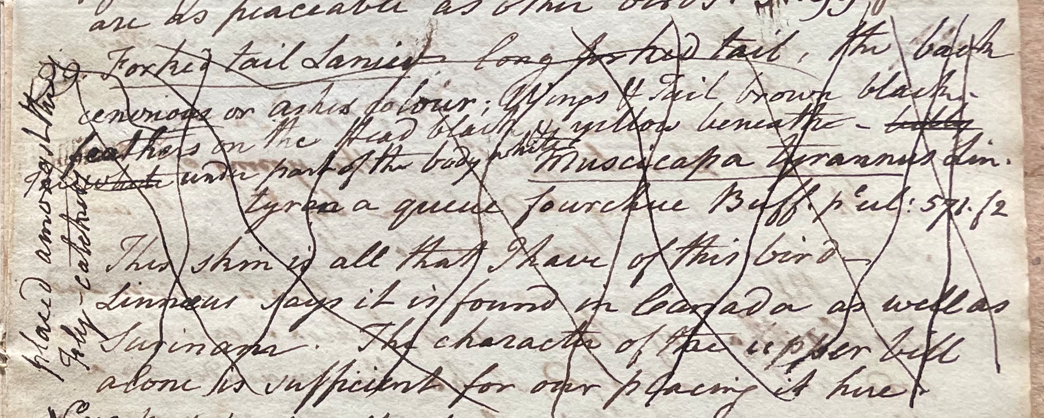
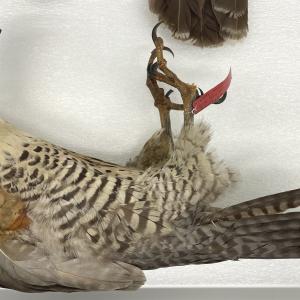
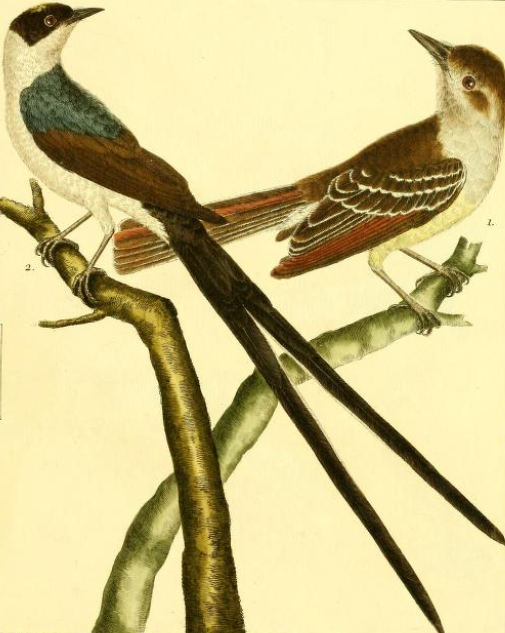
Charles Willson Peale (1741-1827) wrote, in his 15th Lecture (ca. 1799): "[No.] 99. Fork-tail Lanier. long forked tail; the back cenerious or ashen colour; wings, tail, brown black; feathers on the head black & yellow beneath. Muscicapa tyrannus Lin. Tyrana à queue fourchue Buff. pl. enl. 571. f. 2. This skin is all that I have of this bird. Linnaeus says it is found in Canada as well as Surinam. The character of the upper bill alone is sufficient for our placing it here [among the Shrikes]." However, Peale later crossed out this account with a note in the margin reading "Placed among the flycatchers." (Academy of Natural Sciences of Drexel University Archives, coll. 40)
Peale evidently reclassified this species because, in his 35th Lecture, he wrote: "No. 1679. Fork tail Flycatcher. The head and cheeks black; feathers on the crown yellow at their bottoms; upper part of the body ash coloured; lower white; tail greatly forked; the two outermost feathers on each side, several Inches longer than the others, black & the lower half of the exterior feather white. Muscicapa Tyrannas Linn. Le Tyrana à queue fourchue de Cayenne Buff. pl. enl. 571. f. 2. This is said to inhabit Canada, and as low as Surinam. I have never meet with them in Maryland, Pennsyla., Jersey or New York and Buff. says they belong to Cayenne. The want of food three fourths of the year in Canada must oblige them to retire southerly when the cold sets in. Therefore I cannot imagine how they pass us unless they keep to the westward in their passage to the warmer climates." (ANSP Archives, coll. 40)
Charles Lucien Bonaparte (1803–1857) described this species under the name "Fork-tailed Flycatcher / Muscicapa savanna" in his continuation of American Ornithology vol. 1 (1825, Pl. 1). Bonaparte (1825: 1) cited "Peale's Museum, No. 6620" and wrote: "The specimen from which our drawing was made is a beautiful male, in full plumage; it was shot near Bridgetown, New-Jersey, at the extraordinary season of the first week in December, and was presented by Mr. J. Woodcraft, of that town, to Mr. Titian Peale [1799-1885], who favoured me with the opportunity of examining it." A drawing made by Titian (unlocated) was engraved by Alexander Lawson (ca. 1772-1846) for Plate 1 of Bonaparte's work. / https://search.library.wisc.edu/digital/AFKPEJIASN54OC8L/pages/A6LH6WZR…
Specimen Type:
Dead/preserved
Current Common Name:
Fork-tailed Flycatcher
Current Scientific Name
Tyrannidae | Tyrannus savana