Object Status:
Unlocated
Accession Date:
By 1813
Primary Source Reference:
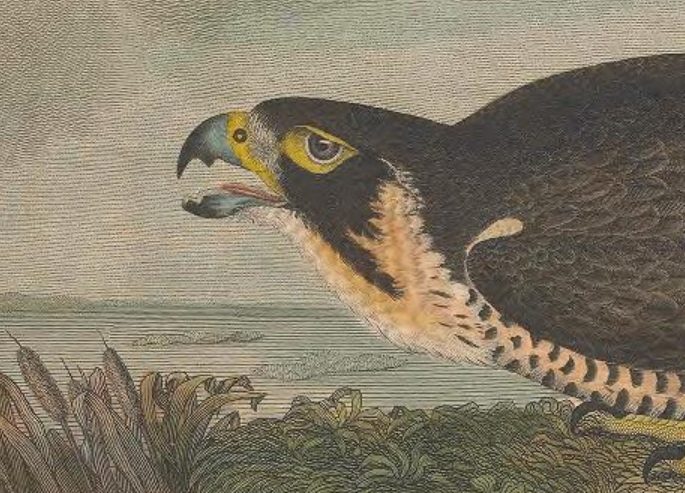
Alexander Wilson (1814). American ornithology, or, The natural history of the birds of the United States: illustrated with plates engraved and colored from original drawings taken from nature. Volume 9, Plate 76. Philadelphia: Bradford and Inskeep, Robert Carr / https://www.biodiversitylibrary.org/item/175518#page/130/mode/1up (text) / https://www.biodiversitylibrary.org/item/175518#page/131/mode/1up (plate)
Additional Source Text:
Alexander Wilson (1766-1813) described this species under the name "Great-footed Hawk / Falco peregrinus" in American Ornithology vol. 9, published posthumously (Pl. 76).
George Ord (1781–1866), editor of Wilson's posthumous volumes, cited "Peale Museum, No. 386" (see Wilson 1814: 120–125) and stated that, "At length in the month of December, 1812, to the unspeakable joy of Mr. Wilson, he received from Egg-Harbor a fine specimen of the far-famed Duck Hawk; which was discovered, contrary to his expectations, to be of a species which he had never before beheld … The bird from which the above account was taken … [and] the figure in the plate [is drawn], is an excellent resemblance of the original, which is handsomely set up in the museum of Mr. Peale" (Wilson 1814: 120).
For unknown reasons, the deposit of this specimen was not recorded in the Peale Museum Accessions Book (Historical Society of Pennsylvania, coll. 0481).
Notes:
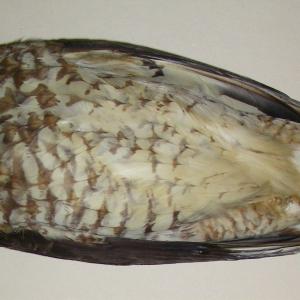
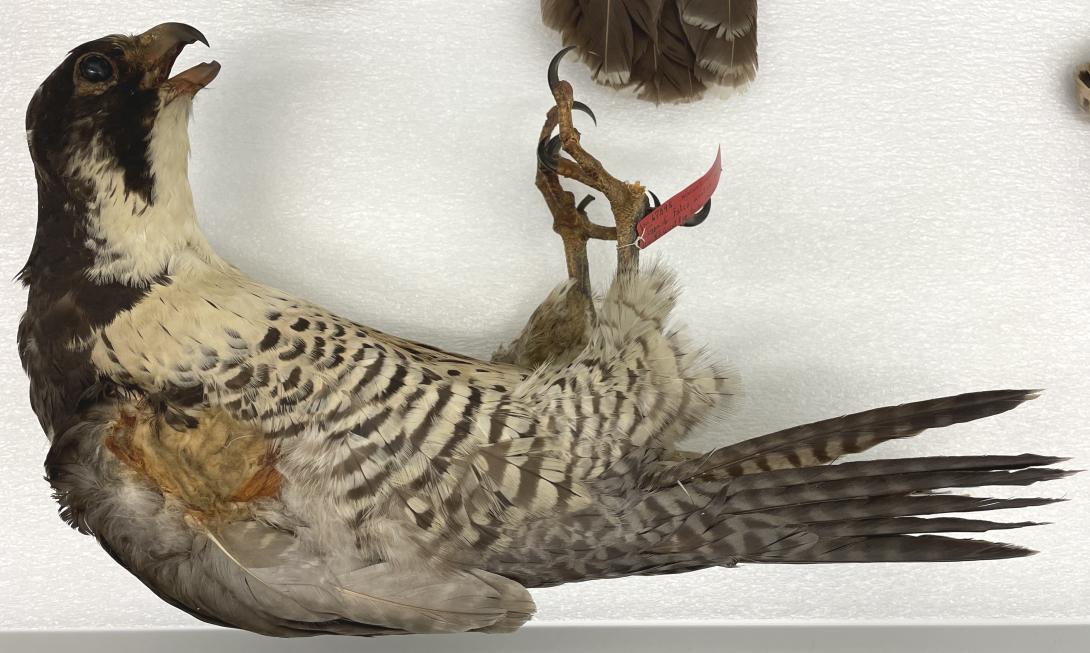
After Peale's Museum closed, a portion of Peale's bird collection was purchased in 1850 by Moses Kimball (1809–95), who displayed it at his "Boston Museum". An advertisement in the Boston Transcript, printed 1 October 1850, stated that Kimball had acquired "One Half of the celebrated Peale's Philadelphia Museum". The other half of Peale's birds had been sold to the circus promoter P. T. Barnum (1810–91) and would be subsequently destroyed in a fire at his "American Museum" in New York City in July 1865. When the Boston Museum closed, Kimball's Peale remnants passed temporarily to the Boston Society of Natural History, who disposed of them to Charles J. Maynard (1845-1929), a local taxidermist. The specimens were stored in a barn in Massachusetts for several years, then eventually were deposited at the Museum of Comparative Zoology (MCZ), Harvard University. By the time the collection was catalogued by Walter Faxon (1848-1920) at MCZ, in 1914, in virtually every case the original mounts and labels had been disassociated from the specimens, and an untold number were lost. Walter Faxon, "Relics of Peale's Museum," Bulletin of the Museum of Comparative Zoology, 59, no. 3 (July 1915): 135, speculated that a data-deficient specimen (MCZ 67848) from the Boston Museum collection is the bird illustrated by Wilson (1814) and therefore the holotype of Falco anatum Bonaparte (1838, Geographical and Comparative List...): "Although this specimen is mounted with its wings differently placed from those of Wilson's beautiful drawing, I am persuaded by a careful perusal of George Ord's description and scrutiny of Wilson's plate that it is the original of both." / https://www.biodiversitylibrary.org/page/6339801#page/185/mode/1up This may be true, but the entire pose of MCZ 67848 conflicts with Wilson's figure—not merely the wings—and there are no data linking the specimen to Wilson. The "data" on the specimen's label ("NJ, Great Egg Harbor, Dec. 1812") are not original, but were copied from Ord's (in Wilson 1814) published account, presumably by Faxon.
Specimen Type:
Dead/preserved
Current Common Name:
Peregrine Falcon
Current Scientific Name
Falconidae | Falco peregrinus
Repository:
Museum of Comparative Zoology, Harvard University (MCZ 67848)