Object Status:
Extant
Accession Date:
By 12 October 1792
Primary Source Reference:
Charles Willson Peale, letter to Thomas Hall of Moorfields, London, dated 12 October 1792; Selected Papers, 2, part 1: 42.
Additional Source Text:
Charles Willson Peale (1741-1827) wrote "American Gold finch" on 12 October 1792, on the manifest of a shipment of specimens to Thomas Hall in London, in exchange for European specimens (Miller 1988: 42, Selected Papers, Vol. 2, part 1, Yale University Press).
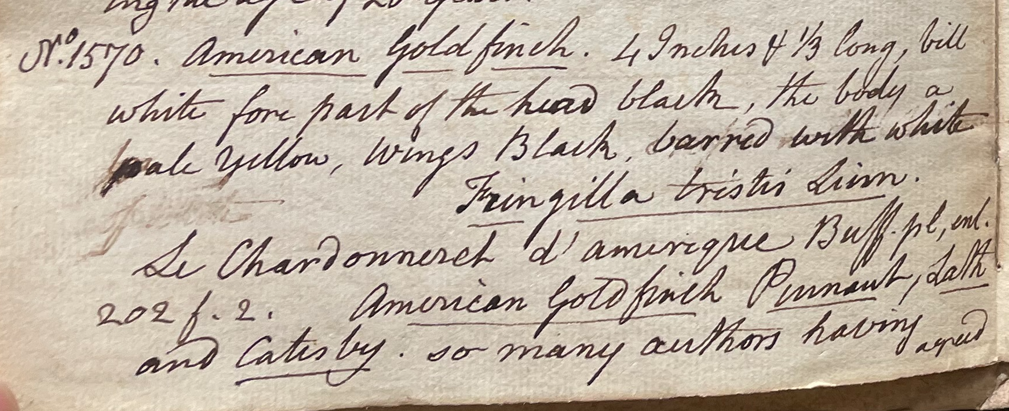
In his 34th Lecture, Peale wrote: "No. 1570. American Goldfinch. 4 Inches & 1/3 long, bill white, fore part of the head black, the body a pale yellow, wings black, barred with white. Fringilla tristis Linn. Le Chardonneret d'Amerique Buff. pl. enl. 202. f. 2. American Goldfinch Pennant, Lath. and Catesby. So many authors having agreed in the same name, renders it very improper to endeavor to change it, especially as there is nothing improper in it. But we have generally called this bird the Lettice bird, because it is often found feeding on the lettice seed. However, it is equally common to find it feeding on the seed of Thistles, like the European Goldfinch. They are very common in New York and in every state southward. No. 1572 is the Autumn and Winter dress of the same bird. No. 1573 is one all white, taken in vicinity of Philadelphia. Very rare." (Academy of Natural Sciences of Drexel University Archives, coll. 40)
Peale wrote, in "A Walk Through the Philad[elphi]a Museum" (1805–1806): "here is the American Goldfinch (F. Tristis) & one white an accidental variety. They feed on the seed of Thistles." (Historical Society of Pennsylvania, coll. 0481)
Alexander Wilson (1766-1813) described this species under the name "Yellow-bird, or Goldfinch / Fringilla tristis" in American Ornithology vol. 1 (Pl. 1), where "Peale's Museum, No. 6344" was cited (Wilson 1808: 20). / https://www.biodiversitylibrary.org/item/175530#page/34/mode/1up (text) / https://www.biodiversitylibrary.org/item/175530#page/8/mode/1up (plate)
Charles Lucien Bonaparte (1803–57) described the adult female in his continuation of American Ornithology vol. 1, where "Peale's Museum, No. 6344, Male; [and] No. 6345, Female; [and] No. 6346, Albino" were cited (Bonaparte 1825 :57). / https://search.library.wisc.edu/digital/AFKPEJIASN54OC8L/pages/AYZLELUN… (text) / https://search.library.wisc.edu/digital/AFKPEJIASN54OC8L/pages/AFOZCVAW… (plate)
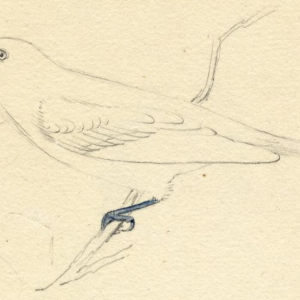
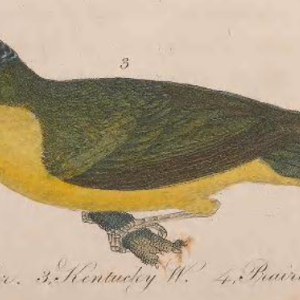
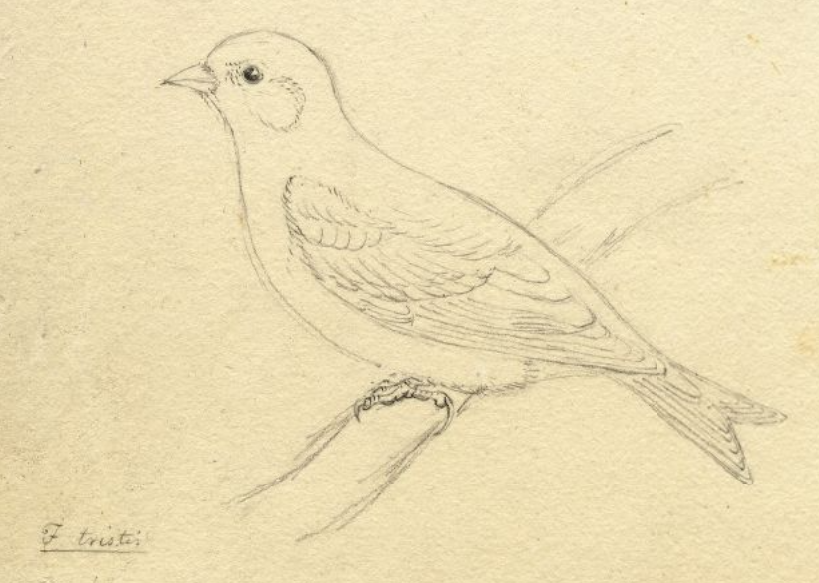
The plate for Bonaparte's (1825) work was based on a pencil sketch by Titian Ramsay Peale (1799-1885), which was engraved by Alexander Lawson (ca.1772-1846). Titian's orignal drawing (shown here) is extant in the American Philosophical Society Library (Mss.B.P.31.15d).
Notes:
The “Albino” bird may have been leucistic (i.e., not albino, but simply lacking melanin in its plumage).
Specimen Type:
Dead/preserved
Current Common Name:
American Goldfinch
Current Scientific Name
Fringillidae | Spinus tristis