Object Status:
Extant
Accession Date:
By 1799
Primary Source Reference:
Charles Willson Peale, Lecture on Natural History 17. (ca. 1799). Academy of Natural Sciences of Drexel University Archives, coll. 40. / https://ansp.org/research/library/archives/0000-0099/coll0040/
Additional Source Text:
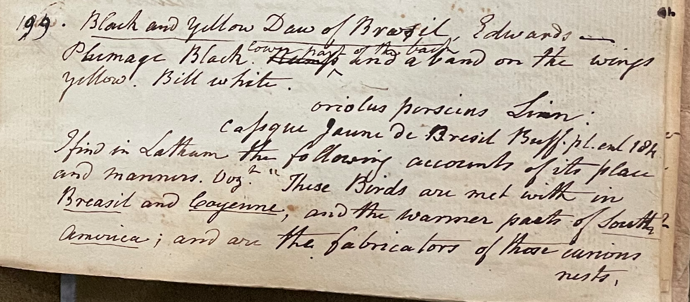
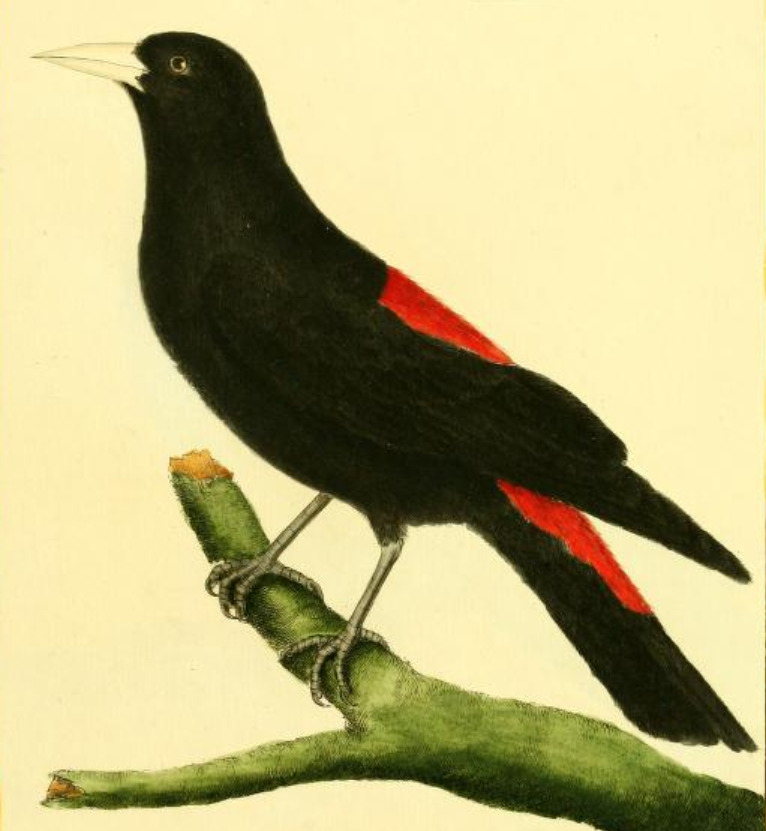
Charles Willson Peale (1741-1827) wrote, in his 17th Lecture (ca. 1799): "No. 199. Black and Yellow Daw of Brasil. Edwards. Plumage Black. Lower part of the back and a band on the wings yellow. Bill white. Oriolus perscius Linn. Cassique Jaune de Bresil. Buff. pl. enl. 184. I find in Latham the following accounts of its place and manner […]: "These birds are met with in Brasil and Cayenne; and the warmer parts of South America; and are the fabricators of those curious nests, met with in the cabinets of the curious. These are in the shape of an elembec [elembic], about one foot and a half in length, composed of dry grass and horse-hair, or hogs bristles, mixed. These nests are in part composed of what is called old-mans-beard, which is common in the south parts of American, and West Indian Islands, and which at first view may easily be mistaken for horse hair; and is the Tillandsia usneoides. Linn. The bottom [of the nest], for one foot upwards, is hollow, like a purse; the remainder, or upper part of it, for half a foot, being solid; and hangs by the top, on the extremity of a branch of a tree. They often build near Houses; and on one tree there have been known above 400 of these nests; and many pairs have been known to hatch and bring up three broods in a year." (Academy of Natural Sciences of Drexel University Archives, coll. 40)
Peale wrote, in "A Walk Through the Philad[elphi]a Museum" (1805–1806): "The larger bird, black & Yellow oriole (Persius) inhabits south America, it forms a Pendant nest, shaped like an alembec, on the extreme branches of the Trees, of which there are sometimes 400 together. It is common with orioles to build nests in the shape of Purses." (Historical Society of Pennsylvania, coll. 0481)
A mounted specimen of "Oriolus persicus (Black & Yellow Oriole)" from Cayenne was listed in "A Catalogue of Duplicate Specimens...", May 1822. [unpublished] American Philosophical Society Library (Mss.B.P31).
Notes:
The name Oriolus persicus Linnaeus, 1766 is a synonym of C. cela (Linnaeus, 1758, Systema Naturae). In 1793, Raphaelle Peale (1774-1825) travelled to Cayenne, French Guiana, to collect specimens for Peale's Museum. However, to the editor's (MRH) knowledge, there is no detailed inventory of the specimens he brought back, and there are many examples of specimens from northern South America that were donated by other people. For more discussion, see Lillian B. Miller, 1993, ""Father and Son: The Relationship of Charles Willson Peale and Raphaelle Peale"", The American Art Journal 25: 4-161. / https://doi.org/10.2307/1594599
Specimen Type:
Dead/preserved
Current Common Name:
Yellow-rumped Cacique
Current Scientific Name
Icteridae | Cacicus cela