Object Status:
Extant
Accession Date:
By 1799
Primary Source Reference:
Charles Willson Peale, Lecture on Natural History 35. (ca. 1799). Academy of Natural Sciences of Drexel University Archives, coll. 40. / https://ansp.org/research/library/archives/0000-0099/coll0040/
Additional Source Text:
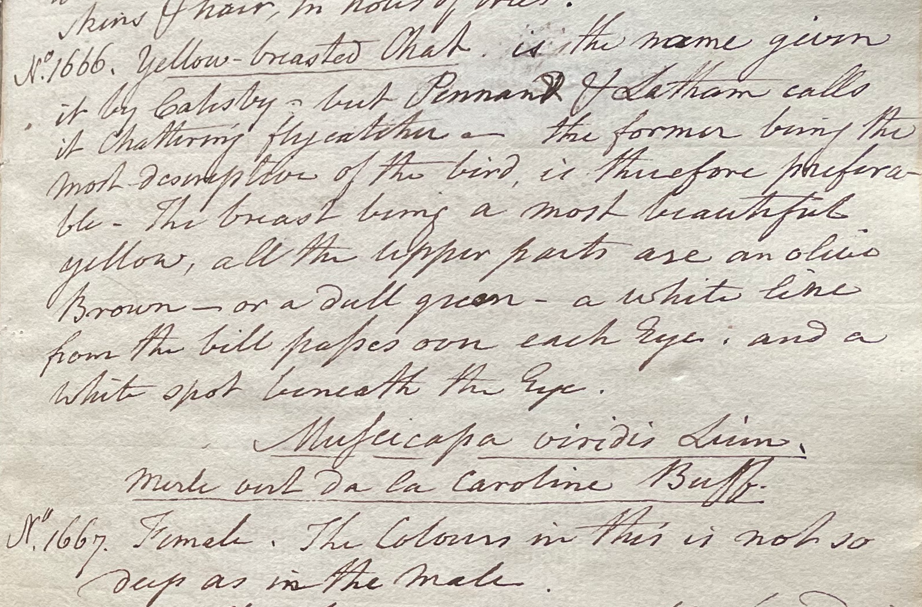
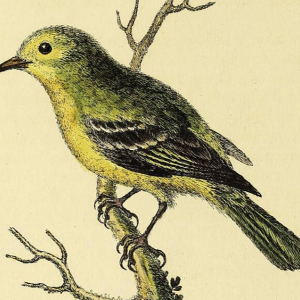
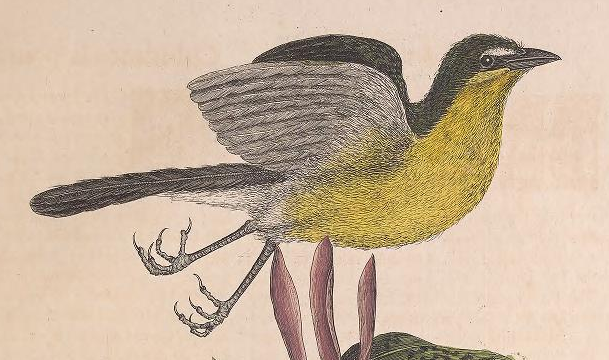
Charles Willson Peale (1741-1827) wrote, in his 35th Lecture (ca. 1799): "No. 1666. Yellow-breasted Chat. is the name given it by Catesby, but Pennant & Latham calls it chattering flycatcher—the former being the most descriptive of the bird, is therefore preferable. The breast being a most beautiful yellow, all the upper parts are an olive Brown—or a dull green—a white line from the bill passes over each Eye, and a white spot beneath the Eye. Muscicapa viridis Linn. Merle vert da la Caroline Buff. No. 1667. Female. The colours in this is not so deep as in the male. These birds are generally found in woods, seldom seen in the open fields. About 10 or 12 years past they were scarce in Pennsylvania, but two summers past I have in my hunting excursions found an abundance of them. Their notes are pretty loud and very pleasing. It flies with its legs hanging down." (Academy of Natural Sciences of Drexel University Archives, coll. 40)
Peale wrote, in "A Walk Through the Philad[elphi]a Museum" (1805–1806): "Yellow breast Chat (M. Viridis) visits us in the Spring & goes farther north to breed. Male & female alike in plumage." (Historical Society of Pennsylvania, coll. 0481)
Alexander Wilson (1766-1813) described this species under the name "Yellow-breasted Chat / Pipra polyglotta" in American Ornithology vol. 1 (Pl. 6), where "Peale's Museum No. 6661" was cited (Wilson 1808: 90). / https://www.biodiversitylibrary.org/item/175530#page/114/mode/1up (text) / https://www.biodiversitylibrary.org/item/175530#page/111/mode/1up (plate)
Specimen Type:
Dead/preserved
Current Common Name:
Yellow-breasted Chat
Current Scientific Name
Icteriidae | Icteria virens