Object Status:
Extant
Accession Date:
By 1799
Primary Source Reference:
Charles Willson Peale, Lecture on Natural History 16. (ca. 1799). Academy of Natural Sciences of Drexel University Archives, coll. 40. / https://ansp.org/research/library/archives/0000-0099/coll0040/
Additional Source Text:
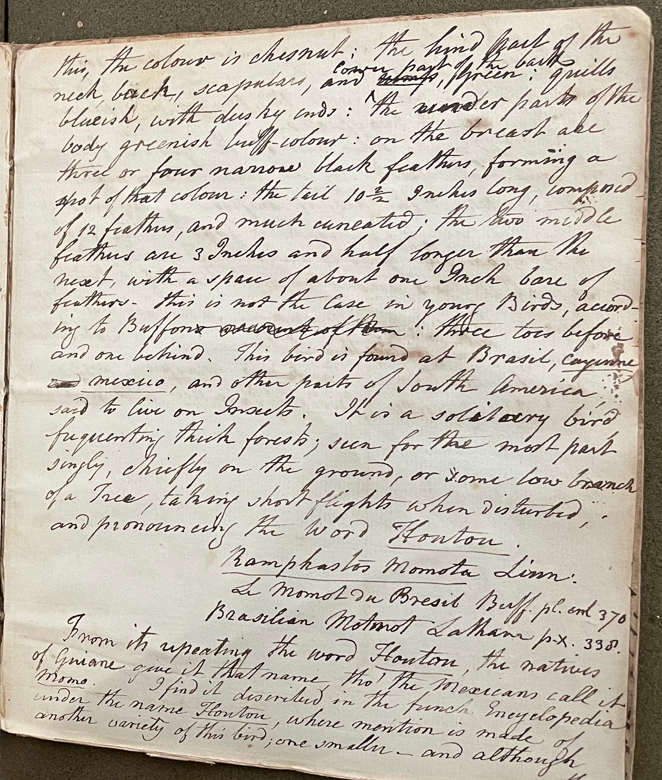
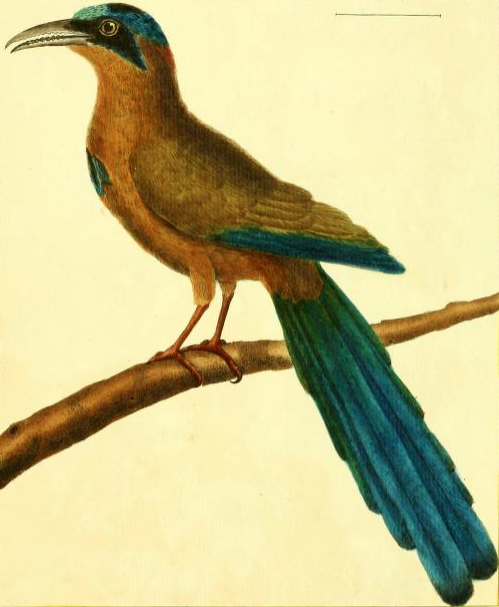
Charles Willson Peale (1741-1827) wrote, in his 16th Lecture (ca. 1799): "162. Momot. The Bill is an Inch and ¾ long, indented on the edges; the indentations from eleven to 13 in number; it is dusky above, and flesh-coloured at the base where it is furnished with a few bristles; the Irides yellow; and the tongue feathered, like that of the Toucan; the upper part and sides of the bill are incompassed with black, which runs through the Eyes, and below them, ending in a point; the middle feathers of the crown is b;ack; between that and the bill blue green; and the hind head blue, so that the crown seems surrounded with blue; below this, the colour is chesnut; the hind part of the neck, back, scapulars, and lower part of the back green; quills blueish, with dusy ends; the under parts of the body greenish buff-colour; on the breast are three or four narrow black feathers, forming a spot of that colour; the tail 10 ½ Inches long, composed of 12 feathers, and much cuneated; the two middle feathers are 3 Inches and half longer than the next, with a space of about one Inch bare of feathers. this is not the case in young Birds, according to Buffon's account of them; three toes before and one behind." (Academy of Natural Sciences of Drexel University Archives, coll. 40)
Peale continued: "This bird is found at Brasil, Cayenne, Mexico, and other parts of South America, said to live on Insects. It is a solitary bird frequenting thick forests; seen for the most part singly, chiefly on the groun, or some low branch of a Tree, taking short flights when disturbed, and pronouncing the word Houtou. Ramphastos momota Linn. Le Momot du Bresil Buff. pl. enl. 370. Brasilian Motmot Latham p. x. 338. From its repeating the word Houtou, the natives of Guiane give it that name, tho' the Mexicans call it Momo. I find it described in the french encyclopedia under the name Houtou, where mention is made of another variety of this bird; one smaller, and although they speak of having seen a number of skins, some bigger than others; the colours of some brighter, yet they agree with Mr. Buffon in opinion that there are not two species. They make their nest on the ground, frequently in the same hole deserted by an armadillo, or other quadruped; the nest is composed of dry grass and stalks; laying commonly 2 Eggs. The flesh is not accounted good to eat. It is esteemed by several Authors among the most beautiful Birds of Guiana, Brasil, and Mexico." (ANSP Archives, coll. 40)
Peale wrote, in "A Walk Through the Philad[elphi]a Museum" (1805–1806): "How variegated the these birds are in Colours as well as in the size, and that Called Momot (Ramphastos Momoto). It has late been made a seperate genus, but as there are only two of them known it is scarcely necessary to seperate them from Toucans. is esteemed among the most beautiful birds of Guiana, Brazil & Mexico—Toucans belong only to South America." (Historical Society of Pennsylvania, coll. 0481)
Notes:
Peale did not specify the origin of the specimen described in his lecture, but it seems likely to be Cayenne, French Guiana, a major South American trade center in the 18th century. In 1793, Raphaelle Peale (1774-1825) travelled to Cayenne to collect specimens for Peale's Museum. However, to the editor's (MRH) knowledge, there is no detailed inventory of the specimens he brought back, and there are many examples of specimens from northern South America that were donated by other people. For more discussion about Raphaelle's travels, see Lillian B. Miller, 1993, "Father and Son: The Relationship of Charles Willson Peale and Raphaelle Peale", The American Art Journal 25: 4-161. / https://doi.org/10.2307/1594599
Specimen Type:
Dead/preserved
Current Common Name:
Amazonian Motmot
Current Scientific Name
Momotidae | Momotus momota