Object Status:
Extant
Accession Date:
By 1799
Primary Source Reference:
Charles Willson Peale, Lecture on Natural History 35. (ca. 1799). Academy of Natural Sciences of Drexel University Archives, coll. 40. / https://ansp.org/research/library/archives/0000-0099/coll0040/
Additional Source Text:
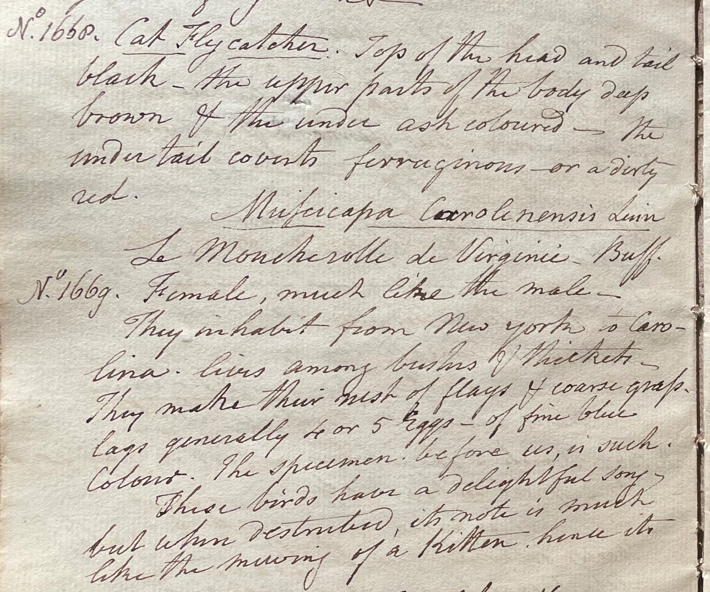
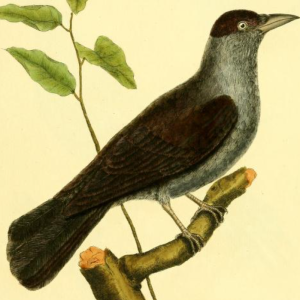
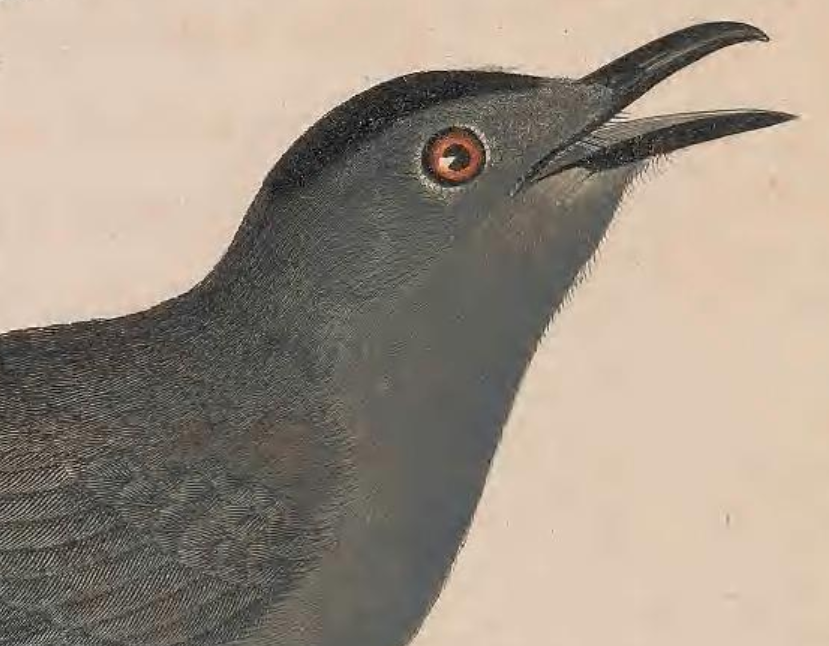
Charles Willson Peale (1741-1827) wrote, in his 35th Lecture (ca. 1799): "No. 1668. Cat Flycatcher. Top of the head and tail black, the upper parts of the body deep brown & the under ash-coloured. The undertail coverts ferruginous, or a dirty red. Muscicapa Carolinensis Linn. Le Moucherolle de Virginie. Buff. No. 1669. Female, much like the male. They inhabit from New York to Carolina—lives among bushes & thickets. They make their nest of flags & course grass. Lays generally 4 or 5 Eggs, of fine blue colour. The specimen [of a nest] before us, is such. These birds have a delightful song, but when disturbed its note is much like the mewing of a Kitten, hence its name." (Academy of Natural Sciences of Drexel University Archives, coll. 40)
Peale wrote, in "A Walk Through the Philad[elphi]a Museum" (1805–1806): "Cat bird (M. Carolinsis) The Classical Name ought to be Altered, since this bird is common throughout the United States – a name taken from its Colours or notes would be preferable. Their dress, except at the vent, is of a uniform led Colour. They have a delightful Song but when disturbed, its notes are much like the mewing of a Cat, whence its English name." (Historical Society of Pennsylvania, coll. 0481)
Alexander Wilson (1766-1813) described this species under the name "Cat-bird / Turdus lividus" in American Ornithology vol. 2 (Pl. 14), where "Peale's Museum No. 6770" was cited (Wilson 1810: 90).
Four mounted specimens, and one unmounted specimen, of "Turdus lividus (Cat Bird)" were listed in "A Catalogue of Duplicate Specimens...", May 1822. [unpublished] American Philosophical Society Library (Mss.B.P31).
Specimen Type:
Dead/preserved
Current Common Name:
Gray Catbird
Current Scientific Name
Mimidae | Dumetella carolinensis