Object Status:
Extant
Accession Date:
23 March 1821
Primary Source Reference:
Peale Museum Accessions Book, 23 March 1821. Historical Society of Pennsylvania, coll. 0481.
Additional Source Text:
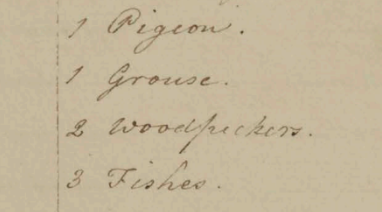
Titian Ramsay Peale (1799-1885) deposited "1 Grouse" on 23 March 1821, as recorded in the Peale Museum Accessions Book (Historical Society of Pennsylvania, coll. 0481), which may have been this species; although, another species was also collected by the expedition, now called Sharp-tailed Grouse (Tympanuchus phasianellus).
Thomas Say (1787-1834) wrote, in Edwin James, 1823, Account of an Expedition from Pittsburgh to the Rocky Mountains..., vol. 2, p. 15 (Philadelphia): "It appears by the observations of Lewis and Clark that several species of this genus inhabit the country which they traversed, particularly in this elevated range of mountains from whence, amongst other interesting animals, they brought to Philadelphia a specimen of the spotted grouse (T. canadensis.) which, together with the above described bird, are now preserved in the Philadelphia Museum, thus proving that the spotted grouse is an inhabitant of a portion of the territory of the United States." / https://www.biodiversitylibrary.org/item/124315#page/27/mode/1up
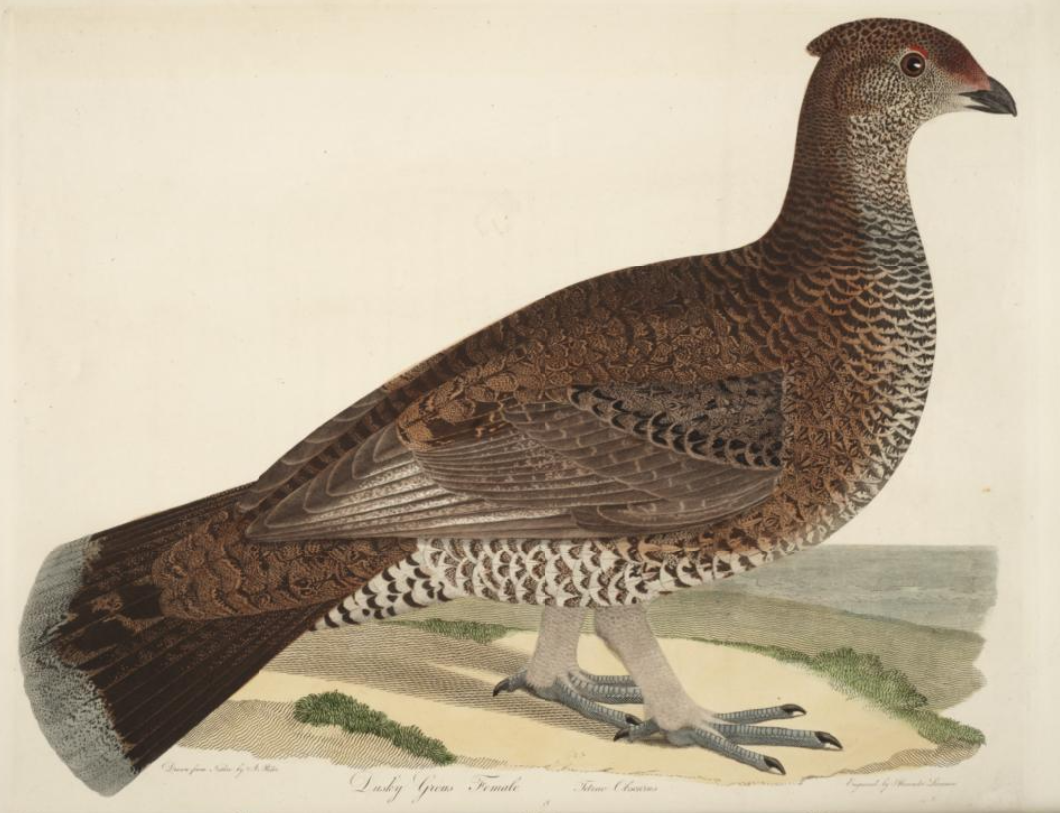
Charles Lucien Bonaparte (1803–1857) described this species under the name "Dusky Grous / Tetrao obscurus" in his continuation of American Ornithology vol. 3 (1828, Pl. 18, Philadelphia: Carey, Lea & Carey). Bonaparte (1828: 27) cited "Philadelphia Museum, Female" and wrote "the figure in our plate is taken from the specimen on which Say established the species: this was killed on a mountain in a great chain dividing the waters of the Mississippi from those which flow towards the Pacific; at a spot where, on the 10th of July 1820, the exploring party of Major Long were overlooking from an elevation of one or two thousands feet, a wide extent of country." Bonaparte's plate was based on a drawing by Alexander Rider, engraved by Alexander Lawson (ca.1772-1846) / https://search.library.wisc.edu/digital/AFKPEJIASN54OC8L/pages/ATZXRXFR…
An undated list of 21 bird specimens in Charles Willson Peale's (1741-1827) handwriting includes an unidentified "Grouse" (American Philosophical Society Library, Mss.B.P31).
Notes:
Here, for simplicity, we state that Titian R. Peale (1799-1885) deposited the Long Expedition specimens at Peale's Museum. However, it should be noted that the specimens did not belong to Titian, and were not his to give away. Officially, they were the property of the United States government, and as such were formally deposited by Major Stephen Harriman Long (1784-1864), who led the government-sponsored expedition. The Peale Museum Accessions Book, pp. 112-113 (Historical Society of Pennsylvania, coll. 0481) contains an "Invoice of Zoological Specimens and Drawings prepared by Titian Peale, Assistant Naturalist for the Exploring Expedition, and deposited in the Philadelphia Museum by Majr. S. H. Long, Maj. U.S. Engr. pursuant to instructions of the Secretary of War." At the conclusion of the invoice, "Rubens Peale [1784-1865], manager" signed the following statement: "Received, Philadelphia Museum, March 23d. 1821. of Majr. S. H. Long, the several articles, specified in the above Invoice, as a deposit for safe keeping, preservation and Exhibition; and I hereby promise, as agent for the Institution to hold the said articles subject to the orders of the War Department, thru the said Maj. Long." (HSP, coll. 0481)
Specimen Type:
Dead/preserved
Current Common Name:
Dusky Grouse
Current Scientific Name
Phasianidae | Dendragapus obscurus