Object Status:
Extant
Accession Date:
By 1799
Primary Source Reference:
Charles Willson Peale, Lecture on Natural History 27. (ca. 1799). Academy of Natural Sciences of Drexel University Archives, coll. 40. / https://ansp.org/research/library/archives/0000-0099/coll0040/
Additional Source Text:
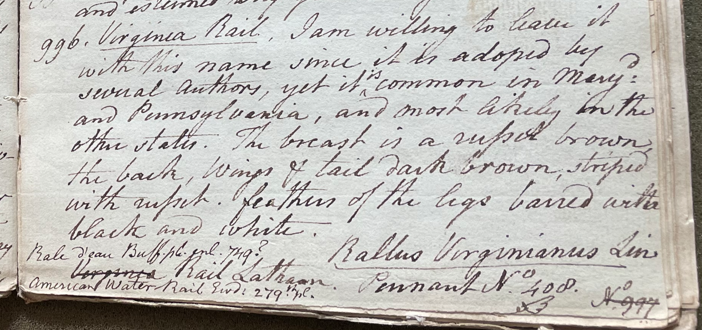
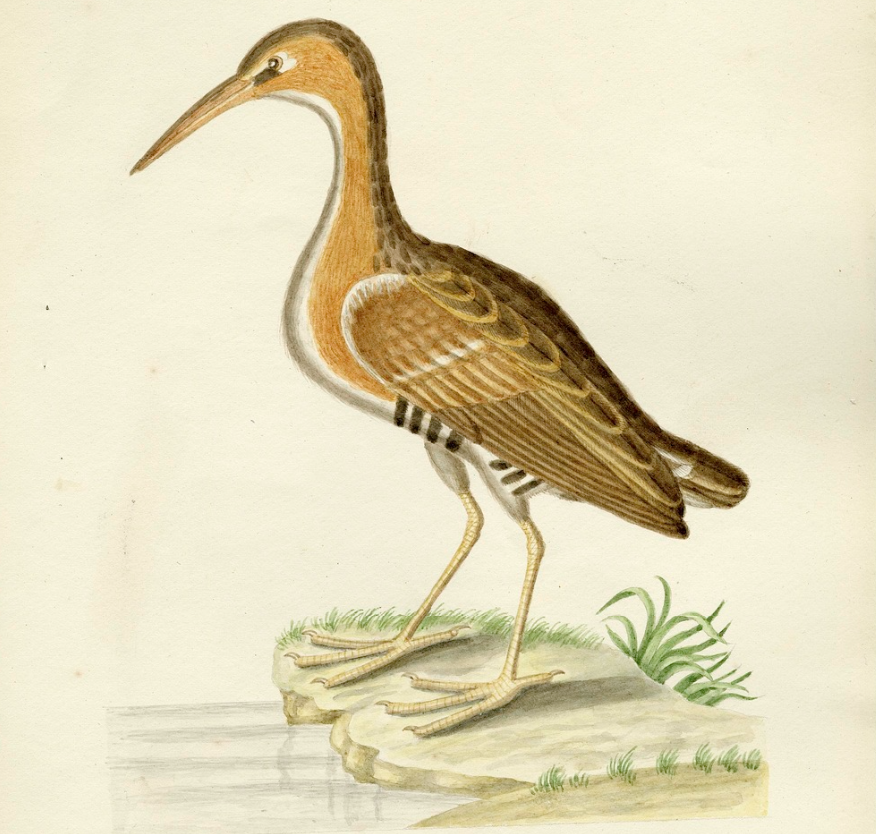
Charles Willson Peale (1741-1827) wrote, in his 27th Lecture (ca. 1799): "996. Virginia Rail. I am willing to leave it with this name since it is adopted by several authors, yet it is common in Maryd and Pennsylvania, and most likely in the other states. The breast is a russet brown; the back, wings & tail dark brown, striped with russet; feathers of the legs barred with black and white. Rallus virginianus Linn. Rale d'eau Buff. pl. enl. 749? Rail Latham. Pennant No. 408. American Water-Rail Edw. 279. 997. Female, not quite so distinct & bright colour of plumage. They are found in marshes." (Academy of Natural Sciences of Drexel University Archives, coll. 40)
In "A Walk Through the Philad[elphi]a Museum" (1805-1806), Peale distinguished three species of North American rails: "The Clapper Rail (R. crepitans) is the largest species — this and the land [rail] and water rail [R. limicola] are all we have belonging to N. America." (Historical Society of Pennsylvania, coll. 0481)
Alexander Wilson (1766-1813) described this species under the name "Virginian Rail / Rallus virginianus" in American Ornithology vol. 7 (Pl. 62), where "Peale's Museum, No. 4426" was cited (Wilson 1813: 109). "This species very much resembles the European Water Rail, (Rallus aquaticus) but is smaller," noted Wilson (1813: 109), "and has none of the slate or lead color on the breast which marks that of the old continent; its toes are also proportionately shorter, which, with a few other peculiarities, distinguish the species."
On 20 January 1814, Dr. James Mease (1771-1846) donated a "Virginia Rail, shot near Tuckertown New Jersey", as recorded in the Peale Museum Accessions Book, p. 71 (Historical Society of Pennsylvania, coll. 0481).
A mounted specimen of "Rallus virginianus (Va Rail)" was listed in "A Catalogue of Duplicate Specimens...", May 1822. [unpublished] American Philosophical Society Library (Mss.B.P31). This may have been this species or Sora (P. carolina).
Notes:
Dr. James Mease (1741-1846) was a physician and scientist, best known for publishing the first known tomato-based recipe for ketchup. / https://en.wikipedia.org/wiki/James_Mease Other "rail" specimens mentioned in the Peale Museum Accessions Book (Historical Society of Pennsylvania, coll. 0481) are unidentified, but may have been this species. For example, on October 1811, "Mr. Grubb, of the tower ferry" donated a "White Rail, shot down the Schuylkill" (p. 56); on 17 April 1815, the Museum received "A living Rail, having been kept by the [unnamed] donor since last fall in a cage, (since dead)" (p. 75); and J. S. Snowden donated a "White Rail, shot on League Island" on 14 October 1821 (p. 116).
Specimen Type:
Live (later taxidermied)
Current Common Name:
Virginia Rail
Current Scientific Name
Rallidae | Rallus limicola