Object Status:
Extant
Accession Date:
By 1799
Primary Source Reference:
Charles Willson Peale, Lecture on Natural History 33. (ca. 1799). Academy of Natural Sciences of Drexel University Archives, coll. 40. / https://ansp.org/research/library/archives/0000-0099/coll0040/
Additional Source Text:
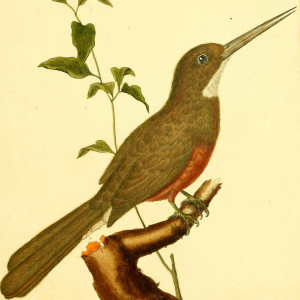
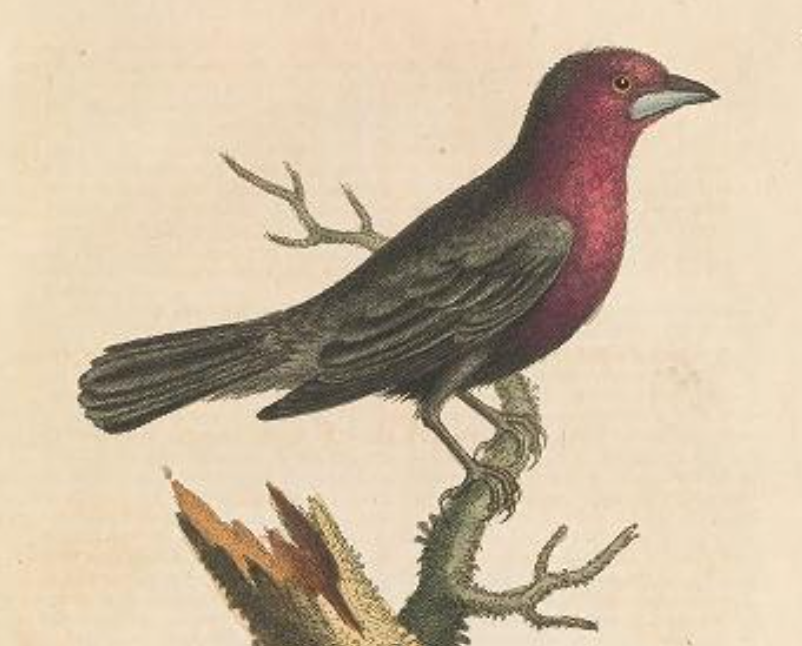
Charles Willson Peale (1741-1827) wrote, in his 33rd Lecture (ca. 1799): "No. 1521. Red-breasted Tanager. Buffon calls it Bec d'argent, Silver bill, which seems to be a pretty distinctive character for this species. The under mandible extends far back, is round at the end under the Eye, and of a silvery colour. The plumage in general black, with a purplish gloss, except the throat and breast which are deep crimson. Tanagra jacapa Linn. Tangara pourpré de Cayenne. Buff. pl. enl. 128. Red breasted Black bird Edwards No. 267, which [is] more like than the plate of Buffon." (Academy of Natural Sciences of Drexel University Archives, coll. 40)
Peale continued: "No. 1522. Female, the characters are the same as the male except less brilliant. This species is common in Cayenne, Guiana, Mexico, and other parts of South America, where it lives on various kinds of fruits only, and comes frequently near habitations, and into gardens, and in general seen in pairs. The female makes the nest of a cylindrical form, a trifle curved; 6 inches long, and 4 ¼ in diameter, composed of dried fibres & leaves, and lined with large pieces of the same leaves within. This is fastened to the horizontal branch of some low tree, the opening beneath." (Academy of Natural Sciences of Drexel University Archives, coll. 40)
Peale wrote, in "A Walk Through the Philad[elphi]a Museum" (1805–1806): "Red breasted Tanager (T. Jacapa) a better Name is given it by Buffon Bec d'argent Silver Bill – Perhaps they both may be females therefore not so bright a Colour on the breast as called for by the name." (Historical Society of Pennsylvania, coll. 0481)
Notes:
Unbeknown to Peale, males of this species do not have a particularly bright red on the breast, and his specimens were unlikely to be female because they had a pronounced "silver" color on the mandible. Peale did not specify the origin of the specimen described in his lecture, but it seems likely to be Cayenne, French Guiana, a major South American trade center in the 18th century. In 1793, Raphaelle Peale (1774-1825) travelled to Cayenne to collect specimens for Peale's Museum. However, to the editor's (MRH) knowledge, there is no detailed inventory of the specimens he brought back, and there are many examples of specimens from northern South America that were donated by other people. For more discussion about Raphaelle's travels, see Lillian B. Miller, 1993, "Father and Son: The Relationship of Charles Willson Peale and Raphaelle Peale", The American Art Journal 25: 4-161. / https://doi.org/10.2307/1594599
Specimen Type:
Dead/preserved
Current Common Name:
Silver-beaked Tanager
Current Scientific Name
Thraupidae | Ramphocelus carbo