Object Status:
Extant
Accession Date:
By 1799
Primary Source Reference:
Charles Willson Peale, Lecture on Natural History 36. (ca. 1799). Academy of Natural Sciences of Drexel University Archives, coll. 40. / https://ansp.org/research/library/archives/0000-0099/coll0040/
Additional Source Text:
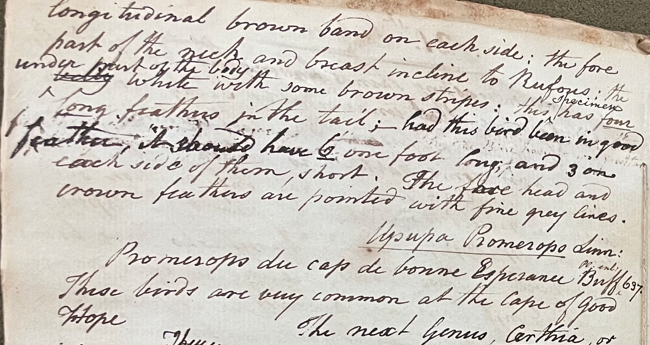
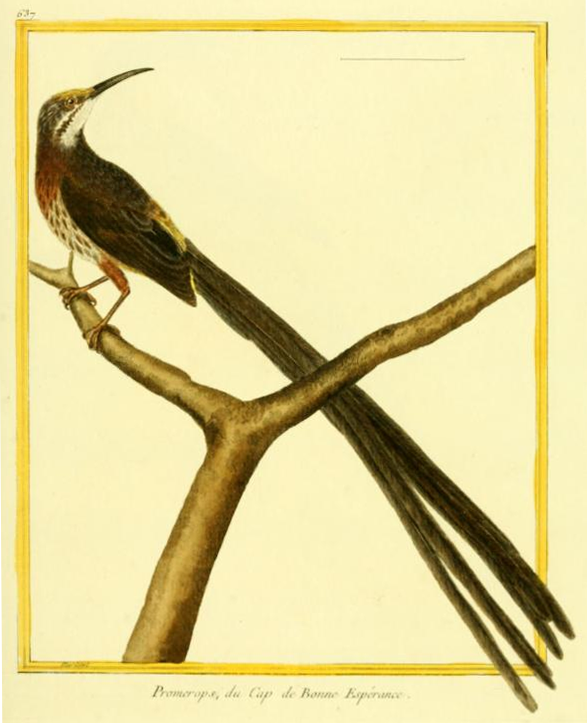
Charles Willson Peale (1741-1827) wrote, in his 36th Lecture (ca. 1799): "No. 1820. Cape Promerops. The Bill is 1 ½ Inch long, and black; the upper parts of the head, neck, back, wing coverts, and scapulars, are brown; upper tail coverts olive green; but under the tail of a fine yellow; the throat is white with a narrow longitudinal brown band on each side, the fore part of the neck and breast incline to Rufous; the under part of the body white with some brown stripes; this specimen has four long feathers in the tail; had this bird been in good feathers, it should have 6 one foot long, and 3 on each side of them, short. The fore head and crown feathers are pointed with fine gray lines. Upupa promerops Linn. Promerops du Cap de Bonne Esperance Buff. pl. enl. 637. These birds are very common at the Cape of Good Hope." (Academy of Natural Sciences of Drexel University Archives, coll. 40)
On 17 December 1804, a "Sugar Birds nest from the Cape of Good Hope" donated by Mrs. Sarah L. Shewell was entered in the Peale Museum Accessions Book (Historical Society of Pennsylvania, coll. 0481).
Peale wrote, in "A Walk Through the Philad[elphi]a Museum" (1805–1806): "The long tail of the Cape Hoopoe (U. promerops) is equally striking as the crest of the former. It inhabits the cape of good-hope." (HSP, coll. 0481)
Specimen Type:
Dead/preserved
Current Common Name:
Cape Sugarbird
Current Scientific Name
Promeropidae | Promerops cafer