Object Status:
Extant
Accession Date:
By 1799
Primary Source Reference:
Charles Willson Peale, Lecture on Natural History 31. (ca. 1799). Academy of Natural Sciences of Drexel University Archives, coll. 40. / https://ansp.org/research/library/archives/0000-0099/coll0040/
Additional Source Text:
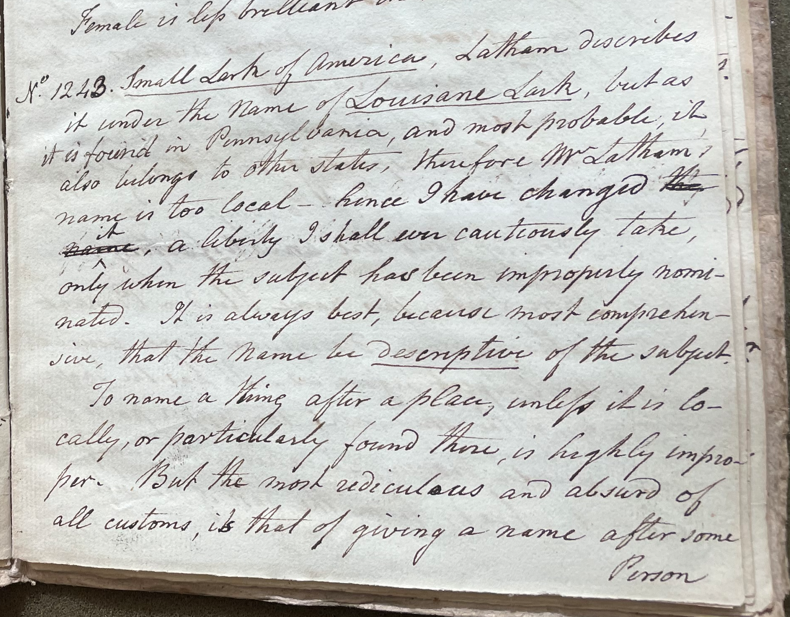
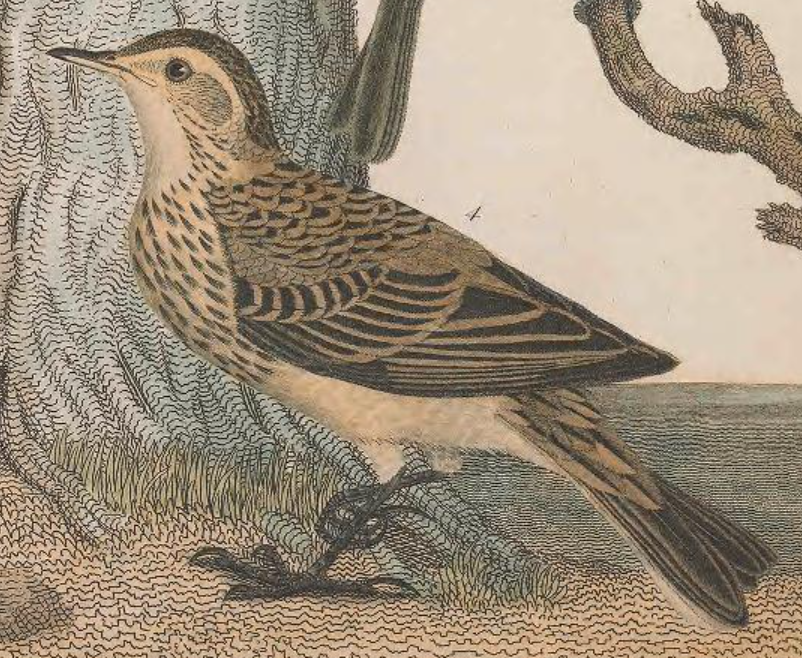
Charles Willson Peale (1741-1827) wrote, in his 31st Lecture (ca. 1799): "No. 1243. Small Lark of America. Latham [1783: 376] describes it under the name of Louisiane Lark, but as it is found in Pennsylvania, and most probable, it also belongs to other states, therefore Mr. Latham's name is too local—hence I have changed it, a liberty I shall ever cautiously take, only when the subject has been improperly nominated. It is always best, because most comprehensive, that the name be descriptive of the subject. To name a thing after a place, unless it is locally, or particularly found there, is highly improper. But the most rediculous and absurd of all customs, is that of giving a name after some person who is supposed to be the first that has taken notice of a natural production. It feeds the vanity of some Naturalists without enlightening the science. [In margin: Is this 297 Edw. Red Lark. Lenn. & Lath. Also found near London]." (Academy of Natural Sciences of Drexel University Archives, coll. 40)
Peale continued: "This is something like a Lark described in Edwards, who says it belongs to Pennsylvania, also found near London. This has nothing of a red appearance, yet some authors call for that colour and Mr. Edwards speaks of the red Lark. I must hold it doubtful, that we have [one] exactly corrisponding with those of Europe. untill we have them to compare together, mere descriptions are unsatisfactory." (ANSP Archives, coll. 40)
Peale wrote in his diary that, around 15 June 1801, he went to "Cony-Island [and] got some sand pipers, a few larks &c. and a good deal of fateague and well-blooded by the musketoes." (American Philosophical Society Library, Peale-Sellers Collection, Mss.B.P31)
Peale wrote, in "A Walk Through the Philad[elphi]a Museum" (1805–1806): "Small Lark of America (a. ludoviciana) described under the name of Louisane Lark, but as it is found in Pennsylvania, and probably in the other states — that name is too local, It would be preferable to give names descriptive of the subjects — But the most ridiculous and absurd, is that of giving a name after some person who is supposed to be the first that has taken notice of a natural production: It feeds the vanity of some Naturalists without enlightening the science." (Historical Society of Pennsylvania, coll. 0481)
Alexander Wilson (1766-1813) deposited a specimen of this species after returning from the southern United States in 1810. In a letter addressed to Rubens Peale (1784-1865), he wrote: "A. Wilson's Compts. To Mr. Peale with a specimen of … a New Lark?" (Hunter 1983: 376, Life and Letters of Alexander Wilson, Philadelphia: American Philosophical Society)
Wilson described this species under the name "Brown Lark / Alauda rufa" in American Ornithology vol. 5 (Pl. 42), where "Peale's Museum, No. 5138" was cited (Wilson 1812: 89). / https://www.biodiversitylibrary.org/item/175520#page/105/mode/1up (text) / https://www.biodiversitylibrary.org/item/175520#page/98/mode/1up (plate)
Notes:
Peale's commentary foreshadowed the "Bird Names for Birds" (#birdnamesforbirds) movement by two centuries. / https://en.wikipedia.org/wiki/Bird_Names_for_Birds Matthew R. Halley, 29 March 2022. "Eponymous bird names feed ornithologists’ vanity, without enlightening the science". / https://matthewhalley.wordpress.com/2022/03/29/eponymous-bird-names-fee… American Ornithological Society (AOS) Leadership. 1 November 2023. "American Ornithological Society Will Change the English Names of Bird Species Named After People". / https://americanornithology.org/american-ornithological-society-will-ch…
Specimen Type:
Dead/preserved
Current Common Name:
American Pipit
Current Scientific Name
Motacillidae | Anthus rubescens