Object Status:
Extant
Accession Date:
By 1799
Primary Source Reference:
Charles Willson Peale, Lecture on Natural History 36. (ca. 1799). Academy of Natural Sciences of Drexel University Archives, coll. 40. / https://ansp.org/research/library/archives/0000-0099/coll0040/
Additional Source Text:
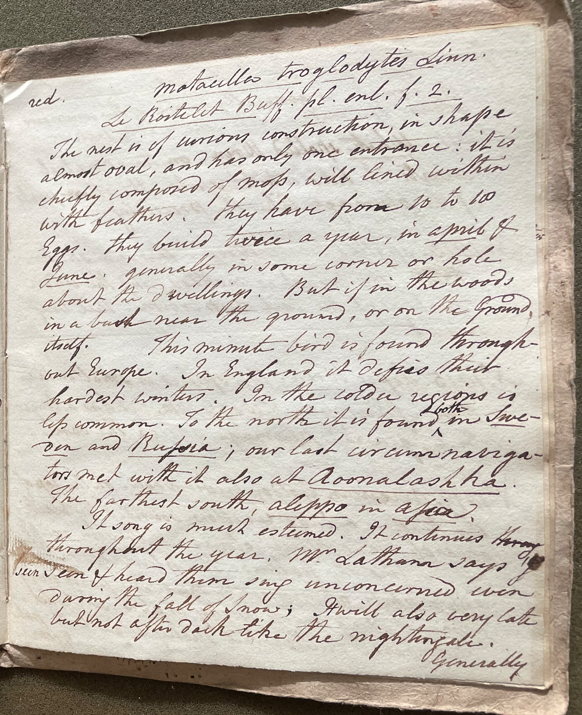
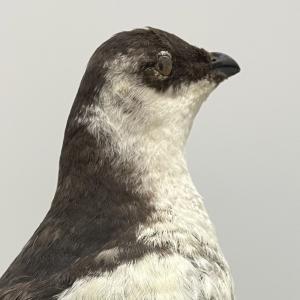
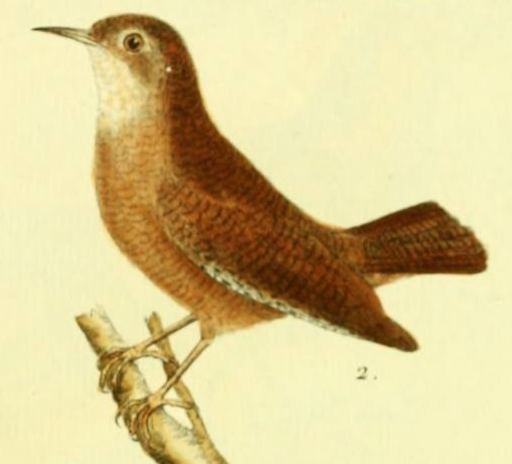
Charles Willson Peale (1741-1827) wrote, in his 36th Lecture (ca. 1799): "No. 1809. Wren of Europe. The general plumage is much like the American Wren but not so red. Motacilla troglodytes Linn. Le Roitelet Buff. pl. enl. f. 2. [Here, Peale evidently copied an error from the caption of Pl. Enl. 651, which misattributed the French name "Roitelet" (= Goldcrest, Regulus regulus) to this wren.] The nest is of curious construction, in shape almost oval, and has only one entrance; it is chiefly composed of moss, well lined within with feathers. they have from 10 to 18 Eggs. they build twice a year, in April & June, generally in some hole about the dwellings. But if in the woods in a bush near the ground, or on the ground itself." (Academy of Natural Sciences of Drexel University Archives, coll. 40)
Peale continued: "This minute bird is found throughout Europe. In England it defies their hardest winters. In the colder regions is less common. To the north it is found both in Sweden and Russia; our last circumnavigators met with it also at Aoonalashka. The furthest south, Aleppo in Assia. Its song is much esteemed. It continues throughout the year. Mr. Latham says he has seen & heard them sing unconcerned even during the fall of snow. It will also [sing] very late but not after dark like the nightingale. Generally carries its tail erect. No. 1810. Female, is generally more of the cenerious colour, the under parts considerably darker." (ANSP Archives, coll. 40)
In the same lecture, Peale described a specimen that was likely an aberrant individual of T. troglodytes ("No. 1811. White spotted Wren. on the upper tail coverts it has white spots. the other parts of the plumage like the preceeding."). Peale also listed "No. 1826. Wren from the Paris Museum. Troglodytes. Le troglodis Fr.", which likely referred to this species. (ANSP Archives, coll. 40)
Notes:
Palisot de Beauvois (1752-1820), the French naturalist, approached Peale about a specimen exchange in October 1794, to which Peale replied: “You desire to know if I would be willing to exchange Birds and other subjects of natural history to supply the public museum at Paris [i.e., Muséum national d'histoire naturelle, known to Peale as the "Paris Museum"]—My first Object is to furnish my [own] Museum with all the Various Animals in the several classes and other objects of Natural History belonging to America, and secondly, while I am engaged in this labour, to prepare duplicates with the view of exchanging them for the subjects of the other quarters of the Globe—by which means I hope to inrich my Museum in a mode which I conceive will be most agreable to the Amateurs of this delightful Science on the other side of the Water, who may be desirous of possessing those of America—I mean by a reciprocal exchange of Subject for subject.” (Miller 1988, Selected Papers, Vol. 2, part 1, Yale University Press) / https://en.wikipedia.org/wiki/National_Museum_of_Natural_History,_France For more discussion about Beauvois’s time in Philadelphia, and how he helped Peale catalogue the taxidermy collection, see Matthew R. Halley, 2022, “Rediscovery of the holotype of the American Goshawk, Accipiter gentilis atricapillus (Wilson, 1812), and a commentary about Alexander Wilson’s contributions to the Peale Museum. Proceedings of the Academy of Natural Sciences of Philadelphia 167: 233–240. / https://doi.org/10.1635/053.167.0114 The specimen exchange with the Paris Museum eventually came to pass in the late 1790s, as Peale corresponded with Étienne Geoffroy Saint-Hilaire (1772-1844). On April 30, 1797, in a letter accompanying two cases of specimens, Peale wrote: “I have many Birds which is not described in Catesby, and several, which are not to be found in any of the authors on Natural History duplicates of which I will send you, with all such articles as you may want, and in my power to procure ... I have imbraced [sic] the first coming of the birds this season, and daily with one of my Sons hunt & preserve all we can. We have already mounted a tolerable number of the small birds in a handsome condition—and by constantly shooting ourselves, we are able to gain a knowledge of their manners.” (Miller 1988: 198–199) Peale wrote to Pierre-Auguste Adet (1763-1834) on 31 May 1798: “with my Son Titian I continue my hunting excursions to collect & preserve Subjects with equal diligence … this year add so many new subjects yet we have got some that are nondescripts—and that while I am increasing my store we find by practice proved—I am anxious to hear from Mr. Geoffroy whether he wishes Birds mounted in the manner of those I have sent or whether he would prefer them without being fixed with wires and mounted on Sticks.” (Miller 1988: 215). Peale wrote to Geoffrey on 13 July 1802: “Sir, Your favor of the 26 Feby and the Package of Birds I have received—they were in very good condition one or two only excepted.” (Miller 1988: 440)
Specimen Type:
Dead/preserved
Current Common Name:
Eurasian Wren
Current Scientific Name
Troglodytidae | Troglodytes troglodytes